Micron Got Obliterated Over The Last Month: This Wall Street Pro Sees 170% Gains Ahead
Micron just delivered record-breaking earnings, locked in multi-billion-dollar AI contracts, and posted monster year-over-year growth, yet the stock cratered nearly 28% in a month. Wall Street's top analysts say the selloff created an opportunity that rarely shows up in semiconductor…

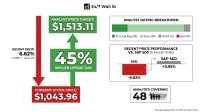
Micron Technology (NASDAQ:MU | MU Price Prediction) currently trades at $820.53, while Wall Street’s average price target sits at $1,507.38, implying meaningful upside from here.
Micron is the only U.S.-based advanced memory manufacturer. It delivered $41.46 billion in fiscal Q3 revenue, growth of 345.72% year over year, driven by high-bandwidth memory ramp for NVIDIA’s Vera Rubin platform. This fundamental strength coexists with a four-week drawdown, creating a notable gap between price and target in semiconductors.
A Bear Market Punch In A Bull Market Stock
Micron has fallen 27.53% over the last month. The trigger was China’s ChangXin Memory Technologies (CXMT) surging 466% on its Shanghai debut to a $487 billion valuation, injecting a credible commodity DRAM competitor into a sector priced for supply scarcity.
The pain was sector-wide. Morgan Stanley strategist Mike Wilson noted investors are punishing memory names after targeting hyperscalers, with the Roundhill Memory ETF down almost 12% and the iShares Semiconductor ETF down about 7%. On the most recent trading day, Micron slid 8.85%.
The company itself did not disappoint. Q3 EPS of $25.11 beat consensus by 23.79%, GAAP gross margin hit 84.6% versus 37.7% a year ago, and management guided Q4 revenue to $50.0 billion. The market is pricing in risks the income statement has yet to reflect.
Why The Bull Case Still Points Higher
Melius Research’s Ben Reitzes carries the most aggressive bull call with a $2,200 price target. That implies substantial upside from current levels, anchored in the argument that HBM has structurally decoupled Micron from traditional DRAM commodity cycles. Reitzes models tight HBM3E and HBM4 capacity across every major supplier, with Micron locking in multi-billion-dollar non-cancelable contracts to feed accelerator roadmaps at NVIDIA and AMD.
Consensus is less extreme but firmly bullish. Of the analysts tracked, 9 rate the stock Strong Buy, 31 Buy, 4 Hold, and 1 Strong Sell, with recent moves skewing toward reiterations rather than downgrades. The core thesis: “AI demand is driving DRAM and NAND data center bits TAM to exceed 50% of the industry TAM for the first time in calendar 2026”, as CEO Sanjay Mehrotra told analysts on the last call.
Catalysts are specific. HBM4 is already in volume shipment for NVIDIA’s Vera Rubin platform, HBM4E targets calendar 2027 ramp, and Micron’s new multi-year Strategic Customer Agreements are designed to “significantly enhance the durability and predictability” of revenue. If Q4 hits guidance, EPS of roughly $31.00 would make the current forward multiple look punishingly cheap.
Where Micron’s Selloff Fits In The Memory Wreckage
The entire memory complex sold off together, but not equally. Micron’s drawdown is actually the mildest of the group.
SanDisk (NASDAQ:SNDK) has been hit hardest, plunging 47.57% in a month to $1,096.10. The NAND pure-play carries an average analyst target of $2,217.77, implying sizable upside, with 3 Strong Buy, 15 Buy, 3 Hold, and 1 Sell ratings.
Western Digital (NASDAQ:WDC), the HDD pure-play spun off from SanDisk, has fallen 20.96% in the last month to $463.51. Its average price target is $633.83, meaningful upside, backed by 4 Strong Buy, 18 Buy, 3 Hold, and 1 Strong Sell ratings.
Consensus upside is largest at SanDisk, but on a risk-adjusted basis, Micron’s HBM franchise is the highest-quality asset in this cohort.
What The Numbers Are Actually Telling You
Micron sits at $820.53 against a consensus target of $1,507.38, with the Reitzes bull case at $2,200. Coverage is deep, with 45 analysts tracked between Strong Buy and Strong Sell, tilted heavily bullish.
Year to date, Micron is up 187.67% against the S&P 500’s 8.64% gain, and the one-year return sits at 638.75%. Over the past month, that leadership reversed, with MU down 27.53% while the S&P edged up 1.63%.
The forward P/E of roughly 6 assumes analysts’ calendar 2027 numbers hold.
The Bull And Bear Cases
The bull thesis holds if HBM supply stays tight through 2027 and CXMT’s DDR5-focused capacity does not bleed into hyperscaler HBM procurement. The bull case runs through Q4 delivery at or above $50 billion revenue, continued HBM4 volume ramp for NVIDIA, and gross margins holding near 86%. If those boxes get checked, even the consensus $1,507 target is conservative.
The bear thesis argues the memory cycle is being called too early. The bear case: Chinese commodity DRAM eventually pressures pricing, hyperscaler AI capex plateaus, and Micron’s $7.8 billion quarterly capex bill becomes a liability. A CVP just sold $879,000 in stock, worth noting.
On balance, the selloff looks sentiment-driven rather than fundamental. Reitzes’ aggressive call requires a lot to go right, but the consensus target does not, and both point in the same direction.
Contact [email protected] for any questions or corrections.
Alex Sirois is a financial writer with experience spanning both retail and institutional investing. He has written for InvestorPlace and held roles at BNY Mellon and Bernstein, giving him a perspective that bridges Main Street portfolios and Wall Street analysis.
Alex holds an MBA from George Washington University and has built his career across multiple industries, including e-commerce, education, and translation — a breadth of experience that informs how he breaks down complex financial topics for everyday investors. His writing is conversational, actionable, and grounded in long-term, buy-and-hold investing principles.
At 247 Wall St., Alex focuses on delivering analysis that is both accessible and useful, with a clear emphasis on helping readers make more informed decisions with their money.