Nvidia Notches Longest Losing Streak Since 2022. Tomorrow’s Earnings Could Make It Worse
Nvidia enters its most anticipated earnings report in years on the back of a seven-session losing streak, and Wall Street has moved the goalposts so far that even a record-breaking quarter might not be enough to stop the bleeding.


The stock market has entered a stretch where merely delivering strong earnings is no longer enough for many of its biggest winners. Investors have grown accustomed to companies beating expectations, raising guidance, and then watching their shares struggle anyway as the bar keeps moving higher.
That makes Nvidia‘s (NASDAQ:NVDA | NVDA Price Prediction) upcoming report particularly important. The company isn’t simply reporting another quarter of explosive growth. It is trying to convince a market increasingly focused on the cost, financing, and eventual return on the hundreds of billions being committed to artificial intelligence infrastructure.
Nvidia’s Losing Streak Meets Earnings Day
Nvidia closed yesterday at $208.48, down 2.91%, for its seventh consecutive daily decline — its longest losing streak since September 2022. The S&P 500 fell just 0.28%, underscoring how much pressure has concentrated in semiconductor stocks.
There is a chance the streak ends today. Nvidia was trading about 1% higher in premarket activity this morning, but with fiscal second-quarter earnings scheduled after Wednesday’s close, shareholders have little time to celebrate a technical rebound.
The bigger problem is precedent. Nvidia’s stock has fallen following earnings in six of the past eight quarters, including each of the last four.
To put that in perspective, Wall Street expects roughly $92 billion of revenue, up 95% year-over-year, and adjusted earnings of about $2.09 per share. A beat alone may not move the needle.
The Bar Keeps Getting Higher
That is because investors increasingly want Nvidia to beat the consensus estimates and the unofficial “whisper” numbers — then provide guidance that leaves those estimates looking conservative.
CEO Jensen Huang has rarely struggled to sound bullish. His long-term outlook for AI remains one of the most optimistic in corporate America. But investors now want the numbers to validate that optimism.
Concerns about AI spending sustainability, debt, returns on investment, and increasingly circular financing arrangements have grown since Nvidia’s previous report. Its August announcement of financing partnerships designed to mobilize more than $500 billion of third-party capital for AI infrastructure has added another layer to that debate.
Then there is pricing. Reports indicate Nvidia’s AI server systems could become more than 15% more expensive beginning in early 2027, partly because of soaring memory costs. That could pressure customers to rethink purchases or accelerate development of custom silicon.
Wall Street Is Raising the Stakes, Too
The irony is that Nvidia doesn’t need to convince Wall Street that it will grow. Analysts already expect extraordinary growth. The challenge is convincing them that the growth can remain extraordinary.
Some bullish forecasts put fiscal 2028 EPS around $17 and fiscal 2029 near $25. Those are demanding numbers even for a company whose earnings have exploded over the past several years.
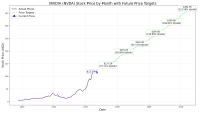
Wall Street remains bullish, with a consensus Buy rating and an average target near $308 — roughly 48% above Monday’s close.
But expectations are doing Nvidia no favors. Its stock is now modestly 7% higher over the past month, but both Nvidia and the S&P 500 are up about 11.8% in 2026. Meanwhile, the PHLX Semiconductor Index has gained roughly 61%, leaving Nvidia well behind its own industry benchmark.
Key Takeaway
In short, Nvidia’s business remains exceptional, but the stock faces an unusually high hurdle tomorrow. A $92 billion quarter may be spectacular by almost any normal standard. For Nvidia, it may simply be the starting point.
Investors should watch guidance, margins, future demand, and Huang’s explanation of AI returns more closely than the headline earnings beat. If Nvidia delivers another small beat-and-raise, the recent selling could continue. But if management produces numbers and guidance that materially exceed an already elevated bar, the seven-day losing streak could quickly become yesterday’s problem.
Contact [email protected] for any questions or corrections.
After two decades of patrolling the dark corners of suburbia as a police officer, Rich Duprey hung up his badge and gun to begin writing full time about stocks and investing. For the past 20 years, he’s been cruising the markets looking for companies to lock up as long-term holdings in a portfolio while writing extensively on the broad sectors of consumer goods, technology, and industrials. Because his experience isn’t from the typical financial analyst track, Rich is able to break down complex topics into understandable and useful action points for the average investor. His writings have appeared on The Motley Fool, InvestorPlace, Yahoo! Finance, Money Morning, and, of course, 24/7 Wall St. He has been featured in both U.S. and international publications, including MarketWatch, Financial Times, Forbes, Fast Company, and USA Today.