Nvidia Vs. AMD: The New Narrative Upending The Challenger-Champion Dynamic
Nvidia just posted numbers that suggest an unbreakable grip on AI infrastructure, yet AMD's biggest customers are quietly placing gigawatt-scale bets on a rival platform. What that split reveals about who actually controls the next buildout cycle matters far more…

NVIDIA (NASDAQ:NVDA | NVDA Price Prediction) and AMD (NASDAQ:AMD) closed AI-heavy quarters that reset the champion-challenger story. Nvidia’s Q1 FY2027 landed at $81.61 billion in revenue. AMD’s Q2 2026 hit $11.54 billion. The debate: is Nvidia running an infrastructural monopoly, or is AMD forcing hyperscalers into value-driven dual sourcing?
Data Center Carries Both, But for Different Reasons
Nvidia’s data center segment reached $75.25 billion, up 92% year-over-year, with networking alone up 199% as InfiniBand and Spectrum-X pulled NVLink rack-scale deployments through. Jensen Huang called this buildout “the largest infrastructure expansion in human history”. AWS plans to add more than 1 million Blackwell and Rubin GPUs beginning this year. All of that hardware still has to be powered, cooled, and networked by somebody, which is why we pulled together seven non-chipmaker suppliers riding the same buildout in a free report.
AMD’s data center story differs. Revenue hit $6.72 billion, up 107%, now representing 58% of total revenue. Instinct sales more than doubled on the MI350 ramp, and EPYC posted its fifth consecutive quarter of record server CPU revenue. Gaming fell 31% on soft semi-custom demand, a reminder that AMD still carries meaningful non-AI exposure.
Infrastructural Monopoly Meets Value-Driven Dual Sourcing
Nvidia’s pitch is vertical integration you cannot easily unbundle. Huang put it plainly: “Customers do not buy GPUs. They build AI factories.” The GB300 delivered a 2.7x increase in throughput and a 60% reduction in cost per token versus six months earlier. Management flagged visibility to $1 trillion in Blackwell and Rubin revenue through calendar 2027.
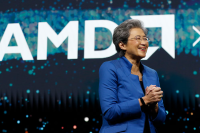
AMD sells the opposite thesis: open ecosystem, comparable performance, better unit economics. Lisa Su said Helios delivers “up to 15% more throughput at the same rack power, and up to 30% more tokens per dollar than the competition.” Anthropic committed to up to two gigawatts of MI450 series GPUs in Helios, and Microsoft plans to run Helios at scale on Azure.
| Lens | Nvidia | AMD |
| Core Bet | Full-stack CUDA platform | Open Helios rackscale |
| Non-GAAP Gross Margin | 75.0% | 56% |
| Anchor AI Customers | Every hyperscaler, OpenAI | Anthropic, OpenAI, Meta |
Rubin Ramp Meets Helios Ramp in the Same Quarter
Both companies push new platforms into the same window. Nvidia begins production shipments of Vera Rubin in the second half of this year, starting in Q3, with claims of up to 35x higher inference throughput versus Blackwell. AMD’s Helios begins initial shipments this quarter and ramps through Q4 2026 and into 2027. The key question: do hyperscalers genuinely split orders or trial AMD at the margins?
Nvidia guided Q2 to $91.0 billion. AMD guided Q3 to approximately $13 billion, up roughly 41% year-over-year.
Why Nvidia Leads for Scale, AMD for Optionality
This quarter validates both theses. Nvidia at a 33x trailing P/E against a 63% profit margin looks reasonable if the Rubin roadmap holds. For investors wanting the compounding infrastructure story with dividends and an $80 billion buyback behind it, Nvidia is the cleaner expression. AMD at a 120x trailing P/E only works if Helios converts pilot deployments into gigawatt orders on schedule. That is a turnaround-style setup for investors comfortable with variance. AMD’s setup weakens if Gaming stays soft and HBM allocation slips. Neither looks compelling if hyperscaler capex growth cools before Rubin ships in volume.
Contact [email protected] for any questions or corrections.
Alex Sirois is a financial writer with experience spanning both retail and institutional investing. He has written for InvestorPlace and held roles at BNY Mellon and Bernstein, giving him a perspective that bridges Main Street portfolios and Wall Street analysis.
Alex holds an MBA from George Washington University and has built his career across multiple industries, including e-commerce, education, and translation — a breadth of experience that informs how he breaks down complex financial topics for everyday investors. His writing is conversational, actionable, and grounded in long-term, buy-and-hold investing principles.
At 247 Wall St., Alex focuses on delivering analysis that is both accessible and useful, with a clear emphasis on helping readers make more informed decisions with their money.