How AMD Captures Significant Market Share From Nvidia
AMD is chasing a slice of a $200 billion AI accelerator market that NVIDIA currently dominates with 75% margins and an 85% revenue surge. Whether Lisa Su's second-source strategy can actually force a wedge into that grip depends on a…

AMD (NASDAQ: AMD | AMD Price Prediction) and NVIDIA (NASDAQ: NVDA) both closed spring reporting periods with blockbuster AI numbers, but the businesses are pulling in different directions. AMD is trying to become the credible second source for every hyperscaler. NVIDIA is running what Jensen Huang called “the largest infrastructure expansion in human history.” That gap is where the market share fight lives.
Instinct Finally Shows Up. Blackwell Keeps Compounding.
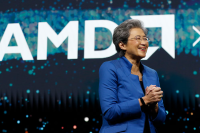
AMD’s Q1 FY2026 delivered revenue of $10.25 billion, up 37.9% year over year, with Data Center hitting $5.78 billion, a 57% jump on EPYC CPUs and Instinct GPUs. Non-GAAP EPS came in at $1.37. Lisa Su pointed to the pipeline: “Customer engagement around MI450 Series and Helios is strengthening, with leading customer forecasts exceeding our initial expectations.” The Meta 6 GW commitment and OpenAI 6 GW deal back that claim.
NVIDIA’s Q1 FY2027 is on a different scale. Revenue landed at $81.6 billion, up 85.2%, Data Center alone was $75.25 billion, and Networking exploded 199% to $14.8 billion. Non-GAAP gross margin held at 75%. Roughly half of Data Center revenue comes from hyperscalers, and Huang added a $80 billion buyback on top.
Second Source vs. Full Stack
| Lens | AMD | NVIDIA |
| Data Center revenue | $5.78B | $75.25B |
| Gross margin | 55% | 75% |
| Core bet | MI450, Helios rack, EPYC pairing | Blackwell 300, Vera Rubin, CUDA |
| Marquee wins | Meta 6 GW, OpenAI 6 GW | OpenAI 10 GW, Anthropic, CoreWeave |
The 20 point margin gap tells you who owns pricing power. NVIDIA sells a platform. AMD sells excellent merchant silicon, which is exactly why hyperscalers want it as leverage. That is the wedge.
Inference Is the Door AMD Walks Through
The bull case is a structural rotation from AI model training to AI model inference, combined with hyperscaler enterprise demands for supply chain diversification and cost optimization. The target is aggressive: a 15% to 20% share of the $200B+ AI accelerator market by 2027/2028. Watch MI450 shipment cadence, ROCm 7 adoption, and whether AMD’s Q2 guide of roughly $11.2 billion (+46% YoY) proves conservative once Helios racks ship.
NVIDIA’s tell is different. Guidance of $91 billion excludes China Data Center compute, and Polymarket traders are pricing NVDA in a tight $200 to $216 range against an analyst target of $302.31. Near-term skepticism is real.
Where the Asymmetric Setup Sits for the Next 18 Months
If you want the safer AI compounder, NVIDIA owns the software moat and 75% margins. But AMD is where the asymmetric setup sits. Shares are up 154.22% year to date against NVDA’s 11.28%, and a forward P/E near 69 reflects expectations that leave little room for execution slips. My view flips if MI450 slips or ROCm adoption stalls. Until then, the second-source thesis is doing exactly what Lisa Su said it would.
Contact [email protected] for any questions or corrections.
Alex Sirois is a financial writer with experience spanning both retail and institutional investing. He has written for InvestorPlace and held roles at BNY Mellon and Bernstein, giving him a perspective that bridges Main Street portfolios and Wall Street analysis.
Alex holds an MBA from George Washington University and has built his career across multiple industries, including e-commerce, education, and translation — a breadth of experience that informs how he breaks down complex financial topics for everyday investors. His writing is conversational, actionable, and grounded in long-term, buy-and-hold investing principles.
At 247 Wall St., Alex focuses on delivering analysis that is both accessible and useful, with a clear emphasis on helping readers make more informed decisions with their money.