Prediction: Nvidia Stock Is Entering Its Most Important Quarter Yet

This post may contain links from our sponsors and affiliates, and Flywheel Publishing may receive compensation for actions taken through them.

NVIDIA (NASDAQ:NVDA | NVDA Price Prediction) reports Q2 FY27 earnings after the close on August 26, and Jensen Huang has effectively told the market what to expect: $91 billion in revenue, plus or minus 2%, on top of a Q1 earnings report where Data Center revenue hit $75.246 billion, up 92% year over year.
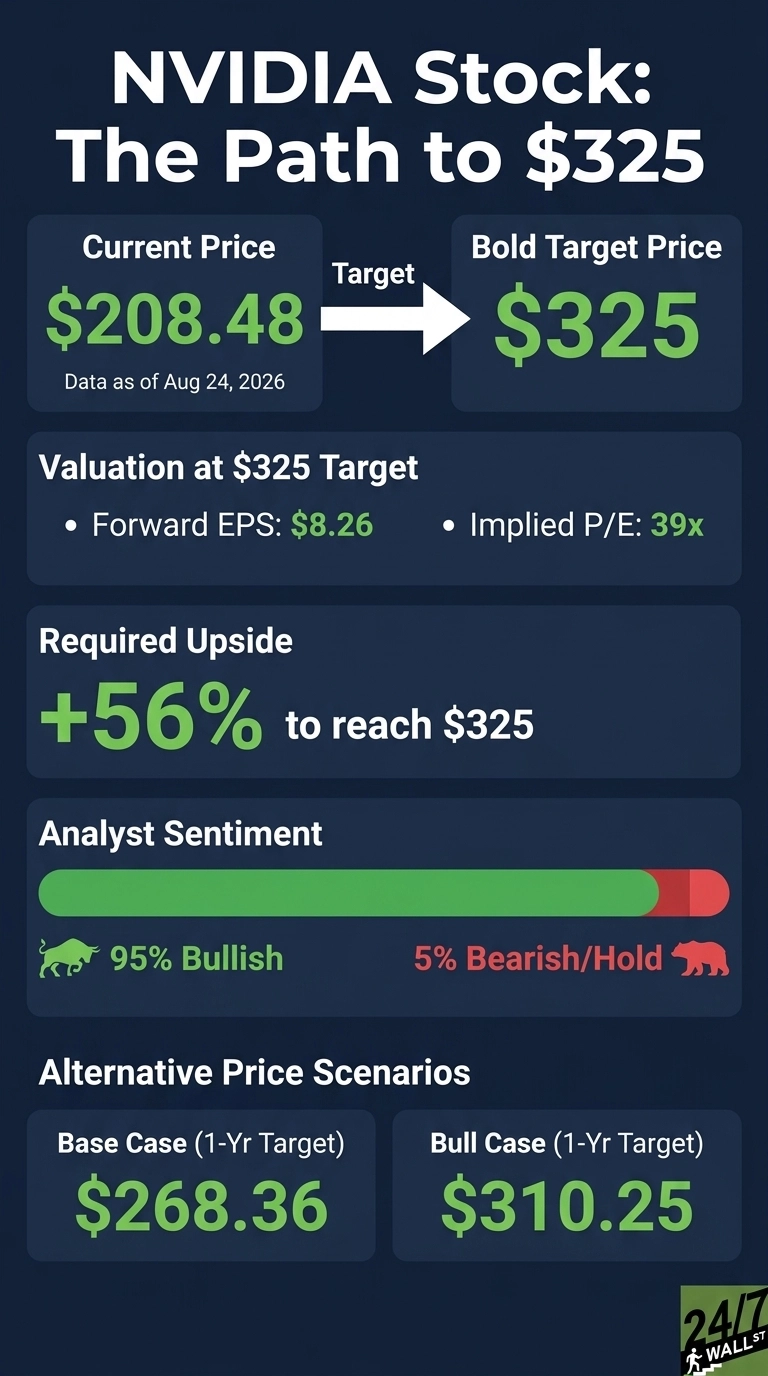
Shares sit at $208.48. Demand has, in Huang’s own words, “gone parabolic”, yet the stock keeps stalling. The question is whether NVIDIA can push through to $325 within a year.

What’s Holding NVIDIA Back Right Now
NVIDIA is up 11.92% year to date, but the last week tells the real story. Shares fell 7.35% over the past week and are essentially flat over the last month at +0.79%. A beta of 2.215 means NVIDIA moves twice as hard as the market, and the stock has been jittery into the earnings report. Two pressures are visible:
- the Q2 outlook explicitly excludes any Data Center compute revenue from China, which caps upside surprise
- Insider activity has turned net selling across 28 recent transactions
Fresh coverage this week from a top strategist warning NVIDIA’s earnings could hit the entire market hasn’t helped sentiment either.
Wall Street Sees 46% Upside. Our Model Says 29%
Consensus is genuinely aggressive. The analyst target price is $304.73, backed by 10 Strong Buys, 48 Buys, 2 Holds, and just 1 Sell. That works out to 95% bullish sentiment among covering analysts. Our model is more conservative. The base case one-year target is $268.36 with high confidence at 0.9, framing a range from bear case of $232.09 to a bull case of $310.25.
Both are too conservative if Q2 lands cleanly. The 247Factor already flags a 1.15x sector momentum boost and strong earnings acceleration contribution of 0.03, but the mega-cap dampener cuts the entire adjustment in half. Strip that dampener out and the picture reprices materially higher.

Path to $325 Per Share
Reaching $325 from $208.48 would require a gain of roughly 56%. With forward EPS of $8.26, a price of $325 implies a forward P/E near 39x. Our base case of $268.36 already implies roughly 32x, meaning the bold target requires about 7x additional multiple expansion. The earnings trajectory does the heavy lifting.
EPS beats have run 3.96%, 4.84%, 6.58%, and 5.42% over the last four quarters, and quarterly earnings grew 214.5% year over year. If Q2 delivers $91 billion and Vera Rubin ramps on schedule, forward EPS re-rates and the multiple compresses.
Huang said “Vera Rubin is going to be even more successful than Grace Blackwell”, backed by $1 trillion in Blackwell and Rubin revenue visibility through calendar 2027. Polymarket traders currently assign a 95.6% probability to an earnings beat tomorrow. Main risks: China restrictions widen or Rubin slips.
Where NVIDIA Trades Today vs Its Earnings Power
At $208.48 against forward EPS of $8.26, NVIDIA trades at roughly 25x forward earnings. For a business posting 85.23% revenue growth and a non-GAAP gross margin of 75%, that is not expensive.
Shares sit inside a 52-week range of $163.85 to $236.26, closer to the middle than the top. The long-term compounding is striking: NVDA is up 13,583.43% over the past ten years. Even modest multiple re-rating on rising EPS gets you toward $325.

Is $325 Realistic? Here’s My Take
Reaching $325 requires a gain of roughly 56% and a forward multiple around 39x. It is a stretch. Three things need to go right:
- Q2 beats and guides Q3 above $91 billion
- Vera Rubin production shipments commence in the second half starting in Q3 without slippage
- China overhang stops widening
What derails it is a supply constraint or policy shock that pushes revenue recognition into FY28. We’ve outlined the blueprint for how NVIDIA could reach $325 in 2027, and if the AI thesis holds, the power, cooling, and networking suppliers behind the data centers deserve their own look (we broke down seven of them in a free report on the AI buildout beyond the chipmakers).

Contact [email protected] for any questions or corrections.
Vandita Jadeja is a financial publisher with over a decade of experience writing about financial topics, including investment, savings, retirement, insurance and banking. Vandita is a Chartered Accountant who loves to debunk financial concepts for readers.
Her work has appeared on sites that include The Motley Fool, InvestorPlace, and Benzinga. She covers investing and focuses on stock picks and price prediction for 24/7 Wall St.
When not looking for the next stock investment opportunity, she can be found traveling, reading, chasing sunsets and enjoying her iced latte.