How High Can Nvidia Stock Go? Wall Street’s Next Target May Surprise You
Nvidia just posted 105% revenue growth yet its stock is barely moving, and Wall Street's price targets tell a story that gets more surprising the further out you look.

This post may contain links from our sponsors and affiliates, and Flywheel Publishing may receive compensation for actions taken through them.

NVIDIA (NASDAQ:NVDA | NVDA Price Prediction) sits at the center of the largest infrastructure buildout in modern history, yet shares are up just 12.55% year to date to $209.66, even after Q2 FY2027 revenue of $96.221 billion grew 105.85% year over year and Data Center revenue hit $89.023 billion.
CEO Jensen Huang framed it bluntly: “AI has reached its inflection point. It’s doing useful work. Its tokens are productive and profitable. Now, compute is revenue.” Can NVDA push to $350 per share by the end of 2027?

Why NVDA Shares Are Stuck Despite a Blowout Quarter
NVIDIA fell 3.63% in the past week and gained 6.69% over the past month, well below what a 105% revenue beat would normally trigger. Historical earnings reactions explain part of it: NVDA has logged six earnings beats and zero misses with an average one-week change of -2.68%.
Investors are also grinding on three overhangs. Gross margin is guided down to 74% in Q3 with a Q4 trough of 71% to 72% on memory pricing. Supply commitments jumped to $279 billion. With a beta of 2.215, every macro wobble hits harder here than elsewhere.
Wall Street Sees 45% Upside. My Model Sees More
Consensus is bullish. The average analyst price target sits at $304.73, with 10 Strong Buy, 48 Buy, 2 Hold, and 1 Sell ratings. Our internal base case lands at $285.68, or 36.26% upside, with a bull scenario of $326.58 and a bear of $244.22. Confidence is high (0.9).
Bernstein raised the firm’s price target on Nvidia to $400 from $315 and keeps an Outperform rating while Morgan Stanley raised the firm’s price target to $300 from $288 and keeps an Overweight rating on the shares. Raymond James raised the firm’s price target to $515 from $352 and keeps a Strong Buy rating on the shares

Analysts are modeling for a normal semiconductor cycle. With 95% bullish analyst sentiment and YoY earnings growth contribution of 2.145, the setup is closer to a platform inflection than a cyclical peak. Consensus may be too conservative.
Path to $350 Per Share
Reaching $350 from today’s price of $209.66 would require a gain of 66.9%. With forward EPS of $9.91, a price of $350 implies a forward P/E of 35x. Our base case of $285.68 already implies 30x, meaning the bold target needs roughly 5x of additional multiple expansion.
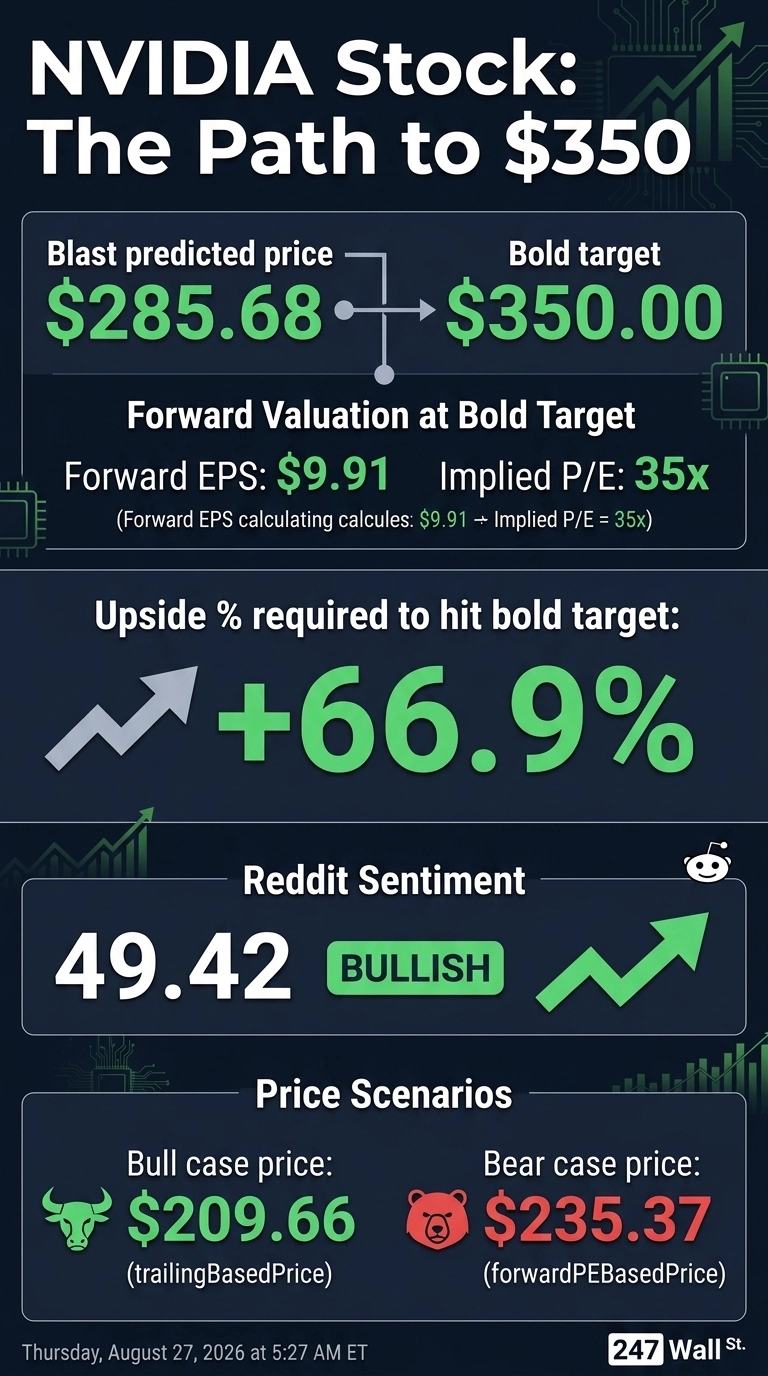
That is a stretch, but not fantasy. NVIDIA guided Q3 revenue to $108 billion and told investors fiscal 2028 revenue will grow roughly 70% year over year, described as supply-constrained.
The revenue opportunity per gigawatt steps up from $25 billion for Blackwell to $40 billion for Vera Rubin. Add $500 billion of third-party capital from Apollo, BlackRock, Blackstone, Brookfield, Goldman Sachs, and KKR, plus hyperscaler capex reaching nearly $800 billion in 2026 and $1.3 trillion in 2027, and the forward P/E compression math works.
Huang added that customer forecasts point to doubling next year on unconstrained demand. The primary risk is a memory-driven margin trough deeper than the guided 71% to 72% in Q4.

Where NVDA Trades Today vs Its Earnings Power
At $209.66 against forward EPS of $9.91, NVDA trades at roughly 21x forward earnings. That is cheaper than the S&P 500’s premium tech basket despite operating margin of 65.6% and net income growth of 125.9%.
Shares are hovering between the 52-week high of $236.26 and low of $163.85. NVDA is up 13,660.88% over the past decade. The multiple is compressing while the earnings base explodes higher.
Is $350 Realistic? My Verdict
Reaching $350 requires a 66.9% gain and a forward multiple of 35x. That is a reachable stretch.
Three things need to go right: gross margin needs to recover off the Q4 trough back toward 72% to 73% in fiscal 2028, Vera Rubin has to deliver the fastest product ramp in NVIDIA’s history, and hyperscaler capex needs to hold near the projected $1.3 trillion for 2027. A serious credit event across the AI-lab ecosystem would derail it. We’ve outlined the blueprint for how NVIDIA could reach $350 in 2027.
Contact [email protected] for any questions or corrections.
Vandita Jadeja is a financial publisher with over a decade of experience writing about financial topics, including investment, savings, retirement, insurance and banking. Vandita is a Chartered Accountant who loves to debunk financial concepts for readers.
Her work has appeared on sites that include The Motley Fool, InvestorPlace, and Benzinga. She covers investing and focuses on stock picks and price prediction for 24/7 Wall St.
When not looking for the next stock investment opportunity, she can be found traveling, reading, chasing sunsets and enjoying her iced latte.