This Magnificent Seven Stock Could Deliver Outsized Returns Over the Next 5 Years
NVIDIA trades at a multiple more typical of a mature chipmaker than a company growing revenue north of 100% year over year, and that gap between perception and reality is exactly where the next five years get interesting.


NVIDIA’s CEO Jensen Huang framed it bluntly last quarter: “AI has reached its inflection point. It’s doing useful work. Its tokens are productive and profitable. Now, compute is revenue.” That is the setup in one sentence.
NVIDIA (NASDAQ:NVDA | NVDA Price Prediction) shares are up 21.16% year to date, and last quarter’s revenue of $96.22 billion more than doubled year over year. Yet the stock still trades at roughly 21x forward earnings. Can shares actually reach $700 by 2031?

What’s Holding NVIDIA Back Right Now
For a stock riding the biggest capex cycle in modern tech, NVIDIA has been oddly range-bound. Shares are up just 3.28% over the past week and 3.74% over the past month.
With a beta of 2.217, this is a high-volatility name the market punishes on every China headline. Management excluded China data center compute from its forward outlook, and Hopper 200 shipments to China customers were less than 1% of data center revenue last quarter. Memory pricing pressure (Q4 gross margin is expected to bottom in the 71% to 72% range) adds caution.
Wall Street Sees Big Upside. Our Model Sees More
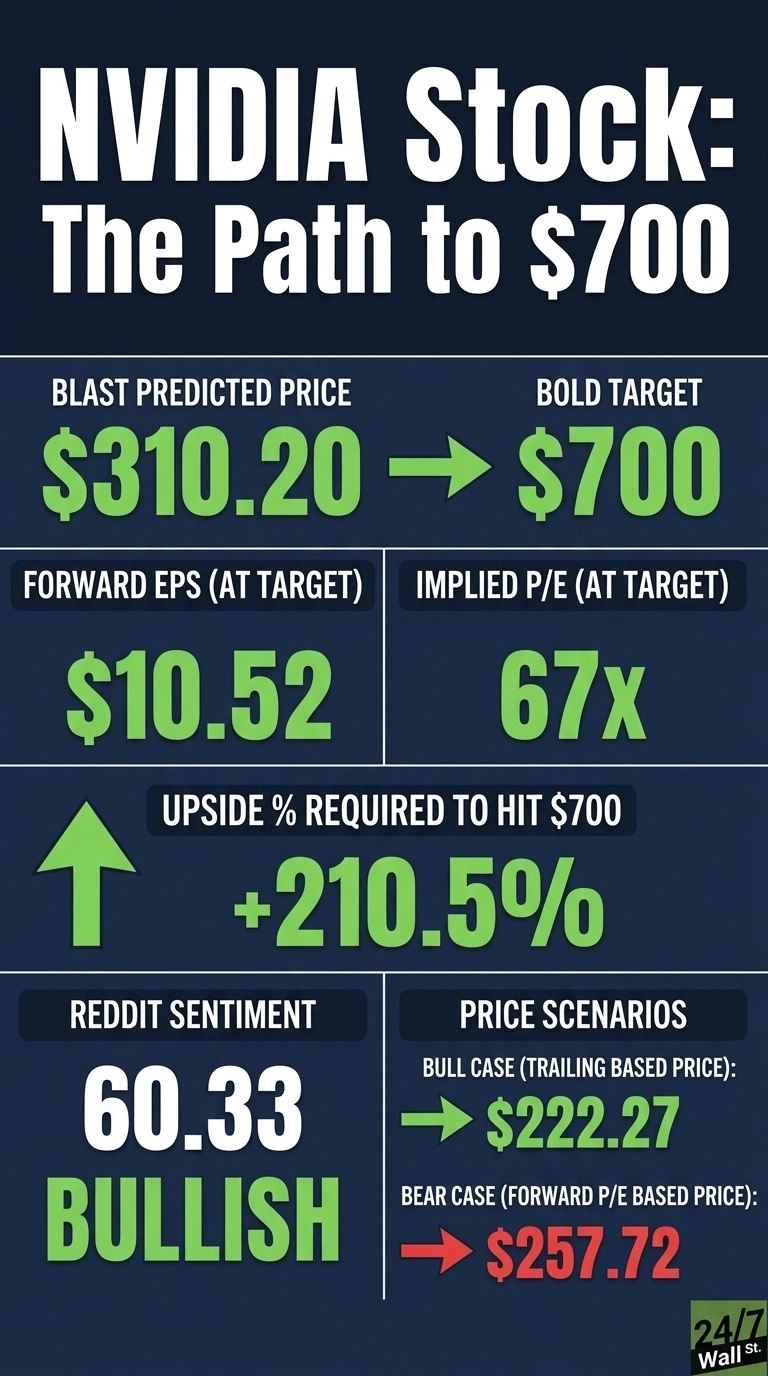
Consensus analyst target sits at $327.70, backed by 9 strong buys, 48 buys, 2 holds, and 1 sell. Our one-year base case is $310.20, or 39.56% upside. Over five years, the bull scenario reaches $646.58, a 190.9% total return.

Fiscal 2028 EPS consensus has jumped from $12.67 to $15.68 over the past 90 days, with 42 upward revisions and zero downward revisions in the trailing 30 days. Consensus is still catching up to the numbers.
Path to $700 Per Share
Reaching $700 from today’s price of $225.44 would require a gain of 210.5%. With forward EPS of $10.52, a $700 print implies a forward P/E of 67x. Our base case of $310.20 already implies 32x.

Management guided fiscal 2028 revenue growth of approximately 70%. Vera Rubin is in full production with a revenue opportunity of $40 billion per gigawatt versus $25 billion for Blackwell.
AWS committed to deploying an additional 2 million GPUs. Neocloud capacity is on track to reach 8 gigawatts by year-end, up from roughly 3 gigawatts at the end of 2025.
Combined with $500 billion in third-party capital mobilized alongside Apollo, BlackRock, Blackstone, Brookfield, Goldman Sachs, and KKR, forward EPS compounding into the mid-$20s over five years is credible.
The primary risk: a policy shock that curtails hyperscale spending or forces asset divestitures.
Where NVIDIA Trades Today vs Its Earnings Power
At 21x forward earnings, NVIDIA trades at a multiple typical of mature semiconductor cyclicals, even as the business is growing revenue 105.8% year over year at 75% non-GAAP gross margins and 92.2% ROIC. Over ten years, the stock has returned 14,464.64%.
Long-term holders know what durable compounding looks like when the market keeps underestimating the terminal opportunity (we reverse-engineered what the biggest tech winners looked like early in a free playbook here: The Next Nvidia Playbook).
Is $700 Realistic? Here’s My Take
Reaching $700 by 2031 requires the 210.5% gain outlined plus EPS compounding into the mid-$20s.
Three things need to go right: hyperscale capex must keep scaling toward $1.3 trillion by 2027, Vera Rubin needs to hold pricing near $40 billion per gigawatt, and neocloud economics must prove out at scale. A regulatory shock or broad antitrust action would derail it. We’ve outlined the blueprint for how NVIDIA could reach $700 in 2031.
Contact [email protected] for any questions or corrections.
Vandita Jadeja is a financial publisher with over a decade of experience writing about financial topics, including investment, savings, retirement, insurance and banking. Vandita is a Chartered Accountant who loves to debunk financial concepts for readers.
Her work has appeared on sites that include The Motley Fool, InvestorPlace, and Benzinga. She covers investing and focuses on stock picks and price prediction for 24/7 Wall St.
When not looking for the next stock investment opportunity, she can be found traveling, reading, chasing sunsets and enjoying her iced latte.