Walmart’s Big Sell-Off Could Be a Buying Opportunity
Walmart just punished investors for a beat-and-raise quarter, slicing 12% off shares in weeks. Before you follow the crowd out the door, consider what the selloff is actually pricing in.

Walmart’s post-earnings tumble has cut roughly 12% off shares since May, and the reaction to a beat-and-raise report looks overdone.
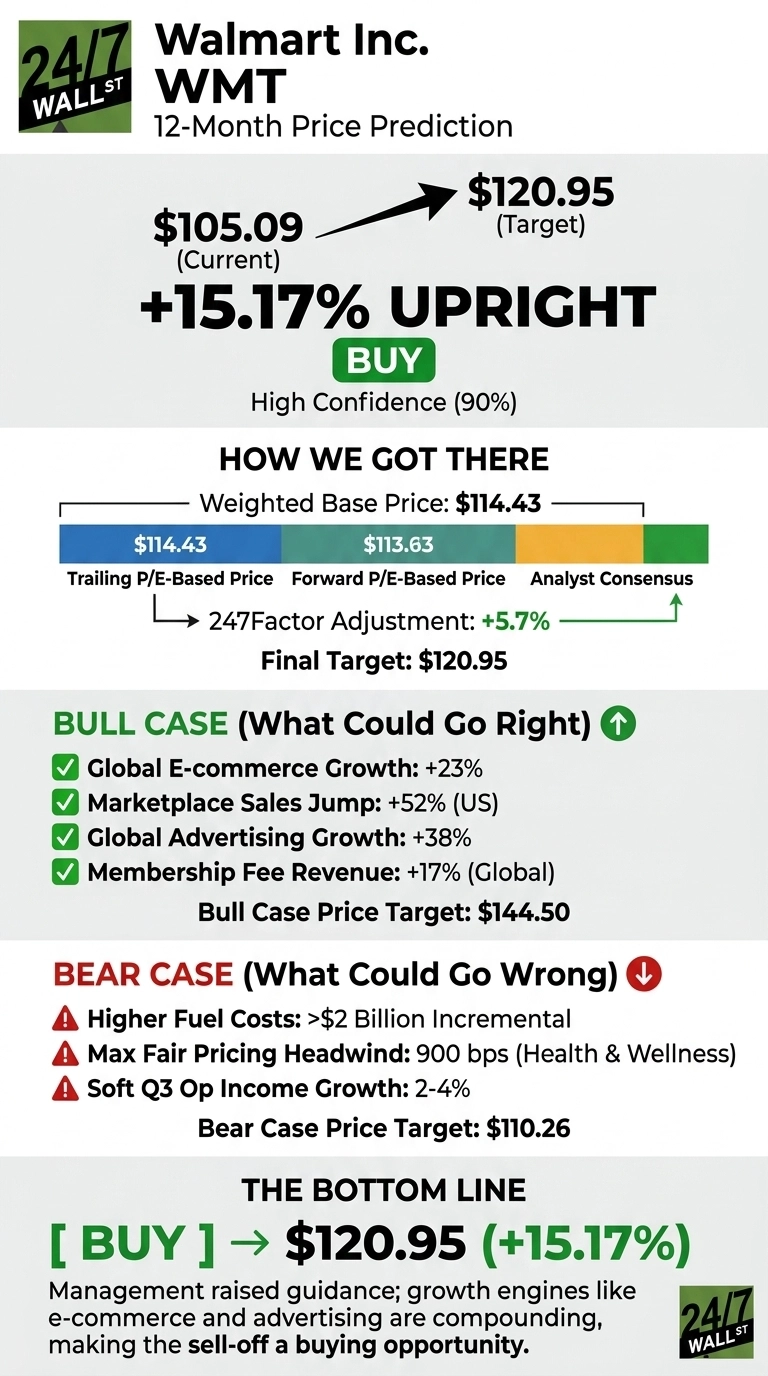
Walmart (NASDAQ:WMT | WMT Price Prediction) currently trades at $105.09, and my 24/7 Wall St. price target lands at $120.95, implying 15.17% upside over the next 12 months. Model confidence is high at 90%, and the recommendation is buy.

| Metric | Value |
|---|---|
| Current Price | $105.09 |
| 24/7 Wall St. Price Target | $120.95 |
| Upside | 15.17% |
| Recommendation | BUY |
| Confidence Level | 90% |
Walmart raised full-year guidance across sales, operating income, and EPS, yet trades below both its 50-day moving average of $113.32 and its 200-day at $118.54. That gap between fundamentals and price is the dislocation the model flags.
Why Shares Sold Off Despite a Beat and Raise
The Q2 FY27 report on August 20, 2026 delivered adjusted EPS of $0.81 versus $0.7413 expected and revenue of $187.94 billion, up 5.94% year over year. Shares fell 9.15% on the earnings report. WMT is down 6.64% over the past week and 12.03% since May 21.

Two issues drove the reaction. Q3 guidance came in soft at $0.62 to $0.64 adjusted EPS as tariff refund benefits get reinvested into price rollbacks.
Maximum Fair Pricing regulation is creating a 125 basis point pharmacy headwind to U.S. comps. Reddit sentiment framed WMT’s weakest sales growth in six years as a warning sign.
Bull Case: A Path to $144
Global e-commerce grew 23%, Walmart U.S. marketplace sales jumped 52%, global advertising rose 38%, and membership fee revenue climbed 17% globally.
These high-margin engines are re-mixing WMT toward a profile that deserves a richer multiple. CFO John David Rainey said, “We think we have a tremendous opportunity to continue to change and see our margins drift up over time.”

Consensus target is $128.43 with 9 Strong Buys, 28 Buys, 5 Holds, and 1 Sell. My bull-case scenario points to $144.50 if margin expansion and share gains accelerate.

What Could Go Wrong
Higher fuel prices are adding over $2 billion in incremental costs. Maximum Fair Pricing is expected to cost 900 basis points in Health & Wellness. Q3 operating income growth is guided to just 2% to 4% as refund dollars get spent on price.
Management expanded rollbacks from 7,000 to 11,000 during the quarter, and CEO John Furner said, “We’re doing this because we think it has a lasting durable impact.” My bear-case path takes the stock to $110.26, still above current levels.
How Walmart Compares to Costco and Target
Costco (NASDAQ:COST) is the natural growth comparison. Q3 FY26 revenue rose 11.58% to $70.53 billion, with comparable sales up 9.8% and digital comp up 21.5%, roughly double Walmart’s pace.
But COST’s $426.8 billion market cap and premium multiple already price that scarcity. Walmart’s forward P/E of 36 looks reasonable given accelerating digital, marketplace, and ad mix.
Target (NYSE:TGT) is the value contrast. Q2 FY27 revenue of $26.54 billion grew just 5.3%, and adjusted EPS of $4.11 included a $1.65 per share IEEPA tariff refund windfall.
Comparable sales grew 3.8%, similar to WMT’s 2.6%. TGT’s $74 billion market cap reflects inconsistent execution. Walmart earns a durability premium, making our $120.95 target reasonable.
Why Walmart Looks Mispriced Here
My 24/7 Wall St. price target is $120.95, my recommendation is buy, and my confidence is 90%. Management raised full-year guidance in the same report the market punished, and growth engines that matter for the next re-rating are compounding above 20%.
The setup looks constructive for investors who can accept another quarter of margin noise as tariff refunds get reinvested. The picture darkens if Maximum Fair Pricing pressure spreads beyond pharmacy. The sell-off looks like an opportunity.
Walmart Price Prediction 2026-2030
Here is where our model projects WMT could trade if current trajectories hold.
| Year | 24/7 Wall St. Price Target |
|---|---|
| 2026 | $120.95 |
| 2027 | $121.17 |
| 2028 | $133.22 |
| 2029 | $147.20 |
| 2030 | $155.82 |
These projections assume Walmart continues executing on omnichannel expansion and margin mix improvement. Upside could come from advertising and membership scaling faster than modeled; downside risk sits with prolonged consumer softness and structural pharmacy pressure.
Contact [email protected] for any questions or corrections.
Vandita Jadeja is a financial publisher with over a decade of experience writing about financial topics, including investment, savings, retirement, insurance and banking. Vandita is a Chartered Accountant who loves to debunk financial concepts for readers.
Her work has appeared on sites that include The Motley Fool, InvestorPlace, and Benzinga. She covers investing and focuses on stock picks and price prediction for 24/7 Wall St.
When not looking for the next stock investment opportunity, she can be found traveling, reading, chasing sunsets and enjoying her iced latte.