AppLovin Rises 4% After 54% YTD Slide: Does a Subdued P/E Make APP Stock a Good Value Here?
AppLovin has shed more than half its value this year while its advertising engine keeps printing record numbers, and now a single valuation figure is forcing investors to choose a side.


An oversold bounce is showing up in ad-tech name AppLovin midday Friday, and the move stands apart because large-cap technology is slightly lower and the broad market is close to flat. That mismatch matters because today’s gain in AppLovin stock is a single-name rebound in a name the market has been selling all year.
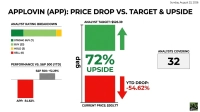
AppLovin (NASDAQ:APP | APP Price Prediction) stock is up 4% to $324.49, extending a modest rally in a name that had been in near-vertical decline. AppLovin stock was down 54% year to date (YTD) through Thursday’s close, which frames the session’s move as a small recovery from deeply oversold levels.
The Invesco QQQ Trust (NASDAQ:QQQ) is down 0.3% to $718.76. Meanwhile, the SPDR S&P 500 ETF Trust (NYSEARCA:SPY) is up 0.1% to $771.62, so AppLovin stock is bouncing against its own sector’s direction today.
Why the Bounce Is Happening Without a Fresh Catalyst
No new AppLovin announcement, filing, contract, earnings release, or analyst upgrade has been verified today. The mechanism appears to be a technical bounce after months of heavy selling.
The derating accelerated after AppLovin reported Q2 2026 results on August 5. Revenue of $1.92 billion grew 53% year over year (YoY) but landed just below the midpoint of guidance, and adjusted EBITDA finished below its guided range. Management attributed the shortfall to timing, saying the next step-up in advertising model performance landed only after quarter end and that demand was not the problem.
CEO Adam Foroughi told analysts that “Q3 is off to a strong start, and the business is back on the trajectory we expect.” AppLovin’s Q3 2026 revenue guidance of $2.055 billion to $2.085 billion implies 46% to 48% YoY growth, with adjusted EBITDA margin at 83%. The company also divested its apps portfolio in 2025 to focus entirely on advertising, which sharpens the model and concentrates the story.

A 25x Trailing P/E After the Slide
AppLovin now trades at a trailing P/E ratio of 25x, a sharp reset from the multi-hundred multiple carried at last year’s peak. Trailing twelve-month revenue is $6.83 billion, up 60.6% YoY, and the operating margin sits at 77.4%, well above the company’s three-year average of 60.8%.
Under the hood, AppLovin’s MAX publisher earnings grew double digits quarter over quarter and consumer-vertical advertiser spend set a record 28% above the Q4 2025 seasonal peak. Q2 free cash flow reached $863.3 million, and management returned $551.3 million to shareholders through buybacks during the quarter. Those figures argue that the business has kept compounding even as the multiple compressed.
The bear case is real, too. Analyst price-target cuts and execution risk in AppLovin’s e-commerce expansion have compounded the sell-off, and the CEO, CFO, CTO, Chief Legal Officer, and a director were each listed with disposal-coded transactions at $308.77 on August 20. Retail sentiment is split, with some traders treating the decline as an overreaction and pointing to potential buybacks and short covering, and others expecting further downside.

Peers Point to Broader Ad-Tech Pressure
Ad-tech peers Trade Desk (NASDAQ:TTD) and Magnite (NASDAQ:MGNI) have traveled very different paths this year, illustrating how uneven the group has been. Trade Desk CEO Jeff Green stated the June quarter “did not meet the standard we set for ourselves,” reinforcing that programmatic advertising has faced real macro pressure at the DSP layer. Magnite, in contrast, has been a bright spot with strong connected-TV growth and a raised full-year outlook.
AppLovin’s advertising engine has kept expanding while some peers stumbled, yet AppLovin stock has been punished anyway. Investors weighing a bull case need to decide whether a 25x multiple compensates for slowing growth expectations, higher compute costs, and continued model-cycle timing risk. AppLovin has argued that additional compute is worth it when it drives incremental revenue, though that trade shows up as near-term margin variability.
What to Watch
Investors can watch for a hold above Thursday’s close on AppLovin stock and for volume that confirms today’s bid. A follow-through session Monday would strengthen the case that mid-August marked a short-term low for AppLovin stock.
Traders may also look for further insider activity and any updated analyst notes on AppLovin, since target cuts have been part of the derating. Given AppLovin’s beta above 2 and the possibility that model-improvement cycles continue to introduce revenue timing volatility, investors should keep their exposure modest until the trend improves.
Contact [email protected] for any questions or corrections.
David Moadel is financial writer specializing in stocks, ETFs, options, precious metals, and Bitcoin. David has written well over 1,000 articles for leading online publications, helping investors understand markets, income strategies, and risk.
His work has appeared in The Motley Fool, InvestorPlace, U.S. News & World Report, TipRanks, ValueWalk, Benzinga, Market Realist, TalkMarkets, Finmasters, 24/7 Wall St., and others.
With a master’s degree in education, David has taught at the elementary, high school, and college levels. That teaching background shapes his writing style: clear, educational, and practical. David has also built a loyal social-media audience by providing trustworthy financial content on YouTube, X/Twitter, and StockTwits.