IREN Just Locked In $4 Billion in ARR — Wall Street Still Sees Only Losses
IREN signed enough AI cloud contracts to dwarf its reported revenue, yet shares collapsed after earnings. The reason why reveals a growing fault line between how Wall Street reads a balance sheet and how this company is actually building its…

This post may contain links from our sponsors and affiliates, and Flywheel Publishing may receive compensation for actions taken through them.

$4 Billion ARR Target
IREN (NASDAQ:IREN) said on its August 27, 2026 fiscal fourth-quarter call that it has locked in $4 billion of contracted annualized recurring revenue tied to its 2026 capacity, a forward-looking target management expects to be operational by the end of the December quarter. The figure represents guidance for run-rate revenue on already-signed contracts. As of the call date, only $1 billion of that ARR was actually operating, following Microsoft’s acceptance of Horizon 1 at Childress.
What It Means
The $4 billion ARR figure describes contractual scale. For context, IREN’s reported fiscal Q4 revenue was $137.2 million, missing the roughly $157 million Wall Street consensus, with a GAAP net loss of $684 million that included a $450.4 million non-cash impairment for decommissioned Bitcoin mining hardware. Management said that $4 billion comes from less than 10% of the company’s five gigawatt plus portfolio of secured grid connections, and that recent three-year contracts are pricing in excess of $20 million per megawatt of IT load, with active discussions around $25 million per megawatt. Three-year pricing is up about 125% since November.
Market Reaction
Investors focused on the reported miss rather than the ARR target. Shares closed at $36.535 on the day of the release, a 9.86% drop from the prior close of $40.53. Selling extended into August 28, with IREN quoted near $35.50 by late morning, a 12.41% single-session decline. Reddit chatter around the earnings report remained neutral, with sentiment scores of 54 and 57 and only two total mentions at the latest boundary.
Strategic Outlook
The economics behind the ARR target explain why management is running the miss narrative in reverse. IREN said customer prepayments are funding 45% to 55% of GPU capex, and that combined with 90% GPU financing, total funding can exceed the cost of the underlying hardware. The company secured $6.5 billion of GPU financing over the past three months, including $3.6 billion of investment-grade paper at roughly 6% tied to Microsoft and $2.4 billion at a 9% fixed rate led by Blue Owl and PIMCO-managed funds. AI Cloud revenue reached $70.5 million in the quarter, overtaking Bitcoin mining revenue of $66.7 million. That crossover is the whole trade: the power, cooling, and networking suppliers behind the data-center buildout are the ones we profiled in a free report on seven AI infrastructure names that aren’t chipmakers. CEO Daniel Roberts said “signing deals is not the bottleneck in this market. Bringing GPUs online is.”
Bottom Line
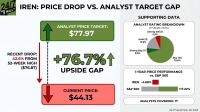
Wall Street’s $80.19 average target price and 11 Buy ratings reflect the ARR trajectory, while the day’s loss reflects the gap between contracted run-rate and reported P&L. The near-term catalyst is execution: management guided to more than $4 billion of ARR by the end of the December quarter, with revenue recognition weighted to the March quarter as Horizons 2 through 4 come online. If commissioning slips, the loss profile widens before the ARR shows up on the income statement.
Contact [email protected] for any questions or corrections.
After two decades of patrolling the dark corners of suburbia as a police officer, Rich Duprey hung up his badge and gun to begin writing full time about stocks and investing. For the past 20 years, he’s been cruising the markets looking for companies to lock up as long-term holdings in a portfolio while writing extensively on the broad sectors of consumer goods, technology, and industrials. Because his experience isn’t from the typical financial analyst track, Rich is able to break down complex topics into understandable and useful action points for the average investor. His writings have appeared on The Motley Fool, InvestorPlace, Yahoo! Finance, Money Morning, and, of course, 24/7 Wall St. He has been featured in both U.S. and international publications, including MarketWatch, Financial Times, Forbes, Fast Company, and USA Today.