4 Financial Stocks That Kept Raising Dividends Through 2 Historic Crashes
Financial stocks are the first to crack when markets panic, yet a handful of them kept handing investors bigger checks through both the 2008 meltdown and the 2020 shock. Four names cleared that bar, and their current yields tell only…


Financial stocks get stress-tested harder than any other sector during recessions, so an income streak that survived both the Global Financial Crisis and the pandemic shock is a genuine credential. These four names did more than survive: verified dividend records show each one paid a higher regular dividend in 2008 than in 2007, and again in 2020 than in 2019. Cincinnati Financial’s quarterly payout went from $0.56 in 2019 to $0.60 throughout 2020, and today the same company pays $0.94 per quarter. That is the shape of a dividend income stream you can actually plan around.
Cincinnati Financial (CINF)
Cincinnati Financial (NASDAQ:CINF | CINF Price Prediction) yields 2.1% at a recent price of $171.08, with an annualized forward dividend of $3.76 after the board lifted the quarterly rate to $0.94.
Trailing EPS of $21.10 against a $3.62 trailing dividend leaves enormous coverage, and the payout is supported by parent-company cash and marketable securities above $5 billion plus an equity portfolio with more than $8 billion of appreciated value. Underwriting has printed 14 consecutive years of profit, and Q1 2026 combined ratio improved to 95.6% from 113.3% a year earlier. The dividend record on file shows unbroken annual increases from $0.17 quarterly in 1999 to $0.94 today, including raises through both 2008 and 2020.
For income investors, this is the archetypal sleep-well-at-night P&C compounder: low beta of 0.554, a trailing PE of 8, and a book value per share of $108.68 that anchors valuation. There is one caveat though, results are equity-heavy, so a sharp market drawdown would compress book value faster than at a bond-heavy insurer.
T. Rowe Price (TROW)
T. Rowe Price (NASDAQ:TROW) is the highest-yielder in this group at 4.57%, paying $1.30 per quarter for a $5.20 annualized forward. Shares recently traded at $110.97.
The dividend is comfortably covered by trailing EPS of $9.86, the balance sheet carries $3.23 billion in cash and equivalents, and the firm has no debt-heavy financing profile to worry about. Dividend history shows a clean pattern of annual raises across both target years: the regular quarterly went from $0.24 in 2008 to $0.25 in 2009, and from $0.90 in 2020 to $1.08 in 2021. Q1 2026 alone returned $629 million to shareholders through dividends and buybacks.
The bull case is straightforward income math: a 4.57% yield from a debt-free asset manager with record AUM of $1.89 trillion and a trailing PE of 11. However, there is active-management flow risk: net client outflows of $6.5 billion in the most recent quarter show the underlying pressure that active shops still face from index funds.
Erie Indemnity (ERIE)
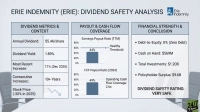
Erie Indemnity (NASDAQ:ERIE) yields 2.22% at a recent price of $257.41, with a quarterly Class A dividend of $1.4625 and an annualized forward of $5.85.
ERIE operates as the management company for the Erie Insurance Exchange, so the earnings stream is fee income from managing the reciprocal rather than underwriting results. Trailing EPS of $11.06 covers the dividend, return on equity runs at 24.8%, and beta sits at just 0.30. The verified dividend record shows the regular quarterly rate rising from $0.40 in 2007 to $0.44 in 2008 to $0.45 in 2009, and from $0.90 in 2019 to $0.965 in 2020, with a separate $2.00 special dividend paid that December.
The bull case is a fee-based business that has raised its regular payout every year across the entire recorded history from $0.44 quarterly in 2008 to $1.4625 today. Valuation here is worth considering with a trailing PE of 24 and price-to-book of 5.5, the stock is priced like a growth compounder even after falling 24.32% over the past year.
RLI Corp (RLI)
RLI Corp (NYSE:RLI) yields 1.03% on the regular quarterly dividend alone, at a recent price of $63.72. That understates what shareholders actually receive: RLI has a long habit of paying sizable special dividends, and the trailing twelve-month total is $4.68, boosted by a $2.18 special on May 29, 2026.
Trailing EPS of $4.77 against a $0.66 regular annual dividend, ROE of 25.2%, and a Q2 2026 combined ratio of 85.6 with $35.1 million of favorable prior-year reserve development. AM Best recently upgraded the group to A++ Superior. The dividend record shows regular quarterly raises within both target years, from $0.23 to $0.26 across 2008 and from $0.23 to $0.24 across 2020, plus special dividends layered on top of both years.
For income investors who accept lumpy timing, RLI has arguably the strongest specialty-underwriting franchise on this list. It’s worth noting that on a regular-dividend basis alone the yield is thin, so the total-income story depends on management continuing to declare specials that are not contractually guaranteed.
Putting the Four Together
What ties CINF, TROW, ERIE, and RLI together is a verified pattern of raising regular dividends through the two nastiest financial-market environments of the past two decades. Each is US-listed, each covers its payout with room to spare, and each represents a different flavor of financial-sector income: a P&C compounder, a debt-free asset manager, a fee-based insurance manager, and a specialty underwriter. Own them for the stream (the whole point of a dividend ladder is collecting checks without ever selling a share, and our free guide walks through how to build one: Never Touch the Principal).
Contact [email protected] for any questions or corrections.
Chris Lange is a financial and geopolitical writer with more than a decade of experience covering a myriad of topics. He has published thousands of articles for 24/7 Wall St., with past coverage focused heavily on stocks, IPOs, healthcare, defense, global affairs, and technology.
His work has been quoted, or referenced by a number of outlets including Business Insider, USA Today, Yahoo Finance, MSN, The Motley Fool, and many other publications. A graduate of Southwestern University, he studied business with a focus on investments and has previous experience in banking and startups.
When not reading or writing the news, he is following his passion for Lacrosse, playing chess, or building solar projects with his dad.