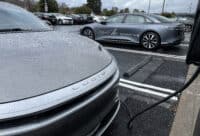
Tesla Jumps 4% as Oil Climbs to $86: Is the Gas-Price Trade Back?
Crude oil surged on fresh Middle East tensions and Tesla shot up 4% while the broader market fell, but the last time this exact trade appeared, it collapsed before most traders could act on it.


A weekend flare-up between the United States and Iran has pushed crude oil sharply higher, and the old gasoline-price trade in electric-vehicle names is getting another look this morning. The question in the title deserves a plain answer, and the direct one is that the mechanism is plausible while no company-specific catalyst has been confirmed for Tesla (NASDAQ:TSLA | TSLA Price Prediction) today.
The framing contrast matters here. Tesla stock is up 4% to $364.30 while the SPDR S&P 500 ETF Trust (NYSEARCA:SPY) is down 0.6% to $764.93, so the move is specific to the stock rather than a rising broad market lifting everything.

Zoom out and the day looks more isolated. Tesla stock was down 22% year to date through Friday’s close, so a single strong session is sitting inside a badly negative year for the name.
Crude Spike Revives the EV Running-Cost Argument
WTI crude oil is at $86.06 per barrel, up 3% over the past 24 hours, and the driver is geopolitical. The United States and Iran resumed military strikes over the weekend, and shipping through the Strait of Hormuz remains constrained. That’s the risk premium moving energy this morning, and it’s what has revived a familiar debate about electric-vehicle demand.
The thesis itself is straightforward. Higher gasoline prices improve the running-cost case for an electric vehicle against a comparable gasoline model, which can support EV demand at the margin. Pump prices are already stretched, with the national average price of regular gas at $4.08 per gallon, up 2.1% from a month ago, above the $4 level that historically registers with household budgets.
A Thesis That Has Been Tested Before
This same argument was examined by 24/7 Wall St. during an earlier phase of the Iran conflict in April, and it hasn’t consistently held. Published skepticism earlier in 2026 argued that Tesla stock had stopped responding to oil-price spikes, and management commentary supports that reading. On Tesla’s July 22 second-quarter call, executives attributed vehicle demand to Full Self-Driving adoption and product appeal rather than fuel-price economics.
Tesla CEO Elon Musk pointed to FSD as “a significant demand driver,” and finance chief Vaibhav Taneja stated, “One of the key factors for vehicle demand has been FSD.” So the Tesla-to-crude link is a mechanism rather than a proven cause, and history says the connection can fade as quickly as the risk premium does.
Peer Read Across and Consumer Signals
If the gasoline logic were holding cleanly, the same read should extend to Rivian Automotive (NASDAQ:RIVN) and Lucid Group (NASDAQ:LCID) as the other pure electric-vehicle names in the group. Rivian and Lucid carry different fundamentals from Tesla, yet they occupy the same corner of the market the thesis would lift. That doesn’t mean the pass-through works evenly across Rivian, Lucid, and Tesla, and past episodes suggest it often doesn’t.
Elevated fuel costs are at least registering with corporate management teams this week. Affirm Holdings (NASDAQ:AFRM) CEO Max Levchin, discussing his company’s results on Thursday, August 27, flagged rising gasoline prices as a pressure on consumers. Consumer sentiment supports the broader budget-pressure read, with the University of Michigan index at 55.2, still below the level the source classifies as recessionary.
Position Sizing Comes First
Position sizing deserves emphasis on a day like this. A Tesla rally built on a geopolitical risk premium in crude rather than on anything Tesla itself announced can reverse as fast as that premium does, so exposure taken on this session in Tesla stock carries headline risk in both directions. Shareholders adding to their Tesla positions on the strength should size those adds to the volatility of the underlying story, not to the size of the intraday move.
The answer to the title question is a hedged yes. The mechanism is back on the table for Tesla, the setup rhymes with the April episode, and today’s action is behaving as if the trade might work again. Whether it holds beyond a headline-driven session in Tesla stock is a separate question, and one the last few episodes have answered with more nuance than conviction.
Contact [email protected] for any questions or corrections.
David Moadel is financial writer specializing in stocks, ETFs, options, precious metals, and Bitcoin. David has written well over 1,000 articles for leading online publications, helping investors understand markets, income strategies, and risk.His work has appeared in The Motley Fool, InvestorPlace, U.S. News & World Report, TipRanks, ValueWalk, Benzinga, Market Realist, TalkMarkets, Finmasters, 24/7 Wall St., and others.With a master’s degree in education, David has taught at the elementary, high school, and college levels. That teaching background shapes his writing style: clear, educational, and practical. David has also built a loyal social-media audience by providing trustworthy financial content on YouTube, X/Twitter, and StockTwits.