AMD vs. Alphabet: One Stock Could Be the Surprise AI Winner
AMD has already surged triple digits this year while Alphabet trades at a bargain valuation despite exploding cloud growth, and choosing between them now could define your AI portfolio returns through 2030.


Advanced Micro Devices (NASDAQ:AMD | AMD Price Prediction) and Alphabet (NASDAQ:GOOG) both delivered blockbuster Q2 FY2026 results, yet they tell very different AI stories.
AMD is riding a hardware supercycle led by Instinct and EPYC. Alphabet is monetizing AI through Search, Cloud, and Gemini while pouring cash into infrastructure. Comparing them now matters because the market has priced one as an AI hero and the other as a value stock hiding in plain sight.
Instinct Accelerates for AMD, Cloud Explodes for Alphabet
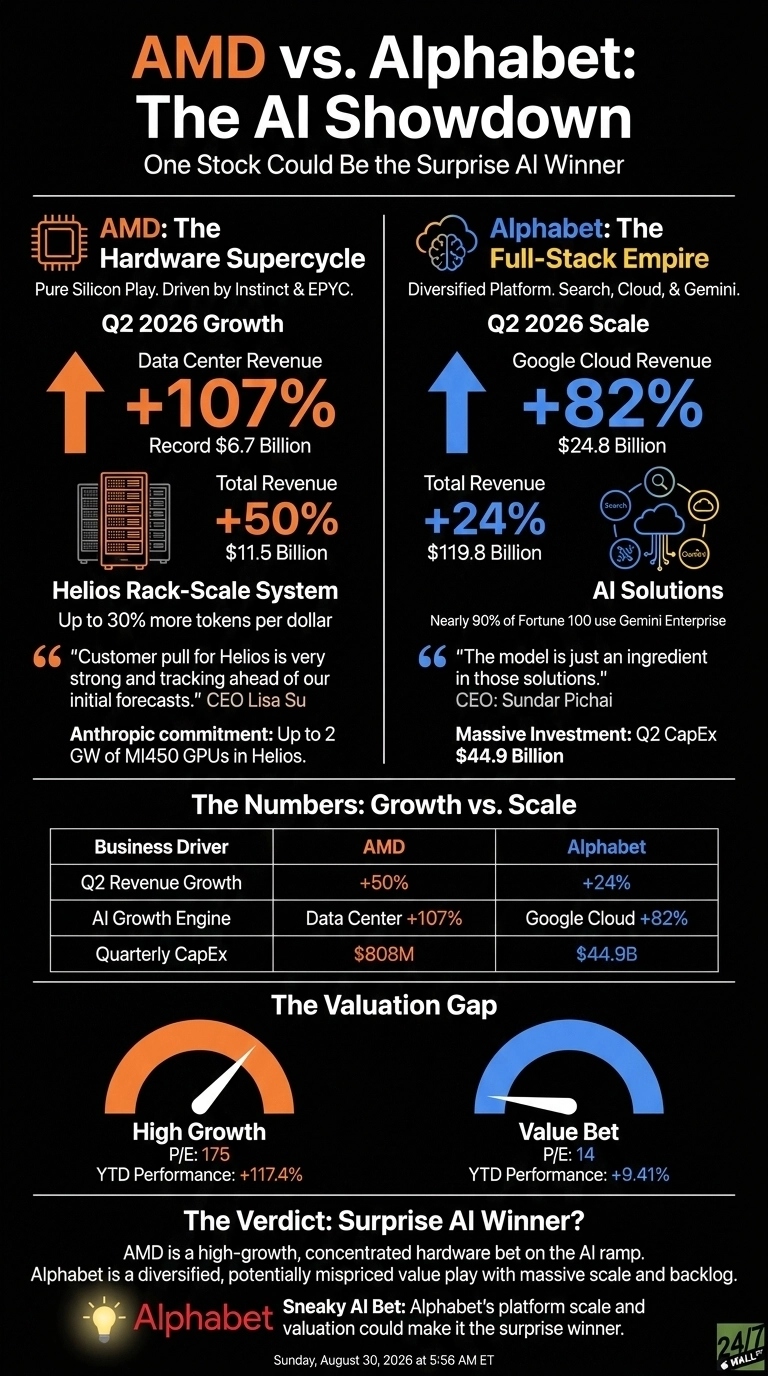
AMD posted revenue of $11.5 billion, up 50% year-over-year, with Data Center revenue growing 107% to a record $6.7 billion. CEO Lisa Su told investors “Customer pull for Helios is very strong and tracking ahead of our initial forecasts.” The Anthropic commitment for up to two gigawatts of MI450 series GPUs in Helios shows the scale of what is coming.

Alphabet countered with revenue growth of 24% year-over-year and Google Cloud revenue of $24.8 billion, up 82%. Sundar Pichai highlighted that nearly 90% of Fortune 100 companies use Gemini Enterprise, while cloud backlog swelled to $514 billion. That backlog is a queue of committed demand AMD simply cannot show on its balance sheet.

| Business Driver | AMD | Alphabet |
| Q2 revenue growth | 50% | 24% |
| AI growth engine | Data Center +107% | Google Cloud +82% |
| Quarterly CapEx | $808M | $44.9B |
Pure Silicon Play vs. Full Stack Empire
AMD’s bet is narrow and deep. Helios rack-scale systems combine EPYC Venice CPUs, MI450 GPUs, Pensando networking, and Rackham software, delivering up to 30% more tokens per dollar than the competition.
Su expects the data center AI accelerator market to grow more than 45% annually to approximately $1.4 trillion by 2030. The risk is concentration. Gaming revenue fell 31% year-over-year, and hardware demand can turn quickly.

Alphabet’s bet is wider. It sells Gemini APIs processing 22 billion tokens per minute, custom TPUs shipped into customer data centers, ad tools where AI Max was adopted by half a million advertisers, and YouTube reach.
Pichai framed it plainly: “The model is just an ingredient in those solutions.” The downside is capital intensity, with free cash flow at negative $5.86B and buybacks suspended.

Valuation Gap Could Decide the Race
The valuation spread between these two names is stark. AMD trades at a P/E of 175 with a forward P/E of 65. Alphabet trades at a P/E of 14. AMD has ripped 117.4% year-to-date. Alphabet is up only 9.41%.
I want to see whether AMD’s server CPU business can hit management’s target of more than 80% year-over-year growth in the second half of 2026, and whether Alphabet can convert its $514 billion backlog into margin without cloud margins slipping.
Why Alphabet Looks Like the Sneakier AI Bet to Me
Personally, I lean Alphabet. Paying 14 times earnings for a business growing Cloud at 82%, sitting on a half-trillion-dollar backlog, and monetizing AI in ads today feels mispriced against a semiconductor cycle that has already delivered a 176.18% one-year gain for AMD.
Growth-oriented investors with tolerance for volatility get the sharper upside on the Helios ramp with AMD. For investors seeking AI exposure without paying 65 times forward earnings, Alphabet quietly looks like the surprise winner hiding behind the louder chip narrative. And if the real money in this cycle sits with the power, cooling, and networking suppliers feeding both companies, we pulled seven of them into a free AI infrastructure report.
Contact [email protected] for any questions or corrections.
Vandita Jadeja is a financial publisher with over a decade of experience writing about financial topics, including investment, savings, retirement, insurance and banking. Vandita is a Chartered Accountant who loves to debunk financial concepts for readers.
Her work has appeared on sites that include The Motley Fool, InvestorPlace, and Benzinga. She covers investing and focuses on stock picks and price prediction for 24/7 Wall St.
When not looking for the next stock investment opportunity, she can be found traveling, reading, chasing sunsets and enjoying her iced latte.