The Enterprise AI Fight Has a New Challenger and It Is Not Who You Would Expect
NVIDIA owns the silicon, but a veteran hardware giant is racking up AI orders at a pace that demands attention. The question is whether one company quietly positioned itself to win enterprise AI budgets without anyone noticing.

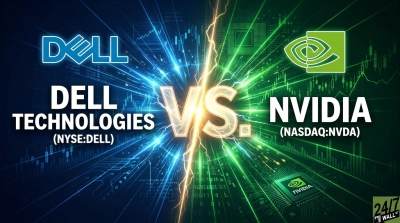
Dell Technologies (NYSE:DELL | DELL Price Prediction) and NVIDIA (NASDAQ:NVDA) both delivered blockbuster AI quarters within a week of each other. NVIDIA is the platform owner behind the compute. Dell is quietly turning that silicon into deployable AI factories for enterprises, sovereigns, and neoclouds. The results reveal a genuine two-sided fight for enterprise AI wallets that extends well beyond chips into hardware integration.
Blowout Quarters, Very Different Business Models
Dell posted $46.97 billion in Q2 FY27 revenue, up 57.75% year over year, with non-GAAP EPS of $7.04 versus the $4.8994 consensus. AI-Optimized Servers alone hit $16.4 billion, doubling year over year, while AI orders reached a record $60.9 billion and backlog swelled to $95 billion. Jeff Clarke framed the moment plainly: “AI infrastructure requires much more than assembling and delivering components.”
NVIDIA, meanwhile, cleared $96.22 billion in Q2 FY27 revenue, up 105.85%, with Data Center at $89.02 billion and non-GAAP gross margin of 75.0%. Jensen Huang told analysts “AI has reached its inflection point… Now, compute is revenue.” The scale gap is enormous, yet both companies now compete for the same enterprise AI build-out dollars.
| Metric | Dell (Q2 FY27) | NVIDIA (Q2 FY27) |
| Revenue growth | 57.75% | 105.85% |
| Non-GAAP gross margin lever | ISG margin 15.0% | Company-wide 75.0% |
| AI order/backlog signal | $95B backlog | $279B supply commitments |
Integrator vs. Platform Owner
Dell’s pitch is systems complexity. Some customer deals require upwards of 50 unique designs to tune workload performance, power, and cooling (the same power-and-cooling supplier layer we mapped in a free report on AI infrastructure names beyond the chipmakers, here). Its AI customer count crossed 6,500, and it added 3,300 customers in the last three quarters alone. Traditional servers grew 122%, storage 26%. Enterprises buying AI gear tend to load up on both.
NVIDIA is going the other direction, moving up the stack into rack-scale systems, CPUs, networking, and financing. Huang argued the non-hyperscaler market is “about half of the picture” and growing 100% a year. Revenue per gigawatt has climbed from $25 billion on Blackwell to $40 billion on Vera Rubin. That expansion pushes NVIDIA directly onto Dell’s turf.
Watching Backlog Conversion and Margin Repair
Dell guided full-year revenue up to $192.0 billion, with AI-Optimized Servers reaching $74 billion. The catch: free cash flow fell to $986 million, down 47.22%, as AI-server mix squeezes gross margin. NVIDIA’s own supply is boxed in. Huang said “we have supply for 70%. Our demand is much higher than that.” I want to see whether Dell converts more of that $95 billion backlog at better economics as its 18G servers begin shipping.
Why I Think Both Fit, Just for Different Investors
I lean toward NVIDIA if I want the compounding platform economics: 75.0% gross margins, ecosystem lock-in, and roadmap dominance are hard to replicate. But Dell’s 320.24% year-to-date rally reflects a real re-rating of its integrator role, and I think the market has finally noticed. If you like turnaround-flavored operating leverage and prefer paying ~$170 billion market cap for exposure to the same AI wave rather than $5.56 trillion, Dell is the more interesting bet. I would hesitate on Dell only if free cash flow keeps deteriorating into next quarter. That is the one number I refuse to ignore.
Contact [email protected] for any questions or corrections.
Alex Sirois is a financial writer with experience spanning both retail and institutional investing. He has written for InvestorPlace and held roles at BNY Mellon and Bernstein, giving him a perspective that bridges Main Street portfolios and Wall Street analysis.
Alex holds an MBA from George Washington University and has built his career across multiple industries, including e-commerce, education, and translation — a breadth of experience that informs how he breaks down complex financial topics for everyday investors. His writing is conversational, actionable, and grounded in long-term, buy-and-hold investing principles.
At 247 Wall St., Alex focuses on delivering analysis that is both accessible and useful, with a clear emphasis on helping readers make more informed decisions with their money.