Dell Just Jumped 16% and One Strategist Says That Is the Whole Tech Argument Right Now
Dell's 16% single-day surge gave one market strategist the proof he needed that AI spending is grounded in fundamentals, not hype. But a closer look at the margins hiding beneath that record backlog tells a more complicated story about who…

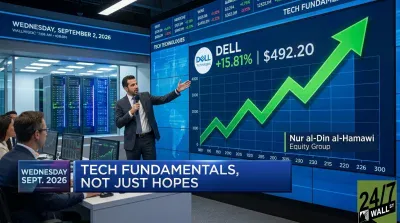
Wednesday was a strange session to watch. Yields drifted higher, oil pressed against traders’ risk budgets, and mega-cap technology mostly held its ground while one name in particular did something outsized. Dell Technologies (NYSE:DELL | DELL Price Prediction) closed up 15.81% at $492.20 after reporting fiscal second-quarter results the prior evening, and the move gave Nur al-Din al-Hamawi, chief market strategist at Equity Group, the specific evidence he wanted when he told Bloomberg that tech is “still leading with fundamentals. It’s not just leading on hopes.”
His argument, if you take him at his word, is that a year ago the group looked expensive on multiples and today those multiples are being met by delivered earnings rather than promises. Dell is his exhibit. The question worth asking is whether Dell actually proves the case, or whether it proves something narrower and more complicated about who within the AI supply chain gets to keep the money customers spend. The answer matters because the stock is now up 294.64% year to date, and the margin of error is smaller than it appears.
What Dell Actually Delivered
Revenue came in at $46.971 billion, up 57.75% year over year, and adjusted EPS was $7.04 against a $4.8994 consensus. AI-optimized server revenue was $16.401 billion, orders during the quarter reached a record $60.9 billion, and the ending backlog stood at $95 billion. Dell raised its fiscal 2027 revenue outlook by $25 billion to $192 billion, with non-GAAP EPS guided to $25.50, according to Dell Technologies. You can read the 8-K exhibit directly.
Jeff Clarke framed the quarter in terms of a broader spending shift, saying, “IT environments have shifted from cost centers to value drivers that fuel growth and competitive advantage.” Traditional servers and networking rose 122%, and storage rose 26%, which is the part investors underweighted.
Why the Backlog Is the Real Number
A $95 billion backlog is meaningful because it translates skepticism about the AI capex cycle into a delivery schedule. It is also a lagging indicator of what Dell already sold and priced. It tells you customers want AI servers, and it tells you comparatively little about how much of each dollar Dell keeps (the suppliers of power, cooling, and networking gear behind those racks are a separate trade, and we profiled seven of them in a free report here).
Management said on the call that “demand outstrips supply,” which is the kind of statement that reads well but also reveals that pricing power is being set by upstream component availability rather than by Dell’s own scarcity.
Margin Pressure Underneath the Backlog
This is where al-Hamawi’s thesis needs a qualifier. Gross margin was 21.1%, and free cash flow fell to $986 million, down 47.22% year over year, despite a record revenue quarter. NVIDIA (NASDAQ:NVDA), meanwhile, reported a non-GAAP gross margin of 75.0% and warned that memory pricing has “exceeded our prior expectations and are headed even higher into next year.”
Memory inflation is the specific mechanism that squeezes an assembler in the same environment that generates its biggest orders. Revenue growth and gross margin can move in opposite directions in this business, and this quarter they did.
Al-Hamawi’s second point, that “Nvidia was expensive a year ago… but now the situation is totally different,” is fair as far as it goes. Earnings arriving can rehabilitate a multiple. What that reasoning does not do is protect a buyer when the multiple expands to meet the earnings anyway, which is roughly what Dell’s chart has done.
Is Dell Stock a Buy?


Compared with peers, each name buys a different piece of the same trade. HPE (NYSE:HPE) trades near $51.83 with $1.11 non-GAAP EPS and a networking-led story built on Juniper and Oracle. Super Micro (NASDAQ:SMCI) at $37 offers the same AI server exposure with thinner margins, working-capital strain, and an unresolved board review. NVIDIA, at a 75% gross margin, owns the component layer that reflects the economics Dell has to pay for.
The setup argues for patience. The demand is real, the guidance raise is credible, and the operating leverage in traditional servers is underappreciated. The stock has already priced most of that. Free cash flow deterioration alongside a doubling of AI revenue is the tell, and until memory costs stabilize, the assembler’s share of the pie stays under pressure even as the pie keeps growing.
Contact [email protected] for any questions or corrections.
Omor Ibne Ehsan is a writer at 24/7 Wall St. He is a self-taught investor with a focus on growth, cyclical, and dividend equities that have strong fundamentals, value, and long-term potential. He also has an interest in high-risk, high-reward investments such as penny stocks.