Vistra Has Edged Lower Throughout 2026: One Bank Says It’s On The Verge of Doubling
Vistra has spent nine months drifting lower while Wall Street piled up bullish price targets, and at least one major bank now sees a setup that looks nothing like the slow bleed playing out on the chart.

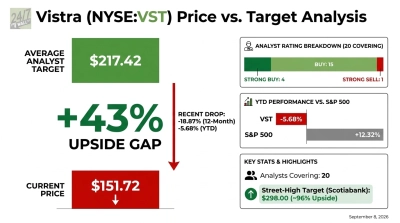
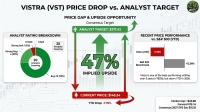
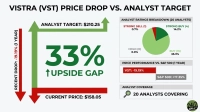
Vistra (NYSE:VST | VST Price Prediction) currently trades at $151.72, while the average Wall Street price target sits at $217.42. That gap implies roughly 43% upside, and one bank believes the stock could nearly double from here.
Vistra is one of the largest independent power producers in the country, running a nuclear, natural gas, solar and storage fleet alongside the TXU Energy retail brand. Wall Street has spent the past two years treating it as a pure-play beneficiary of the AI data center power boom, alongside Constellation and Talen. That is why the persistent 2026 drift matters. A stock that was supposed to compound AI demand has instead spent nine months moving backward.
A Slow Bleed From the Data Center Darling Trade
Vistra’s decline has been a steady rerating of the entire independent power producer complex rather than a single blowup. Shares opened the year at $160.86 and are down 5.68% year to date and 18.87% over the past twelve months, well off the $218.91 52-week high.
The pressure points piled up quickly. Q2 revenue slipped 5.5% year over year to $4.02 billion, and GAAP net income was hit by $472 million in unrealized mark-to-market hedge losses. Management flagged that softer ERCOT forward curves were pushing 2027 EBITDA toward the low end of the $7.40B to $7.80B midpoint opportunity. Wholesale ERCOT prices sat around $30 per megawatt hour, a level CEO Jim Burke bluntly called “not going to get new stuff built.” Weather-driven weakness in the Texas retail book and lingering Moss Landing decommissioning risk added to the pressure.
Operationally, the fleet still delivered. Ongoing Operations Adjusted EBITDA jumped more than 30% year over year to $1.77 billion, and commercial availability held at 97% or better during Texas and PJM heat waves.
Why Scotiabank Sees Vistra Nearly Doubling
The bull thesis has hardened rather than softened. Scotiabank carries the Street-high $298 target on VST with a Sector Outperform rating, implying roughly 96% upside. Analyst Andrew Weisel frames Vistra as the premier unregulated clean and firm power supplier positioned for the hyperscaler AI squeeze rather than as a traditional IPP. The four core pillars are scale (roughly 44 GW of capacity supplemented by the pending Cogentrix acquisition), co-location nuclear PPA upside benchmarked to peer Talen/Amazon and Constellation/Microsoft deals, ERCOT and PJM tightness, and downside protection from the retail book serving roughly five million customers.
Consensus is nearly as constructive. Recent catalysts include the Helix Digital Infrastructure JV with NVIDIA, KKR, and Kuwait Investment Authority, 20-year PPAs with Meta covering more than 2,600 MW at PJM nuclear sites, a 20-year AWS PPA at Comanche Peak for up to 1,200 MW, and Fitch’s upgrade of the corporate credit rating to Investment Grade. Those hyperscaler deals are the visible tip of a much wider buildout in power, cooling, and networking (we profiled seven of the suppliers behind it in a free AI infrastructure report). Analysts also point to roughly $6.5 billion of buybacks executed since November 2021, shrinking the share count by about 30% to roughly 336 million, with about $1.2 billion remaining under authorization targeted for completion by year-end 2027. Analyst targets are one data point, and the direction of recent revisions has been reiterations rather than cuts.
How the Merchant Power Peer Group Stacks Up
Vistra has fallen alongside peers, and further than the closest names. Data center-linked IPPs have compressed together as ERCOT curves softened.
Constellation Energy (NASDAQ:CEG) trades near $299.05 against a $348.30 consensus target, implying roughly 16% upside. The Street is heavily bullish with 20 Buy-side ratings against 3 Holds, though CEG has already re-rated higher on its closed Calpine acquisition.
Talen Energy (NASDAQ:TLN) trades at $325.77 with a $459.94 target, implying roughly 41% upside. The stock sits well below its $451.28 52-week high, and 14 of 16 analysts rate it Buy.
NRG Energy (NYSE:NRG) trades at $119.64 with a $188.75 target, implying roughly 58% upside. That is the second-largest consensus gap in this group behind VST, though a lone Strong Sell rating sits alongside 14 Buys.
The largest analyst-implied upside in the group belongs to Vistra, whether measured by consensus or Scotiabank’s Street-high. That is what makes VST the most dislocated setup among the merchant power names.
What the Numbers Actually Show
Vistra currently trades at $151.72, down 5.68% year to date and 18.87% over the past year. Over the same YTD stretch, the S&P 500 is up 12.32%, roughly an 18-point relative drag. The consensus $217.42 target across 20 analysts implies about 43% upside, and Scotiabank’s $298 implies roughly 96%. Shares trade at a 25 trailing PE and 14 forward PE.
The analyst posture breaks down as follows:
- Strong Buy: 4
- Buy: 15
- Hold: 0
- Sell: 0
- Strong Sell: 1
Where I Come Down on Vistra
The bull case works if the Cogentrix close, the Meta and AWS PPAs, and the Helix JV convert into visible 2027 EBITDA above the current guidance midpoint, and if ERCOT curves stop deteriorating. That is the specific path back to $217, and potentially closer to Scotiabank’s $298 if co-location premiums at Comanche Peak get priced in.
The bear case takes hold if $30 per MWh ERCOT power becomes structural rather than seasonal, hedge-driven GAAP volatility keeps unsettling generalist investors, and hyperscaler contracting slows. Management is already guiding toward the low end of the 2027 range, so the bear case is not hypothetical.
On balance the setup skews favorable. Operating EBITDA is climbing, the contracted backlog is real, and the analyst gap is wider than any peer in this space. I lean constructive, with the caveat that this remains a volatile name where patient investors will likely fare better than tactical ones.
Contact [email protected] for any questions or corrections.
Alex Sirois is a financial writer with experience spanning both retail and institutional investing. He has written for InvestorPlace and held roles at BNY Mellon and Bernstein, giving him a perspective that bridges Main Street portfolios and Wall Street analysis.
Alex holds an MBA from George Washington University and has built his career across multiple industries, including e-commerce, education, and translation — a breadth of experience that informs how he breaks down complex financial topics for everyday investors. His writing is conversational, actionable, and grounded in long-term, buy-and-hold investing principles.
At 247 Wall St., Alex focuses on delivering analysis that is both accessible and useful, with a clear emphasis on helping readers make more informed decisions with their money.