Vistra’s Price Has Edged Downward Throught 2026: One Analyst Says It’s Due to Double Soon.
Vistra has quietly shed a quarter of its value while its operating results kept beating expectations, and Wall Street's most bullish analyst thinks that disconnect points to something big coming in 2027.

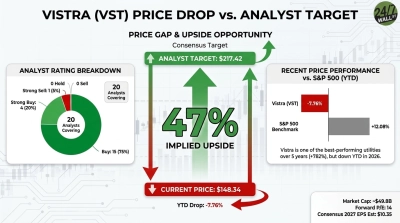
Vistra (NYSE:VST | VST Price Prediction) trades at $148.34 against a consensus Wall Street price target of $217.42, leaving roughly 47% of implied upside on the table.
Vistra is an integrated retail electricity and merchant power producer that has become one of the most watched names on the AI power trade. Its nuclear and natural gas fleet feeds ERCOT and PJM, the two grids most exposed to data-center load growth, and it has signed long-term supply deals with Meta, AWS, and hyperscaler-focused partners.
The gap matters because the operating base case has not shifted. Analysts still see close to 47% upside, and one of them thinks the stock should nearly double.
Why a Nuclear and Gas Winner Slipped in 2026
The selloff looks like a valuation reset rather than an operational break. Vistra has drifted lower every quarter of 2026, from $176.96 at the Q4 25 filing to $143.87 at the Q2 26 filing, even as the business kept beating on the fundamentals.
Q2 2026 Ongoing Operations Adjusted EBITDA jumped more than 30% year over year to $1.77 billion, with Texas segment EBITDA more than doubling to $311 million and the East segment climbing to $642 million from $418 million. GAAP net income slipped to $305 million, dragged by $472 million in unrealized mark-to-market hedging losses.
The pressure has come from three places. ERCOT wholesale power has averaged around $30 a megawatt hour year to date, unchanged from last year, capping merchant upside. 2027 EPS estimates have been revised down six times over the past 30 days. And after a 782% five-year run, some AI-power froth was always due to compress.
Analysts Still See $217, and One Sees $298
Wall Street is not blinking. Of the 20 analysts covering Vistra, 4 rate it Strong Buy, 15 Buy, 0 Hold, 0 Sell, and 1 Strong Sell. Implied upside to the $217.42 consensus is roughly 46.6%, which crosses the threshold where the bull case deserves real space.
The anchor is the contract book. Vistra holds 20-year Meta PPAs covering more than 2,600 MW at PJM nuclear facilities, a 20-year AWS deal for up to 1,200 MW at Comanche Peak, an 860 MW Permian Basin gas build, and the pending 5,500 MW Cogentrix gas acquisition with FERC approval in hand. Cogentrix and the Meta PPAs are both excluded from current 2027 numbers. Management said on the Q2 call the two together could add “roughly $700 million” to the 2027 midpoint.
Then there is Scotiabank’s Andrew Weisel, whose $298 Street-high target implies about 101% upside from here. His four pillars: hyperscaler nuclear PPA premiums benchmarked off the Amazon/Talen and Microsoft/Constellation comps; roughly 44 GW of gas capacity commanding rising ERCOT and PJM capacity clearing prices; a share count reduced by roughly 30% since 2021 amplifying per-share metrics; and an integrated retail arm serving about 5 million customers as a hedge against wholesale volatility.
The timeline is 2027. That is when Meta PPA cash flows begin, Cogentrix contribution shows up, and management guides to a $7.4 billion to $7.8 billion Ongoing Ops Adjusted EBITDA midpoint opportunity. (We mapped five ways to play the broader nuclear restart, utilities and fuel suppliers included, in a free report.)
Peer Group Sold Off Together, With NRG Sitting on the Widest Gap
The AI-power trade cooled across the whole space in 2026, and every merchant generator is trading below consensus. Vistra is not the outlier.
Constellation Energy (NASDAQ:CEG) at $284.75 is down 19.4% YTD and sits below its $348.30 consensus for about 22% upside. Ratings skew bullish at 6 Strong Buy, 14 Buy, and 3 Hold, but the Street sees a smaller gap here than at Vistra.
NRG Energy (NYSE:NRG) at $113.46 has been the worst performer in the group, down 28.75% YTD after two straight quarterly misses tied to LS Power integration. Its $188.75 consensus implies roughly 66% upside, the largest gap in the group. Ratings: 3 Strong Buy, 10 Buy, 3 Hold.
Talen Energy (NASDAQ:TLN) at $312.74 is down 16.57% YTD and trades against a $459.94 target for about 47% upside, almost identical to Vistra. Ratings: 6 Strong Buy, 10 Buy, 2 Hold, with the just-closed Cornerstone Acquisition still to prove in.
NRG carries the widest analyst-implied gap, but also the messiest integration story. Vistra’s ~47% gap comes attached to the cleanest execution.
What the Setup Actually Looks Like
Vistra trades at $148.34 with a market cap near $49.8 billion, a trailing P/E of 25 and a forward P/E of 14. Consensus target is $217.42 across roughly 20 covering analysts.
The performance gap versus the market tells the reset story. Shares are down 7.76% YTD and 26.89% over the past year, while the S&P 500 has returned 12.08% YTD and 16.22% over one year. Five years out, VST is still up 782%, one of the best-performing large-cap utilities of the AI cycle.
Consensus 2026 EPS sits at $9.5863; the 2027 average is $10.3461, revised down from $11.3019 sixty days ago.
Where I Land on Vistra Here
The bull case strengthens if the Meta and AWS PPAs actually flow through in 2027, Cogentrix closes and integrates cleanly, and Helix (the JV with NVIDIA, KKR, and Kuwait Investment Authority) surfaces even one meaningful hyperscaler deal. Get two of those three, and the $217 consensus looks conservative while $298 stops sounding aggressive.
The bear case holds if 2026’s decline reflects a durable valuation reset on AI-power names, ERCOT forwards stay stuck near $30 per MWh, and mark-to-market hedging noise keeps obscuring the earnings story quarter after quarter. Analyst targets are only one data point, and six downward 2027 EPS revisions in 30 days deserves attention.
I lean cautiously constructive. The contract book is real, the buyback authorization is real, and a ~47% consensus gap in an operationally clean IPP is unusual. The consensus setup looks more defensible than Weisel’s double.
Contact [email protected] for any questions or corrections.
Alex Sirois is a financial writer with experience spanning both retail and institutional investing. He has written for InvestorPlace and held roles at BNY Mellon and Bernstein, giving him a perspective that bridges Main Street portfolios and Wall Street analysis.
Alex holds an MBA from George Washington University and has built his career across multiple industries, including e-commerce, education, and translation — a breadth of experience that informs how he breaks down complex financial topics for everyday investors. His writing is conversational, actionable, and grounded in long-term, buy-and-hold investing principles.
At 247 Wall St., Alex focuses on delivering analysis that is both accessible and useful, with a clear emphasis on helping readers make more informed decisions with their money.