China Could Absolutely Cripple Anthropic And OpenAI IPOs
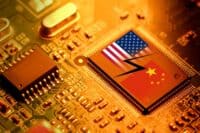
Anthropic and OpenAI are racing toward blockbuster IPOs with trillion-dollar valuations, but a rival they cannot sue, regulate, or outspend may already be eroding the foundation those numbers rest on.

Anthropic and OpenAI plan to go public sometime in the next year. Their valuations have been pegged at $1.5 trillion to $2 trillion. This is based on two things. The first is that each has the most advanced AI models in the world, and by wide margins. The other is that revenue is growing at a mind-boggling rate. A recent analysis of Anthropic’s revenue run rate for this year put it at $65 billion. That would be as much as seven times 2025 revenue.
If the impression grows that China’s AI models are nearly as good as, if not as good as, American models, OpenAI and Anthropic’s valuations could be badly crippled. There is also concern that AI data centers will cost hundreds of billions of dollars. Whether this pays off depends on major AI technology advantages and revenue’s ability to support the need for capital. If any of these assumptions are badly undermined, the AI funding pace will look more like the dot-com bubble, and IPO values will be badly damaged.
There is considerable concern that Chinese AI progress has moved fast enough that US advances have not kept pace in efficiency and overall results, particularly for business, government, and the military. The anxiety falls into several categories. One is that China has stolen intellectual property from Anthropic and OpenAI. The same concern applies to several major American public companies, including Microsoft (NASDAQ: MSFT | MSFT Price Prediction).
Another is that enterprise users will move to China’s open-source and open-weight models. The cost per token can be less than 50% of proprietary products from some US companies. CNBC reports, “Chinese-built AI models are gaining traction among U.S. companies as they narrow the performance gap with leading American rivals while remaining significantly cheaper to use.” Nvidia (NASDAQ: NVDA) CEO Jensen Huang recently said that these models should not be pushed out of the US. He added that these Chinese models are “excellent.”
US politicians have moved to block the use of Chinese technology like DeepSeek or Kimi. They have voiced concern that these can be used to “spy” on US technology. A related issue is that the Chinese government has supported AI development, while in the US, capital comes from private companies and financial firms.
Another concrete issue is the backlash against data centers in the US. Bloomberg has reported that the number blocked so far is huge. “Delays to data-center projects would likely result in cuts to forecasts for US gas demand, which is expected to climb as new power plants are built to provide electricity for the artificial-intelligence boom,” the news service reports. The Chinese central government has much more control over land use and where data centers are built.
Another advantage Chinese data centers have is access to electricity. China can supply about twice the electricity the US can. The aging American grid and lack of ready energy to power the rising need for electricity mean some data centers will be delayed.
The final large advantage China has is its ability to steal US IP. This often happens through a technique called “model distillation.” Reuters reports, “Distillation is the process of training smaller AI models using output from larger, more expensive ones as part of an effort to lower the costs of training a new AI tool.”
Current investors need Anthropic and OpenAI values to be at or above $1.5 trillion. Public investors also need to believe those figures to support these valuations.
Contact [email protected] for any questions or corrections.
Douglas A. McIntyre is the co-founder, chief executive officer and editor in chief of 24/7 Wall St. and 24/7 Tempo. He has held these jobs since 2006.
McIntyre has written thousands of articles for 24/7 Wall St. He is an expert on corporate finance, the automotive industry, media companies and international finance. He has edited articles on national demographics, sports, personal income and travel.
His work has been quoted or mentioned in The New York Times, The Wall Street Journal, Los Angeles Times, The Washington Post, NBC News, Time, The New Yorker, HuffPost USA Today, Business Insider, Yahoo, AOL, MarketWatch, The Atlantic, Bloomberg, New York Post, Chicago Tribune, Forbes, The Guardian and many other major publications. McIntyre has been a guest on CNBC, the BBC and television and radio stations across the country.
A magna cum laude graduate of Harvard College, McIntyre also was president of The Harvard Advocate. Founded in 1866, the Advocate is the oldest college publication in the United States.
TheStreet.com, Comps.com and Edgar Online are some of the public companies for which McIntyre served on the board of directors. He was a Vicinity Corporation board member when the company was sold to Microsoft in 2002. He served on the audit committees of some of these companies.
McIntyre has been the CEO of FutureSource, a provider of trading terminals and news to commodities and futures traders. He was president of Switchboard, the online phone directory company. He served as chairman and CEO of On2 Technologies, the video compression company that provided video compression software for Adobe’s Flash. Google bought On2 in 2009.