Meet Wall Street’s 3 Safest High-Yield Dividend Stocks
Three pipeline giants collect tolls on North American energy flows regardless of where crude prices land, but choosing the wrong one for your retirement account could quietly cost you more than the yield is worth.

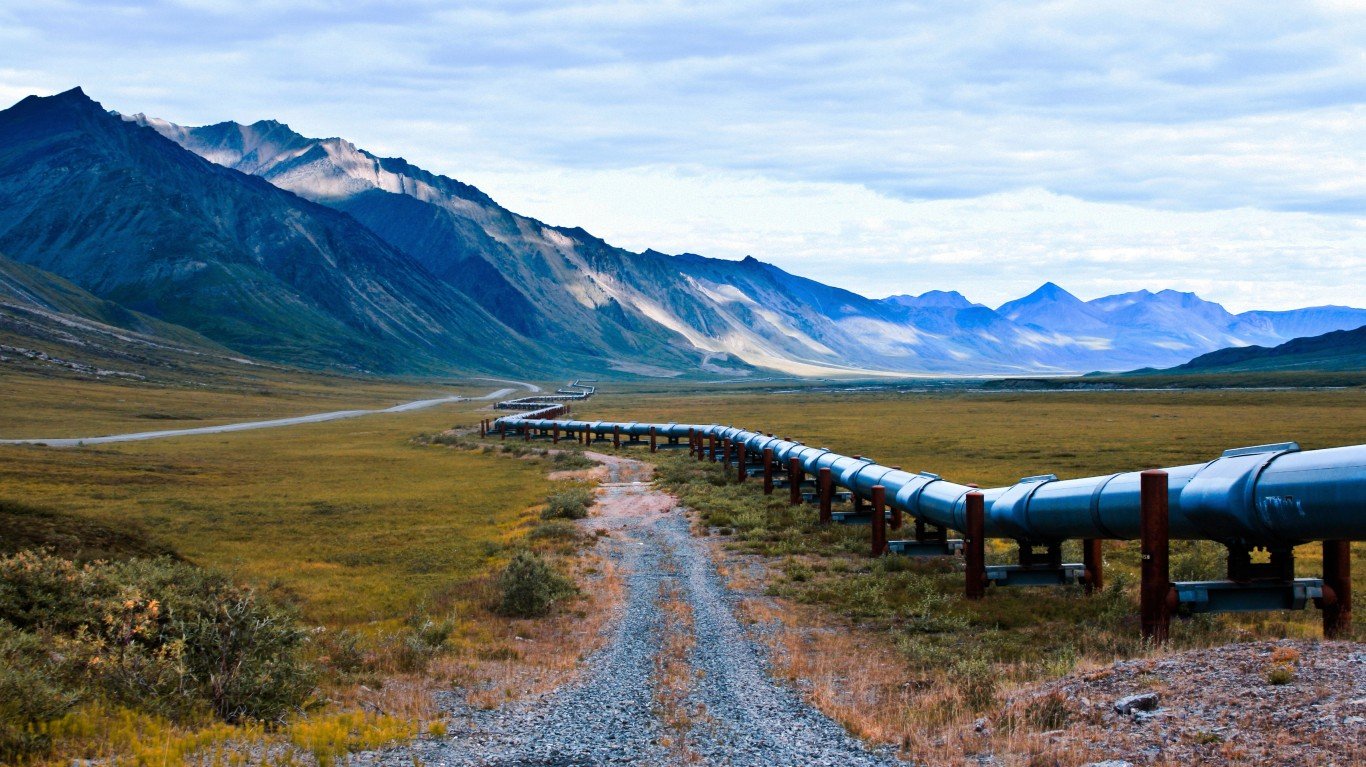
Pipeline operators sit at the center of North American energy flows, and their contracts are what fund the checks that hit retiree accounts. The three names below run on fee-based, capacity-reservation and take-or-pay style agreements that generate cash whether crude sits at $60 or $90. The shared hook: Enterprise Products Partners (NYSE:EPD | EPD Price Prediction) generated a record $2.8 billion of EBITDA in the second quarter, a 17% increase over the second quarter of last year, and used it to raise its distribution again while holding leverage at target.
A tax note before the yields, because this matters more for retirement money than most investors realize. EPD is a master limited partnership that issues a Schedule K-1 and can generate unrelated business taxable income (UBTI) inside an IRA. The other two stocks on this list are corporations and issue standard 1099s. The three are not tax-interchangeable, and account location should drive selection as much as yield.
Enterprise Products Partners: The MLP Cash Machine
EPD trades with a current distribution yield of 4.27%, putting it firmly in high-yield territory for a fee-based midstream operator. The forward annualized distribution runs at $2.24 per unit after the latest hike to $0.56 quarterly on the July 31, 2026 ex-date.
Distribution safety is the strongest story in the group. Co-CEO Jim Teague said the second quarter produced “one times coverage of our distributions” on record EBITDA, and operational distributable cash flow of $2.3 billion provided 1.9x coverage of the cash distribution. Adjusted cash flow from operations reached a record $2.5 billion for the second quarter of 2026. The balance sheet backs it up: the consolidated leverage ratio sits at the 3.0 target on a net basis, approximately 97% of our debt was fixed rate at a weighted-average cost of 4.7%, and consolidated liquidity totals roughly $5 billion including the new credit facility. The recent distribution progression, from 45 cents in 2021 to 56 cents on July 31, is a steady quarterly climb.
The bull case for income investors is straightforward. EPD runs an integrated NGL, crude, natural gas and petrochemical network that moved 14.7 million barrels a day of oil equivalent last quarter, with LPG export capacity about 90% contracted. A trailing P/E of 13 and beta of 0.48 make this the kind of low-volatility income compounder retirees typically build portfolios around.
Risk: the K-1 and potential UBTI treatment inside retirement accounts is a real complication that no yield on its own solves. Management also flagged that new LPG export capacity coming online could produce a period of time where we have less volatility in terminal fees and just overall lower rates than we’ve seen the last couple of years.
Enbridge: Ultra-High-Yield With A Regulated Backbone
Enbridge (NYSE:ENB) carries the fattest payout of the three, with a current yield of 5.84%. That qualifies as ultra-high-yield, and it is backed by a business mix weighted toward regulated gas utilities and long-haul liquids pipelines rather than direct commodity exposure. The most recent quarterly cash dividend recorded in USD was 69 cents, with a trailing 12-month total of $2.786832.
Coverage and cash generation are solid, though leverage is worth watching. Second-quarter distributable cash flow was $2.95 billion, and 2026 guidance is reaffirmed at adjusted EBITDA of C$20.2-20.8 billion and DCF per share of C$5.70–6.10, with a ~5% CAGR outlook post-2026. Debt-to-EBITDA sits at 5.1x, which is elevated versus peers and partly reflects FX. The secured growth backlog is roughly C$41 billion, with $9 billion sanctioned year-to-date, giving management a decade of contracted growth to fund the payout.
The bull case: this is arguably the most diversified midstream infrastructure business on either side of the border, spanning Liquids Pipelines, Gas Transmission, Gas Distribution and Renewable Power. A large share of cash flow is regulated or take-or-pay contracted, which is exactly why the stock behaves more like a utility than an oil name. Beta is 0.769 and the forward P/E is 21.
Risk: the USD dividend fluctuates with the Canadian dollar. The most recent quarterly payment of 69 cents was actually lower than the prior 70 cents in USD terms even though the 97-cent Canadian declaration was unchanged. Retirees relying on the check should expect quarter-to-quarter FX noise on top of the underlying growth.
Kinder Morgan: Natural Gas Toll Roads With A Growing Payout
Kinder Morgan (NYSE:KMI) yields 3.86%, the lowest of the trio, and the lower yield reflects both a stronger recent stock run and a more conservative payout policy after the 2015 dividend reset. The forward annualized dividend is $1.19, with quarterly payments now at 29 cents.
Dividend safety here rests on a natural-gas heavy asset base and improving credit. Second-quarter cash from operations was $2.0 billion, with free cash flow of $1.0 billion. Net debt to adjusted EBITDA ended the quarter at 3.6 times, which is down from 3.8 at the beginning of the year, and CFO David Michels noted this “puts us well below the midpoint of our target leverage range of 4.0 times.” Moody’s upgraded the company to Baa1 (BBB+ equivalent). For 2026, management now expects adjusted EBITDA at least 5% above the 2026 budget and adjusted EPS at least 12% above the original 2026 budget. The recent dividend history is a slow, deliberate climb: 28 cents in early 2024 to 29 cents in 2026.
The bull case is levered to gas. Natural gas transport volumes rose 7% in the quarter versus the second quarter of 2025, and gathering volumes were up 26% year over year. The project backlog stands at $9.6 billion (~92% natural gas; >60% supporting power gen/LDC demand), aimed at LNG export and power-generation demand that Wood Mackenzie projects to reach more than 160 billion cubic feet per day by 2035. Executive Chairman Rich Kinder said the company can “fund these projects almost completely with our internally generated cash flow while still continuing to pay a solid and growing dividend”.
Risk: KMI carries the memory of a reduction from 51 cents on Oct. 29, 2015, to 12 cents beginning with the Jan. 28, 2016, ex-dividend date. The current payout is well-covered and rising, but retirees looking at the ten-year dividend chart should know that history exists.
Putting The Three Together For Retirement Income
All three names collect the toll while producers, refiners and utilities absorb the commodity risk, which is exactly the business model that produces stable retirement income across oil cycles. ENB offers the largest yield and the most regulated cash-flow mix, EPD offers the strongest coverage and balance sheet in exchange for K-1 paperwork, and KMI offers the cleanest natural-gas growth story with an investment-grade credit and a lower but faster-improving payout. Volume declines in a deep production downturn would eventually hit all three, so the correct posture is owning them for the contracted cash flow across oil cycles (the same live-off-the-checks setup we walked through in a free dividend ladder guide here: Never Touch the Principal).
Contact [email protected] for any questions or corrections.
Joel South covers large-cap stocks, dividend investing, and major market trends, with a focus on earnings analysis, valuation, and turning complex data into actionable insights for investors.
He brings more than 15 years of experience as an investor and financial journalist, including 12 years at The Motley Fool, where he served as an investment analyst, Bureau Chief, and later led the Fool.com investing news desk. He has also co-hosted an investing podcast and appeared across TV and radio discussing market trends.