Who Buys Colgate’s Cast-Off Brands? Why the Obvious Answers Are Unlikely.
Colgate is reportedly shopping Softsoap, Irish Spring, and Speed Stick with Goldman Sachs running the process, but the names most investors would expect to step up all have reasons to sit this one out.

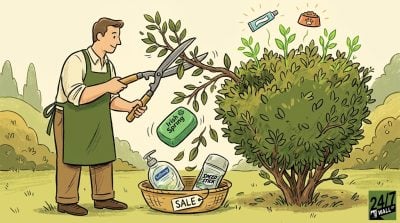
Colgate-Palmolive (NYSE:CL | CL Price Prediction) is reportedly shopping a slice of its portfolio that many investors forgot it still owned. Reuters reported on Friday, September 11, 2026, citing unnamed sources, that Colgate is exploring a sale of Softsoap, Irish Spring, and Speed Stick and has hired Goldman Sachs to run the process.
No buyer has been identified, and Colgate has not confirmed any sale. Colgate shares changed hands at $87.49 in premarket trading on September 14, 2026. The stock is down 3.7% over one week. Yet it is up 9.9% year to date and 3.3% higher than a year ago. The market cap is near $69.2 billion.
Why Colgate Would Sell These Brands
Reuters characterizes oral care as almost half of Colgate-Palmolive’s net sales. The pruning fits a broader Strategic Growth and Productivity Program (SGPP) that took a $129 million charge in the second quarter of 2026. Cumulative pretax SGPP charges now guided to $350 million to $550 million. North America revenue fell 3.0% in the quarter to $891 million. Colgate’s chief executive described the U.S. business as a long-term turnaround in remarks delivered at the Barclays consumer conference. Selling mature mass-market offerings would fund premium innovation and reduce the drag from the weakest region.
Ranking the Plausible Buyers
1. Private Equity Is the Base Case
The Reuters reporting itself points here. Yellow Wood Partners has bought this exact type of asset twice recently, taking a large tranche of beauty and personal care brands off Unilever and agreeing to buy Nestle’s vitamins business. Platinum Equity took a stake in Nestle’s waters and premium beverages business. Neither firm is publicly traded. Financial sponsors underwrite mature cash-generative brands based on free cash flow, brand awareness, and shelf space. Softsoap, Irish Spring, and Speed Stick supply all of that.
2. Church & Dwight: Bigger, but Wrong Mandate
Church & Dwight (NYSE:CHD) is a serial acquirer with a market cap of $22.3 billion and a trailing 12-month revenue of $6.23 billion. Its stated strategy is fast-moving consumables with a balanced value/premium mix, and its recent tuck-ins have been Touchland and Miss Mouth’s Messy Eater. Cash and equivalents fell to $254.8 million, down 72.4% year over year on M&A spend. Management has been divesting slower-growth lines rather than adding legacy mass-market bar soap.
3. Edgewell Personal Care: The Right Fit at the Wrong Scale
Edgewell Personal Care (NYSE:EPC) owns Schick, Banana Boat, and Cremo, and Speed Stick would nest cleanly next to them. The problem is arithmetic. Edgewell’s market cap is $1.2 billion, a small fraction of the reported price tag for the three brands. Adjusted net debt leverage is guided to 3.3x to 3.4x at fiscal year end, and the company just divested Feminine Care to pay down its revolver. Edgewell is in simplification mode.
4. Kenvue: Off the Board
Kenvue (NYSE:KVUE) is itself being acquired by Kimberly-Clark for $48.7 billion, with Hart-Scott-Rodino (HSR) cleared, shareholders approved, and closing expected in the fourth quarter of 2026 pending foreign regulatory approvals. Kenvue’s market cap is $34.2 billion, and the company has withdrawn all forward guidance. A company being acquired is not in a position to buy.
5. Strategic Mega-Caps: Silent
Procter & Gamble, Unilever, and Reckitt are the theoretical universe of buyers with checkbooks large enough. None has been connected to this process by any source. Unilever is a seller of exactly these categories.
What to Watch
- Whether a buyer emerges and whether the brand list expands beyond the three names reported by Reuters.
- Whether Colgate addresses the process on its next earnings call.
- How proceeds are deployed: premium innovation, share repurchases, or Hill’s expansion following the Prime100 acquisition.
- The Kenvue closing timeline, which locks that company out until it clears.
The real question is whether shedding mature brands fixes the North America problem in what Colgate’s chief executive has already framed as a long-term turnaround, or whether it simply makes the company smaller.


Contact [email protected] for any questions or corrections.
Trey has been an editor and author at 24/7 Wall St. for more than a decade, where he has published thousands of articles analyzing corporate earnings, dividend stocks, short interest, insider buying, private equity, and market trends. His comprehensive coverage spans the full spectrum of financial markets, from blue-chip stalwarts to emerging growth companies.
Beyond 24/7 Wall St., Trey has created and edited financial content for Benzinga and AOL's BloggingStocks, contributing additional hundreds of articles to the investment community.
Trey's editorial expertise extends across multiple publishing environments. He served as production editor at Dearborn Financial Publishing and development editor at Kaplan, where he helped shape financial education materials. Earlier in his career, he worked as a writer-producer at SVE. His freelance editing portfolio includes work for prestigious clients such as Sage Publications, Rand McNally, the Institute for Supply Management, the American Library Association, Eggplant Literary Productions, and Spiegel.
Outside of financial journalism, Trey writes fiction and has been an active member of the writing community for years, moderating workshop sessions at regional conventions.