3 Boring Stocks That Have Quietly Outlasted Every Bear Market of the Last 50 Years.
Three unglamorous companies have kept raising dividends through every bear market since the 1970s, and the reason they survived has nothing to do with innovation or hype.


Boring works. Over a market cycle, essential-service businesses tend to keep selling toothpaste, chips, and industrial adhesives regardless of what the S&P 500 is doing on any given afternoon. Consider PepsiCo’s own dividend record: management has committed to a 4% increase in the annualized dividend per share beginning with the June 2026 payment, which will represent the 54th consecutive annual increase. A streak that long spans every officially declared bear market since the mid-1970s. The three names below are held together by that same idea: durable demand, unglamorous products, and customers who do not easily leave.
PepsiCo: Snacks and Beverages That Sell in Every Cycle
PepsiCo (NASDAQ:PEP | PEP Price Prediction) sells convenient foods and beverages: Lay’s, Doritos, Cheetos, Quaker, Tostitos, Pepsi, Gatorade, Mountain Dew, Aquafina, and Tropicana. These are low-ticket, habitual purchases. When households tightened budgets in 2008-2009 and again in 2020, they did not stop buying salty snacks or sports drinks; they traded down within the aisle, and PepsiCo’s multi-tier portfolio caught them on the way. On the most recent call, CEO Ramon Laguarta described the international business plainly: “The truth is that all those markets have remained very resilient.”
The dividend record supports the durability case. Ex-dividend records extend from 1999-03-10 through 2026-06-05, with the quarterly amount progressing from 1.0225 in 2020 to 1.075, 1.15, 1.265, 1.355, 1.4225, and 1.48. Return of capital is meaningful without being the whole story: FY2026 guidance points to approximately $8.9 billion in total cash returns to shareholders, comprising $7.9 billion in dividends and $1.0 billion in buybacks. Over ten years, the stock is up 74.74% on a price basis, with a beta of 0.361.
Risk: North America has been softer than expected, and core operating margin contracted 40 bps in Q2. Commodity and FX volatility continue to move quarterly numbers around, and management has signaled full-year EPS “may be towards the low end of the EPS range” previously provided.
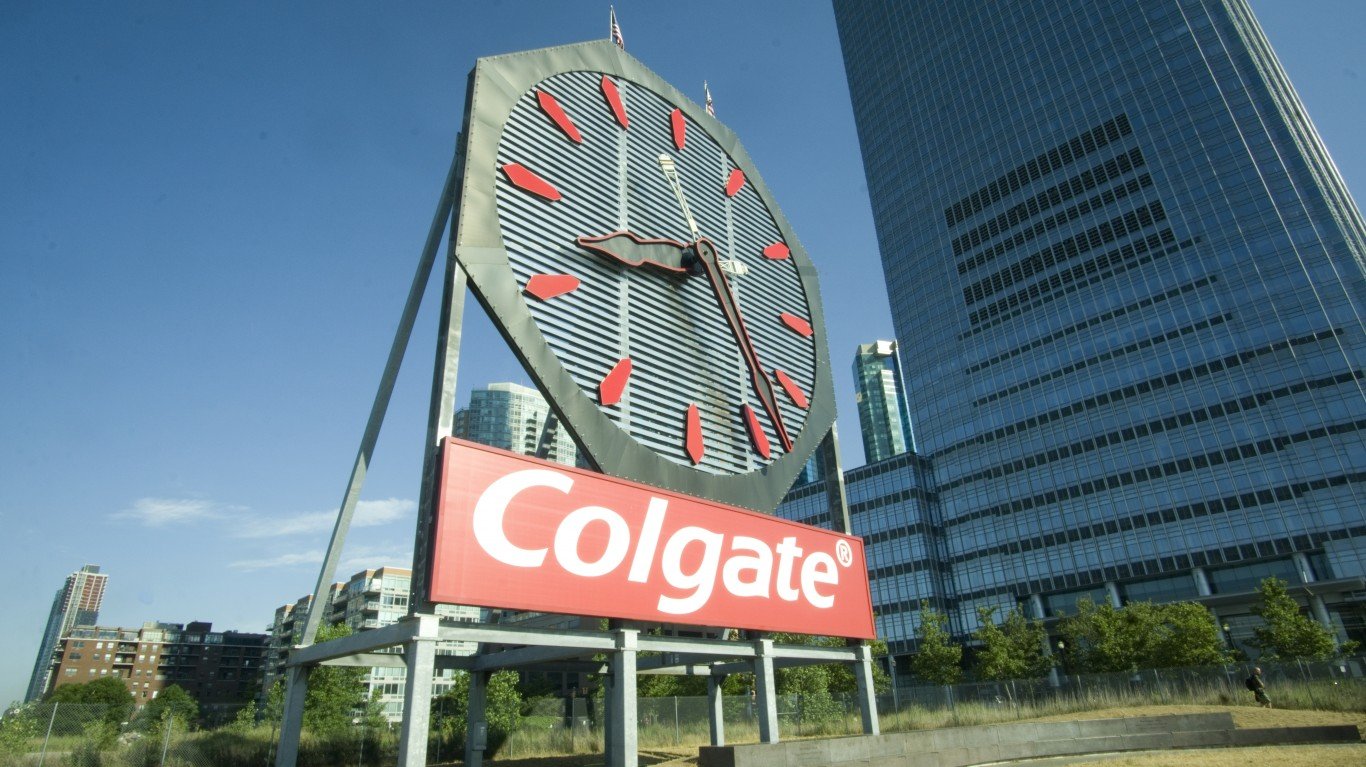
Colgate-Palmolive: Toothpaste, Soap, and Pet Food
Colgate-Palmolive (NYSE:CL) sells oral care, personal care, home care, and pet nutrition under Colgate, Palmolive, Speed Stick, Softsoap, Fabuloso, Irish Spring, Tom’s of Maine, and Hill’s Science Diet. Toothpaste is the archetypal recession-resistant purchase: people do not skip it when equities fall. Colgate held global category leadership in toothpaste through the 2001 dot-com decline, the 2008-2009 financial crisis, and the 2020 pandemic shock, and it kept raising the dividend through each. On the Q2 call, management framed it directly: “I think it speaks to the resilience of our model.”
Pricing power shows up in the gross margin. In Q2 2026, gross margin expanded 140 bps to 61.5%, with advertising rising 15% to $777 million. Management attributed the result to revenue growth management and promo AI tools deployed globally: “Pricing is in the P&L. We’ll watch inflation carefully.” Dividend records in the source data extend from 1999-01-22 through 2026-07-20, with recent per-share payments rising from 0.48 in 2023 to 0.5 in 2024, 0.52 in 2025, and 0.53 in 2026. Beta sits at 0.327.
Risk: North America organic sales declined 3.0%, SGPP restructuring charges were $129 million in Q2, and tariff exposure is a live variable. Category volumes remain, in the CFO’s phrasing, “still below historical numbers.”
3M: Industrial Adhesives, Abrasives, and Specified Materials
3M (NYSE:MMM) is an industrial conglomerate whose customers cannot easily switch out specified products. When a tape, abrasive, or connector is designed into an automotive line, a semiconductor fab, or an aerospace assembly, replacing it requires a full qualification project. The company sells into Safety and Industrial, Transportation and Electronics, and Consumer segments, and its diversification carried it through the 2001 industrial slowdown, the 2008-2009 collapse in global manufacturing, and the 2020 shutdown period. CEO Bill Brown framed the current operating base plainly on the Q2 call: “We delivered strong performance in Q2, including organic growth of 5.4%, operating margin of 24.9%, up 40 basis points, earnings per share of $2.40, up 11%, and free cash flow of $1.3 billion with 107% conversion.”
Dividend continuity requires a caveat. The Solventum spinoff in 2024 broke the pre-existing streak: the regular listed quarterly dividend fell from 1.51 in February 2024 to 0.70 later that year, alongside a separate 17.3875 special distribution with an ex-dividend date of 2024-04-01. Post-spinoff, 3M has resumed increases: the quarterly amount moved to 0.73 in November 2025 and 0.78 beginning in February 2026, with the most recent ex-dividend date of 2026-08-24. The long consecutive-increase streak has reset; the business itself, and its long record of regular quarterly payment, has not. FY2026 adjusted EPS guidance stands at $8.80 to $8.95, with adjusted free cash flow guided to $4.7 billion to $4.9 billion.
Risk: Ongoing PFAS litigation, Combat Arms Earplugs, and respirator mask and asbestos litigation remain material overhangs. The Consumer segment declined 1.8% organically, and tariff and transformation execution risks are real.
Boring, Stated Plainly
Each of these is a long-duration holding, selling something households or industrial customers keep buying when the cycle turns. The dividend records are long (we ranked ten companies with 50-plus-year raise streaks by valuation in a free Dividend Kings report), the operating margins are stable, and the customers do not migrate easily. For readers building a durable core rather than chasing a quarter, that is the point of holding them.
Contact [email protected] for any questions or corrections.
Joel South covers large-cap stocks, dividend investing, and major market trends, with a focus on earnings analysis, valuation, and turning complex data into actionable insights for investors.
He brings more than 15 years of experience as an investor and financial journalist, including 12 years at The Motley Fool, where he served as an investment analyst, Bureau Chief, and later led the Fool.com investing news desk. He has also co-hosted an investing podcast and appeared across TV and radio discussing market trends.