Arm’s CEO Says Demand Is ‘Off the Charts.’ The Problem Is Nobody Can Build Chips Fast Enough
Arm's CEO says order books are overflowing and demand has never been stronger, yet the company keeps missing its own targets. Whether that gap points to a broken supply chain or a broken story changes everything for investors holding a…


Shares of Arm (NASDAQ:ARM | ARM Price Prediction) trade at $243.98, down 10.11% over the past month and 7.66% in the last week, yet still up 123.2% year to date.
The pullback across AI chip names reflects market concerns about softening demand from frontier labs. CEO Rene Haas argues the opposite: order books are full and growing, and near-term revenue growth is capped by how quickly the global chip supply chain can produce silicon. A demand slowdown and a manufacturing bottleneck produce different stock outcomes even when both cause missed quarters.
If Haas is right, the drawdown is a buying window into a company whose data center royalty stream compounds at triple-digit rates. If he is wrong, an investor pays a trailing P/E near 247x for a story that has begun to break.

Demand Breadth Across Edge, Auto, Robotics and Data Center
Haas insisted no single end market carries the company, citing edge, automotive, robotics and data center all running at record strength. Robotics matters more than it sounds. A humanoid or industrial machine ships with many Arm CPUs rather than one, because sensing, control and actuation each demand their own compute silicon, multiplying royalty units per unit shipped.
Data center is already visible in the numbers. Data-center royalty revenue more than doubled year over year last quarter, and the most recent 500 million Neoverse cores shipped in the last nine months after the first billion took six years.
Why a Multi-Stage Bottleneck Keeps Revenue Capped
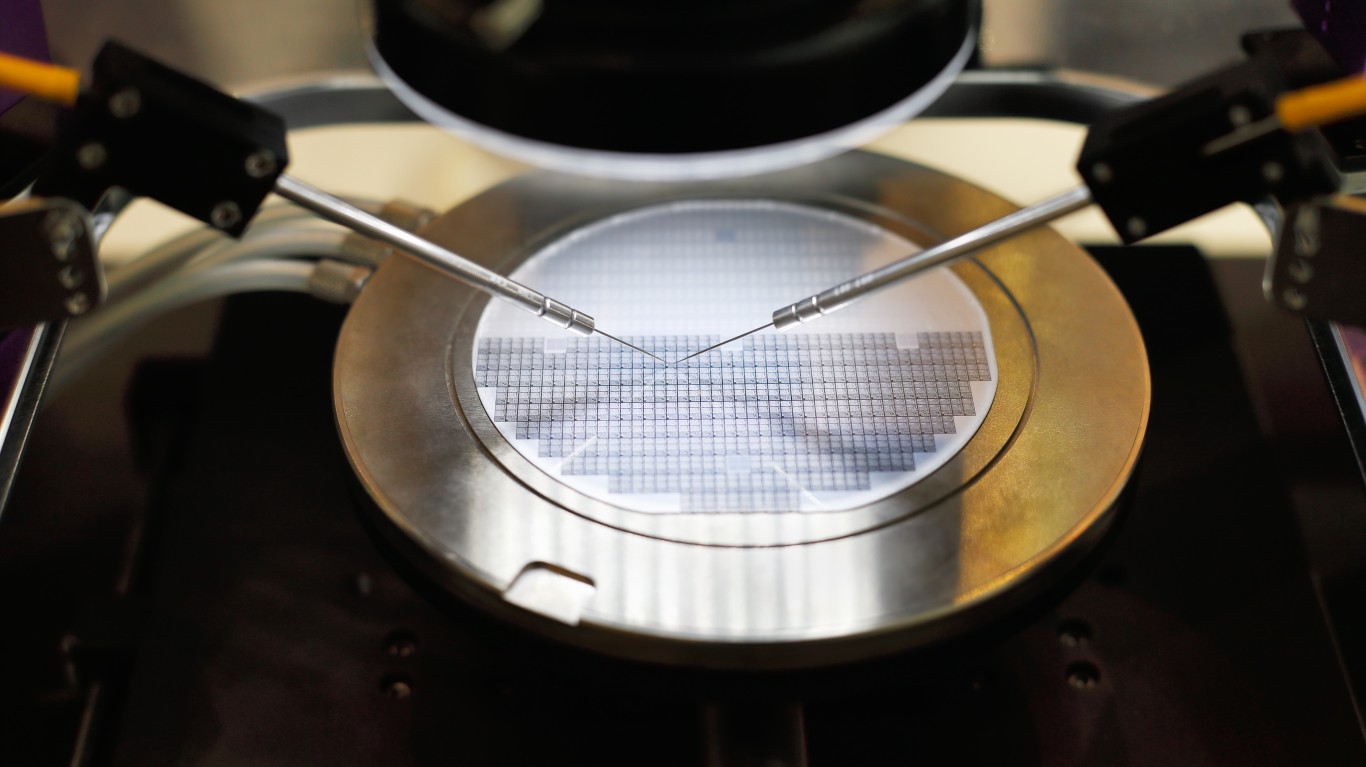
Haas described the constraint as spread across wafers, substrates, testers, and memory rather than sitting at any single node. A multi-stage bottleneck is harder to fix because expanding one stage does not release throughput until every other stage catches up.
That keeps pricing firm because customers cannot easily source substitute capacity. It also caps how fast Arm converts its order book into recognized royalty and silicon revenue, since chips that do not exist generate no royalties.
Arm has secured the manufacturing capacity needed to support the $1 billion opportunity for its AGI CPU and is working with partners to expand further, according to Arm Holdings. Haas said the market is “very, very tight” across memory, test equipment, substrates and TSMC wafers.
Guidance Round Trip and Pivot to Data Center Silicon
Rene Haas earlier cut the AGI CPU target to $1 billion amid foundry capacity worries. On CNBC this week, he said his confidence in achieving the $2 billion target had risen from May to July and again from July to September.
Pair that with his claim that “data center is going to be our largest business”. For a company built on smartphone royalties, that pivot changes customer concentration, deal size, and margin trajectory.
The AGI CPU is Arm’s first in-house data center chip with a different margin profile than pure IP licensing. Management guided first-generation gross margin in the high 30% range to low 40s, with a path to 50% over the next couple of years, well below core royalty margins, meaning silicon revenue will initially dilute reported profitability even as it grows the top line.

Bull and Bear Case for ARM Stock
The bull case rests on demand breadth and secular share gains. IDC reported spending on Arm-based accelerated server platforms has nearly doubled in the past two quarters and surpassed x86, and hyperscaler design wins at NVIDIA (NASDAQ:NVDA), Google (NASDAQ:GOOG, NASDAQ:GOOGL), AWS and Microsoft (NASDAQ:MSFT) lock in multi-year royalty streams. Analysts carry an average target of $288.70.
The bear case is that a chief executive describing his own demand has an obvious interest in the story, and “supply constrained” is the most flattering explanation for revenue that arrives later than promised. Q1 FY2027 EPS of $0.25 missed the $0.40 estimate, and operating margin compressed to 7% from 11%.

The test is clean. If Arm ships silicon by the end of calendar year 2026 and the AGI CPU line clears the $2 billion mark across fiscal 2027 and fiscal 2028, Haas is right; if shipments slip or the number gets walked back again, the bear wins.
Contact [email protected] for any questions or corrections.
Omor Ibne Ehsan is a writer at 24/7 Wall St. He is a self-taught investor with a focus on growth, cyclical, and dividend equities that have strong fundamentals, value, and long-term potential. He also has an interest in high-risk, high-reward investments such as penny stocks.