AI Infrastructure Spending Is Set to Hit $1.4 Trillion by 2030. These Are the 3 Chip Stocks Positioned to Capture It.
JPMorgan sees AI infrastructure spending surging toward a figure that would reshape entire markets, and the companies capable of manufacturing and designing the chips at that buildout's core fit on one hand. Three names sit at the chokepoint, and their…


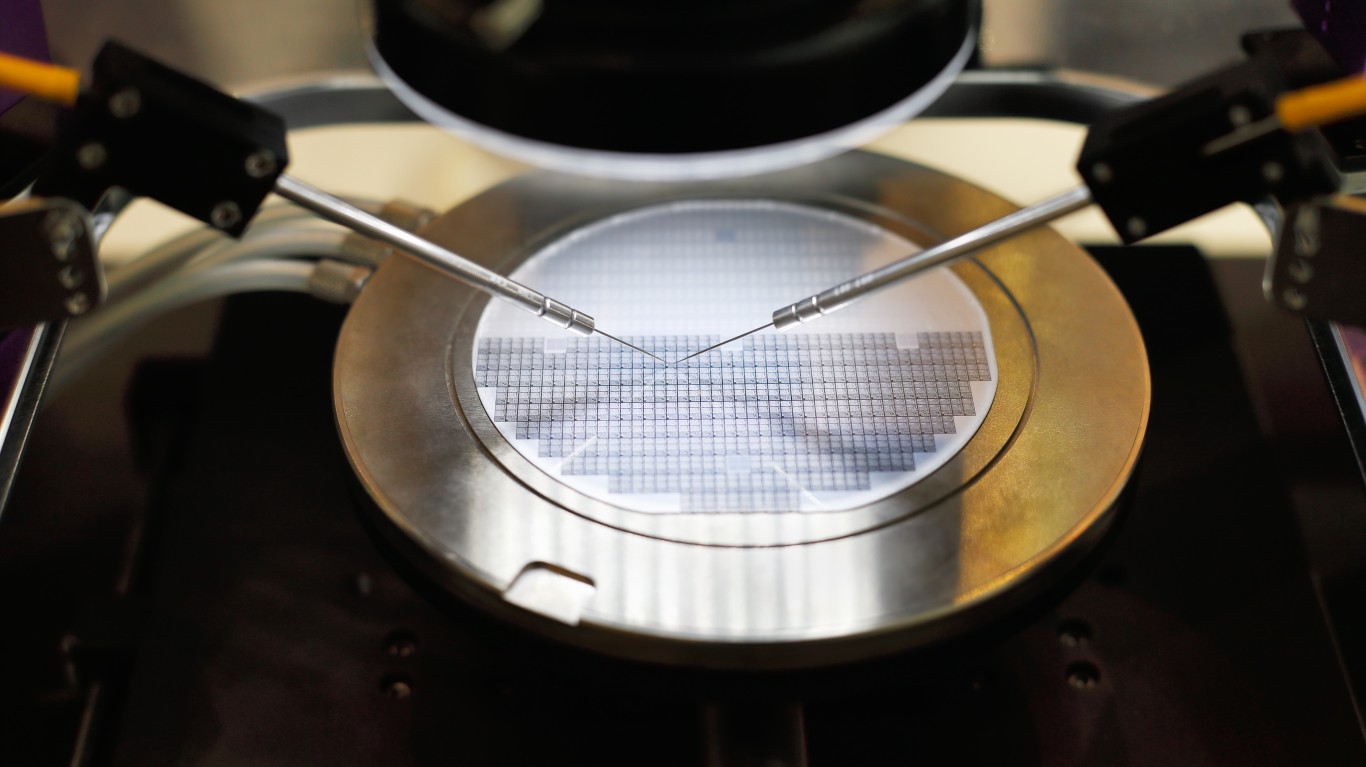
The silicon layer is where the AI buildout begins and where the bottleneck is tightest. JPMorgan projects annual AI infrastructure spending will reach $1.4 trillion by 2030, and the chips at the heart of that spend come from a small group of designers and one indispensable manufacturer. NVIDIA’s own CFO commentary underlines the constraint: management characterized the outlook as supply-constrained and expects supply to remain a bottleneck at least through the end of fiscal 2028. Three US-listed names capture the economics of that supply chain, and their most recent quarters make the setup concrete.
NVIDIA: Merchant GPU Standard Riding the Vera Rubin Ramp
NVIDIA (NASDAQ:NVDA | NVDA Price Prediction) designs the accelerators that train and run the largest AI models. In plain language, NVIDIA sells the compute engine, plus the switching fabric that connects thousands of those engines into an AI factory. The company outsources manufacturing, handing designs to Taiwan Semiconductor.
The August 26 report was the tell. Q2 FY27 revenue reached $96.22 billion, up 105.85% year over year, with data center revenue of $89.02 billion growing 117%. Non-GAAP EPS of $2.22 beat the $2.0887 consensus by 6.29%, and Q3 revenue guidance came in at $108.0 billion plus or minus 2%, excluding any data center compute revenue from China. Management said Vera Rubin commenced production shipments earlier this month and expects it to mark the fastest product ramp in NVIDIA’s history.
The bull case is simple. Content per gigawatt is expanding as fast as the number of gigawatts being built. NVIDIA cited roughly $18 billion per gigawatt on Hopper, $25 billion on Blackwell, and $40 billion on Vera Rubin. The top five hyperscalers are guided toward nearly $800 billion in capex in 2026 and $1.3 trillion in 2027, and NVIDIA expects to grow revenue approximately 70% in fiscal 2028 with unconstrained demand described as “a lot higher.” Shares are up 14.49% over the past month and 16.79% year to date, closing at $217.55 on August 28.
The risk is concentration and execution. Supply commitments surged to $279 billion, largely tied to memory procurement for Vera Rubin, and China contributed less than 1% of data center revenue in Q2 with no China data center compute revenue in the forward outlook. A slower Vera Rubin ramp or a memory hiccup would leave a lot of committed capital exposed.
Taiwan Semiconductor: Foundry Monopoly on Leading-Edge Silicon
Taiwan Semiconductor Manufacturing (NYSE:TSM) is the world’s dominant pure-play foundry. TSMC manufactures the designs that NVIDIA, Broadcom, AMD, and Apple hand over. When observers say “leading-edge silicon,” they largely mean wafers coming out of TSMC’s 3nm and 2nm nodes. Every AI chip designer in this article depends on it.
Q2 was a demonstration of pricing power. Revenue reached $40.20 billion with a 67.7% gross margin, diluted EPS of $4.31 beat the $3.8866 consensus by 10.89%, and technologies at 7nm and below accounted for 77% of wafer revenue, with 3nm at 30% and 2nm at 3% in its first commercial quarter. Guidance was equally aggressive: Q3 revenue of $44.6 billion to $45.8 billion and full-year 2026 revenue growth slightly above 40% in US dollar terms.
The bull case is structural scarcity. CEO C.C. Wei said conviction in the multi-year AI megatrend “remains very high” and that demand should stay strong through 2029 and 2030. TSMC raised its 2026 capital budget to $60 billion to $64 billion and said the next three years of capex will be “even more significantly higher than the past three years.” Total planned Arizona investment now sits at $265 billion following an additional $100 billion commitment. Shares have responded, up 38.08% year to date and 77.12% over the past year through August 28, and the average analyst target sits at $554.45.
The risks are two-sided. Geopolitics around Taiwan is the obvious tail, and near-term margin compression is the near-term one: management expects the 2nm ramp to dilute gross margin by about 3 to 4 percentage points in the second half of 2026, with overseas fabs adding another 2% to 3% of dilution in the early stages.
Broadcom: Custom Accelerator Alternative and AI Networking Backbone
Broadcom (NASDAQ:AVGO) plays two roles the merchant-GPU story does not cover. It designs custom AI accelerators (XPUs, essentially bespoke chips) for hyperscalers that want an alternative to NVIDIA’s GPUs, and it sells the Ethernet switching silicon that stitches those clusters together. When a hyperscaler wants its own chip instead of an off-the-shelf GPU, Broadcom is typically the design partner.
The Q2 FY26 earnings report confirmed the trajectory. Revenue reached a record $22.19 billion, up 47.87% year over year, with AI semiconductor revenue of $10.80 billion growing 143%. Adjusted EBITDA margin came in at 69% of revenue, and free cash flow of $10.262 billion represented 46% of revenue. CEO Hock Tan said Q2 AI semiconductor bookings exceeded $30 billion against $10.8 billion shipped, and Q3 guidance calls for AI semiconductor revenue of $16.0 billion, up over 200% year over year.
The bull case rests on visibility. Broadcom disclosed a contractual OpenAI commitment for 1.3 gigawatts in 2027 within a broader 10 gigawatt agreement targeted by 2029, a Meta MTIA deal contemplating 3 gigawatts through 2028, and an Anthropic arrangement enabling access to 5 gigawatts of next-generation TPU-based compute beginning in 2027. Tan said visibility now runs to 2028 and called demand for XPUs and networking “simply insatiable.” Forward P/E sits at 20, and shares closed at $368.79 on August 28, up 20.36% over the past year.
The risk is customer concentration. Broadcom’s AI revenue leans on a handful of hyperscaler programs, and Tan acknowledged Google may use “diversity of sources” as AI compute consumption grows. Lose a socket at one of six customers and the growth math bends quickly.
Where This Leaves Investors
These three names sit at different points of the same value chain: NVIDIA designs the standard, Broadcom designs the custom alternative and the networking silicon around both, and Taiwan Semiconductor manufactures for all of them. All three are mega-cap blue chips, so the risk profile is homogenous. The forward setup rests on hyperscaler and frontier-lab capex holding up through 2027 and 2028, and current bookings, backlog, and capacity commitments say it is. Watch Vera Rubin yield, 2nm dilution at TSMC, and Broadcom’s Q3 earnings report for the next confirmation. Chips are only half the buildout, of course; the power, cooling, and networking suppliers behind the data centers are the other half, and we profiled seven of them in a free report on the AI boom beyond the chipmakers.
Contact [email protected] for any questions or corrections.
Joel South covers large-cap stocks, dividend investing, and major market trends, with a focus on earnings analysis, valuation, and turning complex data into actionable insights for investors.
He brings more than 15 years of experience as an investor and financial journalist, including 12 years at The Motley Fool, where he served as an investment analyst, Bureau Chief, and later led the Fool.com investing news desk. He has also co-hosted an investing podcast and appeared across TV and radio discussing market trends.