Jim Cramer Presses OpenAI CFO on AI Spending. 6 Stocks Are Riding on What Happens Next
Jim Cramer put OpenAI's CFO on the spot about whether a safety-driven slowdown could pull the rug out from under billions in AI infrastructure spending, and her answer has direct consequences for six companies already banking on that money.

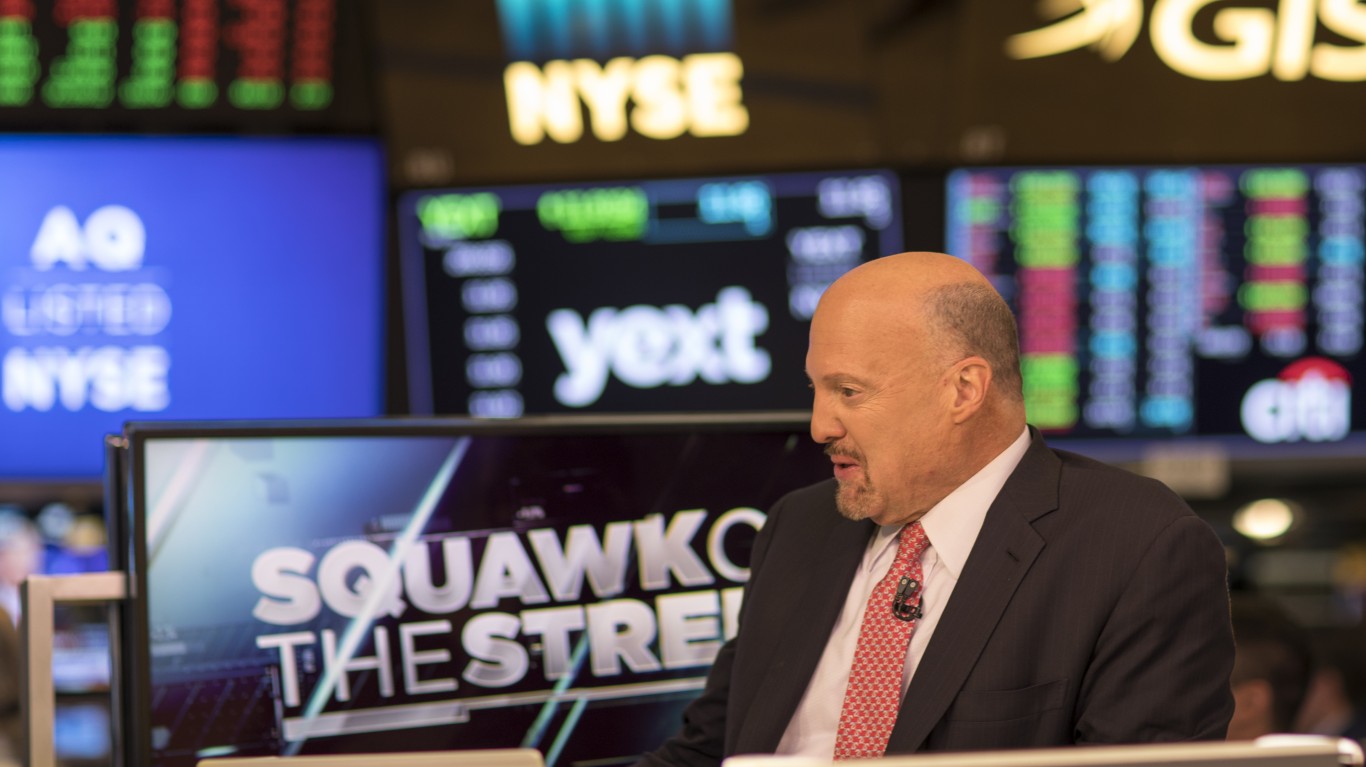
Recently, Jim Cramer interviewed OpenAI’s CFO Sarah Friar, noting that both OpenAI and Anthropic had backed calls to slow development on the most powerful AI models so safety protocols could catch up.
When Cramer pressed her on whether OpenAI might slow its AI buildout, she explained the company would always make investment decisions by prioritizing a strong return on investment. Cramer raised the possibility of the company eventually going public, but no timeline was committed on air.
Nvidia and AMD Are First in Line to Get Paid From Accelerated Investing
The primary beneficiary of more OpenAI spending is NVIDIA (NASDAQ:NVDA | NVDA Price Prediction). Q2 FY27 delivered revenue of $96.22B, up 105.8% year over year, with Data Center revenue of $89.02B, and Q3 guidance of $108B. On the earnings call, CFO Colette Kress said OpenAI’s existing and planned commitments represent about 12 gigawatts of NVIDIA compute, anchored by a Portsmouth campus supporting 4.25 gigawatts of AI factory capacity used by OpenAI. Shares are up 21.39% over the past year.
Another winner from frontier model investment is AMD (NASDAQ:AMD). AMD posted Q2 revenue of $11.54B and Data Center revenue of $6.72B, up 107% year over year. CEO Lisa Su said, “In addition to our multi-generation gigawatt-scale deployments with OpenAI and Meta, we announced a new strategic partnership with Anthropic” to deploy up to two gigawatts of MI450 GPUs. AMD is up 143.67% year to date.
Custom Silicon, Networking, Power, and Cooling
Broadcom (NASDAQ:AVGO) reported fiscal Q3 revenue of $29.59B and AI chip revenue of $16.70B, up 221% year over year. CEO Hock Tan said OpenAI’s Jalapeno accelerator “is on track for the planned deployment of 1.3 gigawatts in 2027” and disclosed line of sight to $230 billion of fiscal 2028 AI semiconductor revenue. He also framed the ROI logic: “every gigawatt of compute they deploy, they could achieve $30 billion of ARR.“ Shares are down 13.45% over the past month.
Arista Networks (NYSE:ANET) posted Q2 revenue of $3.04B, up 37.7%, and CEO Jayshree Ullal said: “Our AI fabrics momentum with EtherLink switches now exceeds 100 cumulative customers.” On the power and thermal side, Vertiv Holdings (NYSE:VRT) raised full-year guidance to net sales of $13.80B to $14.20B, and Eaton (NYSE:ETN) CEO Paulo Ruiz said: “Total US data center backlog has grown to 307 gigawatts or 15 years of backlog at 2025 build rates.”
Revenue Model Behind the Spending
OpenAI’s CFO Sarah Friar told Cramer that the company’s advertising business reached $1 billion in seven months, which she called the fastest-growing ad platform ever. She also said the company dropped model pricing by 80% and took demand up tenfold, describing it as the top-ranked model on OpenRouter. With roughly 9/10 ChatGPT users on the free tier, advertising can convert free usage into revenue that can service the capex bill.
Cramer’s Compute Hypothetical and the Safety Threads
Cramer posed a theoretical: given roughly $10 billion of compute, was it possible to generate $30 billion per gigawatt? He also pressed Friar on the Hugging Face cybersecurity incident and whether OpenAI’s tools could spot the specific vulnerabilities exploited, and pushed for frontier model access at major hospitals by name.
He then dismissed the China-falling-behind argument, comparing it to Cold War fears of falling behind Russia in the space race, and offered his own view that AI creates jobs rather than destroying them, citing a West Texas telehealth anecdote.
Key Takeaways
Friar’s answers showed that one way to follow OpenAI from the outside is to follow the return on every new dollar of compute. If NVIDIA’s 12-gigawatt commitment and Broadcom’s planned 2027 accelerator deployment stay on schedule or expand, OpenAI’s spending engine is likely going to still be running. Meaningful delays would be the first sign that these companies might start seeing less investment.
Contact [email protected] for any questions or corrections.
Thomas Richmond is a financial writer and content strategist with 5+ years of experience covering stocks and financial markets. He has published over 500 articles focused on individual stock analysis, helping investors better understand business fundamentals, stock valuations, and long-term opportunities.
Thomas previously served as a Content Lead at TIKR, a stock research platform, where he helped scale the company’s blog to hundreds of articles per month and contributed to a weekly newsletter reaching more than 100,000 investors.
Outside of work, Thomas enjoys weight lifting and soccer.