SpaceX, OpenAI, and Anthropic Are Worth More Than Every Single IPO in the Last 45 Years
Three private and newly public companies tied to artificial intelligence now carry a combined valuation that dwarfs decades of tech history, and the profitability math behind those numbers raises serious questions about where the money actually comes from.


The technology market has entered a period where a handful of companies can command valuations that once required an entire industry. The latest example puts today’s AI boom into extraordinary perspective: three companies associated with the technology are collectively valued at more than the combined first-day market value of thousands of U.S. technology IPOs spanning 45 years.
That comparison isn’t perfectly apples-to-apples. But it is still useful because it shows just how much capital investors are willing to place behind the possibility that artificial intelligence will become one of the most valuable technologies in history.
Three Companies, $5.2 Trillion
SpaceX (NASDAQ:SPCX | SPCX Price Prediction) currently carries a market capitalization of almost $2.1 trillion following its June IPO. The space, AI, and technology company raised $85.7 billion in the offering and finished its first trading day with a market cap similar to its valuation today..
Privately held OpenAI is discussing a new funding round at a valuation of roughly $1.2 trillion, according to Bloomberg. That’s up from the $852 billion valuation attached to its March financing. It recently put its planned IPO on hold after the market began looking askance at the valuations of AI-forward companies.
Finally, privately held Anthropic is reportedly targeting a valuation of about $2 trillion for a potential IPO now anticipated in November (pushed back from an expected October debut).
This chart was put out by the Willett Advisors investment firm’s CEO, Steve Rattner:
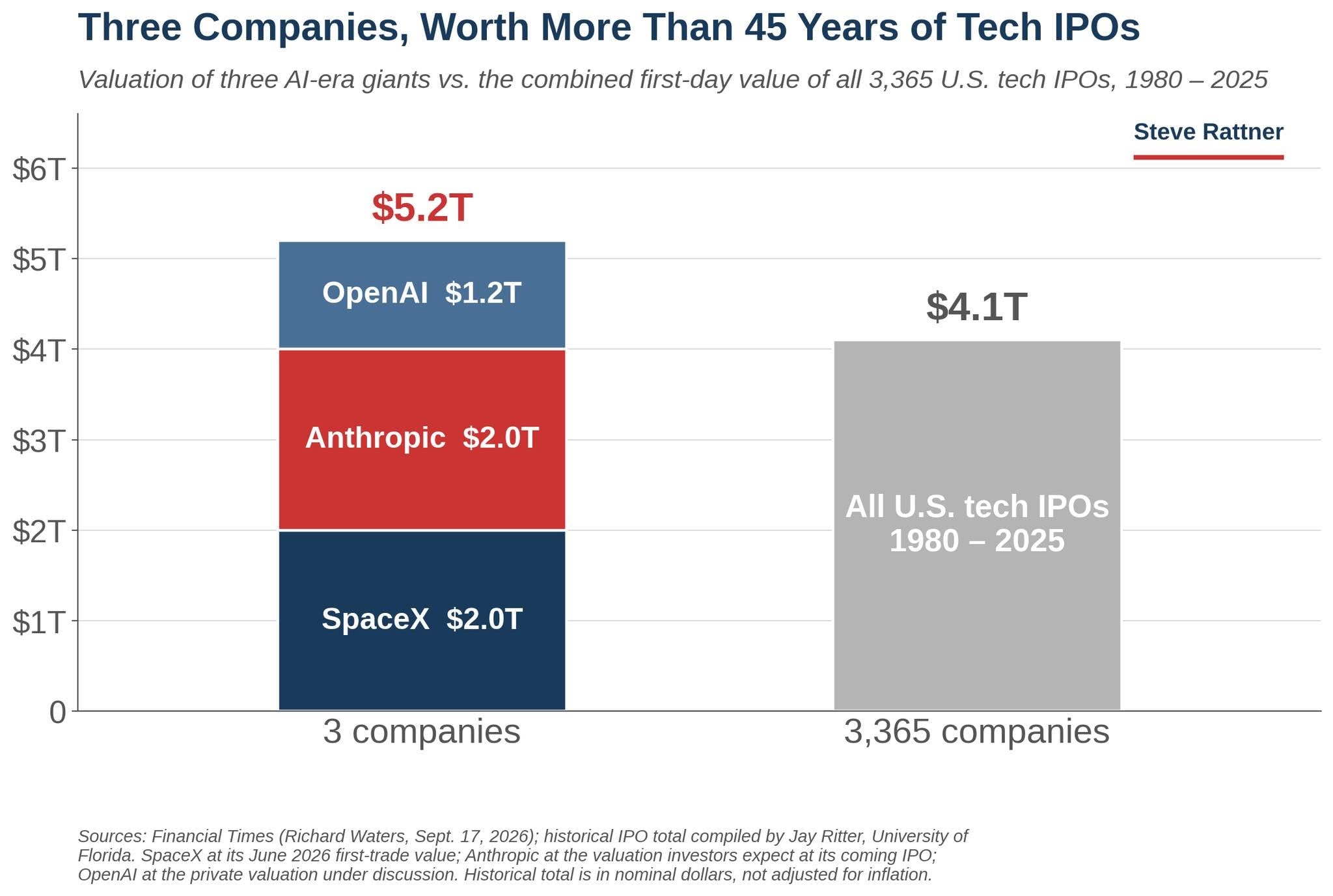
I shows the insane valuations being attached to the leading AI stocks compared to the combined first-day market value of 3,365 U.S. technology IPOs from 1980 through 2025 at $4.07 trillion, as compiled by University of Florida professor Jay Ritter. It is a jaw-dropping comparison that pits just three companies against 3,365.
The Valuations Come With a Very Large Asterisk
Yet, it is important not to confuse a fun comparison with an investment metric. Ritter’s historical figures are nominal dollars and represent companies’ market values at their trading prices on the first day following their public debut. SpaceX has a live public-market valuation, while OpenAI’s $1.2 trillion figure is a proposed private financing valuation, and Anthropic’s $2 trillion number is a prospective IPO target.
More importantly, the businesses don’t have comparable financial profiles. OpenAI, for example, projects $278 billion of negative free cash flow from 2026 through 2030, according to the Financial Times. Revenue is forecast to rise from $36 billion in 2026 to $350 billion in 2030, but the company expects to spend about $856 billion on computing infrastructure during that period.
Anthropic faces a similar challenge. The Information reported that it expects revenue to reach as much as $18 billion this year and $55 billion in 2027, but it has pushed back its expected transition to positive cash flow until 2028.
That makes the $5.2 trillion figure less a measure of today’s profits than a bet on tomorrow’s economics.
The AI Bubble Question Gets Harder to Ignore
Ironically, that’s what makes this comparison useful for investors. The market isn’t simply valuing existing earnings. It’s capitalizing enormous expectations for future revenue, margins, and technological breakthroughs.
Yet Apollo Global Management’s chief economist Torsten Slok notes that major technology companies could need to triple their cash flow by 2030 to sustain the industry’s AI infrastructure spending. “If this doesn’t happen, then the risk is that the AI trade weakens, with credit spreads widening, capex plans getting cut and ultimately US GDP growth slowing,” he wrote to clients.
In short, investors are being asked to believe that AI’s future cash generation will eventually catch up with today’s capital requirements.
Key Takeaway
The $5.2 trillion comparison is not proof that AI is a bubble. It is proof that expectations have become enormous.
Smart investors should separate the technology’s potential from the price being paid for it. A revolutionary technology can create extraordinary businesses while investors can still overpay for them. With OpenAI projecting $278 billion in negative free cash flow through 2030 and Anthropic delaying positive cash flow until 2028, profitability remains the number worth watching as these valuations move from private markets to public scrutiny.
Contact [email protected] for any questions or corrections.
After two decades of patrolling the dark corners of suburbia as a police officer, Rich Duprey hung up his badge and gun to begin writing full time about stocks and investing. For the past 20 years, he’s been cruising the markets looking for companies to lock up as long-term holdings in a portfolio while writing extensively on the broad sectors of consumer goods, technology, and industrials. Because his experience isn’t from the typical financial analyst track, Rich is able to break down complex topics into understandable and useful action points for the average investor. His writings have appeared on The Motley Fool, InvestorPlace, Yahoo! Finance, Money Morning, and, of course, 24/7 Wall St. He has been featured in both U.S. and international publications, including MarketWatch, Financial Times, Forbes, Fast Company, and USA Today.