Bank of America Just Cut Its Price Target on UPS
Amazon volume fell faster than Bank of America expected at the end of Q2, and the timing matters more than the price target cut itself. Here is what the numbers reveal about whether UPS can shrink its way to profitability…


Correction: An earlier version of this article said Bank of America downgraded UPS to Sell this week over the end of the de minimis exemption. That downgrade occurred in September 2025. This week, BofA maintained its Neutral rating and lowered its price target to $108 from $115, citing weaker Amazon volumes. The article has been updated.
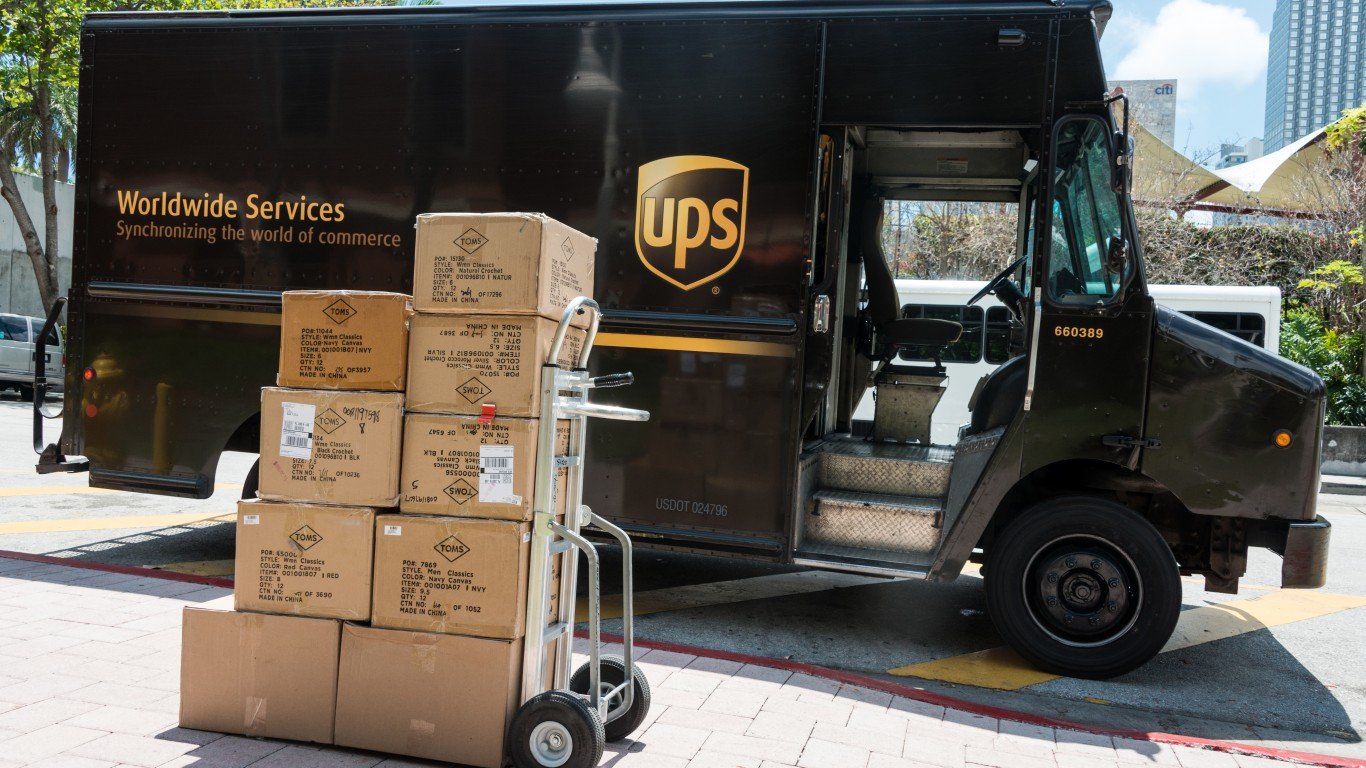
Bank of America (NYSE:BAC | BAC Price Prediction) kept its Neutral rating on United Parcel Service (NYSE:UPS) this week but cut its price target to $108 from $115, after Amazon volumes fell faster than expected at the end of the second quarter. Analyst Ken Hoexter now expects UPS’s domestic volume to decline by a mid-single-digit percentage in the second half of 2026 and trimmed his 2026 revenue estimate to $91.3 billion.
Goldman Sachs took the other side, raising its target to $132 and keeping a Buy rating.
What BofA Is Actually Worried About
BofA’s concern this week is volume, not regulation. UPS has been deliberately shrinking its Amazon business, but BofA says the drop at the end of the second quarter came more abruptly than it expected. The bank cut its third-quarter 2026 revenue estimate to $22.4 billion from $23.2 billion and trimmed its EPS estimates by 2% to 4%.
That differs from the last time BofA turned cautious on UPS. In September 2025, the bank briefly moved the stock to Underperform, arguing that the end of the U.S. de minimis exemption would hit the carrier’s low-value import lanes. A year later, that problem has faded. UPS’s Q2 2026 slides show the China-to-U.S. lane back to year-over-year volume growth.
Where the Cost Pressure Actually Comes From
Losing volume matters because UPS runs a high fixed-cost network. Fewer packages mean each one carries more of the cost of trucks, hubs, and labor.
UPS already runs hot on the cost line. According to its Q2 2026 earnings release, U.S. Domestic non-GAAP adjusted cost per piece rose 8.7% year over year to $13.21 in the first half. In the second quarter alone, fuel expense jumped 60.4% and purchased transportation climbed 26.4%. Shrinking the package count on top of that base squeezes margins from both sides.
GAAP operating profit fell 48.96% to $930 million in Q2, weighed down by $1.172 billion in transformation charges as UPS closes buildings and reshapes the network around its smaller Amazon business. On an adjusted basis, operating profit rose to $2.10 billion from $1.88 billion, which shows the restructuring is working, but it is costly.

Rotation Around the Target Cut
The same trading session that took UPS lower saw Advanced Micro Devices (NASDAQ:AMD) and Arm Holdings (NASDAQ:ARM) jump on bets that AI agents will drive a new wave of CPU demand. Capital paid up for a semiconductor demand story while selling an industrial cash flow story.
The long-horizon record is telling investors something different.
A company with a genuine network moat, trading at 17x trailing earnings and a 6.92% dividend yield, that sits 35.48% below its price from five years ago signals the market has priced in serial disappointment.
UPS guides to about $5.4 billion in 2026 dividends against expected free cash flow of about $5.5 billion. That leaves almost no cushion if domestic volume falls further than planned, the kind of thin coverage our free guide on the warning signs behind a big yield was written for.
The bull retort is that pricing has held up. International revenue per piece rose 18.9% in Q2, though UPS’s slides show a little more than half of that came from fuel surcharges. Fuel still cost the International segment 120 basis points of margin, so surcharges have not fully covered the jump in fuel prices.
Bull and Bear Case for UPS Stock

The bull case rests on an irreplaceable integrated network, a revenue mix shifting toward higher-value work, and a stock already discounted by years of underperformance. Healthcare revenue topped $3 billion for the second straight quarter, and management raised full-year guidance in July.
Full-year guidance calls for roughly $91.2 billion in revenue and $7.22 in adjusted EPS, putting the forward multiple near 13x. Analyst consensus target is $115.81.

The bear case is that volume is leaving faster than costs can come out, arriving while capital rewards semiconductors instead of industrial throughput. Cash and equivalents fell to $4.653 billion at the end of June from $5.887 billion at the end of 2025.
The key question is whether UPS can cut costs as fast as Amazon volume declines. Watch U.S. Domestic average daily volume and cost per piece in the third-quarter report for the answer.
Contact [email protected] for any questions or corrections.
Omor Ibne Ehsan is a writer at 24/7 Wall St. He is a self-taught investor with a focus on growth, cyclical, and dividend equities that have strong fundamentals, value, and long-term potential. He also has an interest in high-risk, high-reward investments such as penny stocks.