Forget SCHD’s Home Bias: Schwab’s International Fund Charges 0.08% and Nearly Matched It Over Five Years
SCHD has become the default dividend ETF for American investors, but Schwab runs a similar fund built entirely from foreign companies at a rock-bottom cost. Whether it belongs in your portfolio depends on a performance gap that cuts both ways.

This post may contain links from our sponsors and affiliates, and Flywheel Publishing may receive compensation for actions taken through them.

Many income investors ground their portfolios with the Schwab U.S. Dividend Equity ETF (NYSEARCA:SCHD), and the record explains why. SCHD owns established American dividend payers and returned 58.58% over five years. Every dollar inside SCHD, however, rides on American companies. That said, Schwab runs a sister fund.
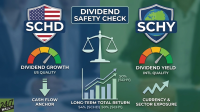
It is the Schwab International Dividend Equity ETF (NYSEARCA:SCHY), which applies a similar dividend focus to markets outside the U.S. and charges an expense ratio of 0.08%. Over a five-year window that starts on October 13, 2021, for both funds, SCHY returned 56.02%. That leaves it just 2.56 points behind SCHD, even though the two funds own a completely different set of companies.
All returns in this article assume distributions were reinvested. In delayed quotes from Tuesday afternoon, October 13, 2026, SCHD traded at $33.37 and SCHY at $32.05.
Two Rosters With No Overlap Make the Diversification Case
The two filings dated May 31, 2026 show what each fund owns. SCHD’s largest reported position was Qualcomm (NASDAQ:QCOM | QCOM Price Prediction) at 6.74% of net assets, followed by Texas Instruments (NASDAQ:TXN) at 5.90%. The rest of the top of SCHD’s roster is filled with American healthcare, beverage, energy, and consumer staples names.
In the same May 31, 2026 filings, SCHY’s largest position was BHP Group (NYSE:BHP) at 4.55%. Germany’s Deutsche Post came in at 4.26%, Australian retailer Wesfarmers at 4.26% and German insurance company Allianz at 4.25%. Italian and French energy producers, Swiss drugmakers and Asian telecom carriers fill out the list.
The two reported rosters share no companies. Combining SCHD with SCHY adds dividends from a different set of markets, regulators, and business cycles.
SCHY Has Trailed Badly Over the Past Year
Recent performance runs strongly in SCHD’s favor. Over one year, SCHD returned 30.13% against SCHY’s 19.8%, a gap of 10.33 points. The year-to-date gap is wider still: SCHD is up 24.65% and SCHY 10.41%, putting SCHY 14.24 points behind.
Simply put, SCHY buyers from a year ago have done much worse than SCHD buyers. SCHY’s appeal rests on the five-year near-match. Its recent results do not support it.
Quarterly Payouts That Arrive Unevenly
SCHY pays quarterly. Its most recent distribution was $0.316 per share, with an ex-dividend date of September 23, 2026, and a payment date of September 28, 2026. The June payment was $0.3571 and the March payment $0.1818.
The amounts vary because many companies outside the U.S. pay dividends only once or twice a year. A fund holding them collects cash in lumps. So comparing one quarter with the next says less about SCHY than it would about a domestic fund. A full-year view gives a clearer picture of the payout.
SCHD Dwarfs SCHY in Size
As of May 31, 2026, SCHD reported net assets of $94.94 billion, while SCHY reported $2.27 billion. Differences in size can affect trading costs on very large orders.
Currency Exposure Comes With Every International Fund
SCHY’s holdings are priced in euros, Australian dollars, pounds and other currencies, while the fund reports its value in U.S. dollars. Its returns therefore reflect both the underlying businesses and changes in exchange rates, as currency moves can add to returns or take away from them in any period. That is how every international fund works, and it is part of owning SCHY.
Five Years Is the Longest Fair Comparison
SCHY’s price history begins on April 29, 2021, so it has no ten-year record. The five-year window is close to the longest like-for-like comparison available. Any judgment about SCHY rests on that limited record.
Adding SCHY Without Triggering a Tax Bill
A sale of SCHD in a taxable account can realize capital gains. New contributions, or SCHD’s own distributions, can be directed into SCHY over time. The mix changes without any selling. A partial reallocation within an IRA or 401(k) carries no immediate tax cost. SCHY is structured to complement SCHD rather than replace it.
Who Belongs in SCHY and Who Does Not
SCHY suits SCHD holders whose dividend income comes entirely from American companies and who want a second, independent source of payouts at a low cost. It does not suit investors chasing last year’s winner, needing smooth quarter-to-quarter income, or unwilling to accept currency swings. SCHY functions as a diversification tool. The five-year record tells two stories. It shows that a dividend portfolio built entirely outside the U.S. can keep pace over a full cycle, while the past year shows it can also trail by a wide margin.
Contact [email protected] for any questions or corrections.
Ryne Mauck is an investment writer covering exchange-traded funds, retirement planning, and portfolio strategy. Through his work at 24/7 Wall St. and other investment platforms, including Seeking Alpha, he aims to provide clear, research-driven insights that help investors make more informed decisions while maintaining a long-term approach to investing.
Ryne holds a B.Sc. in Finance and an M.A. in Political Science. He is a formerly registered Municipal Advisor Representative and has passed the Series 50, Series 63, and Series 65 exams. His articles are not intended to be, nor should they be interpreted as, financial advice.