Mastercard Economist Reveals the Uncomfortable Truth Behind Rosy Holiday Sales Numbers
Mastercard's chief economist just projected a blockbuster holiday season, but buried inside her own forecast is a qualifier that changes everything about what those numbers actually mean for the stock.

Mastercard’s (NYSE:MA | MA Price Prediction) chief economist walked into fall with a holiday forecast that reads bullish on the surface and more complicated underneath.
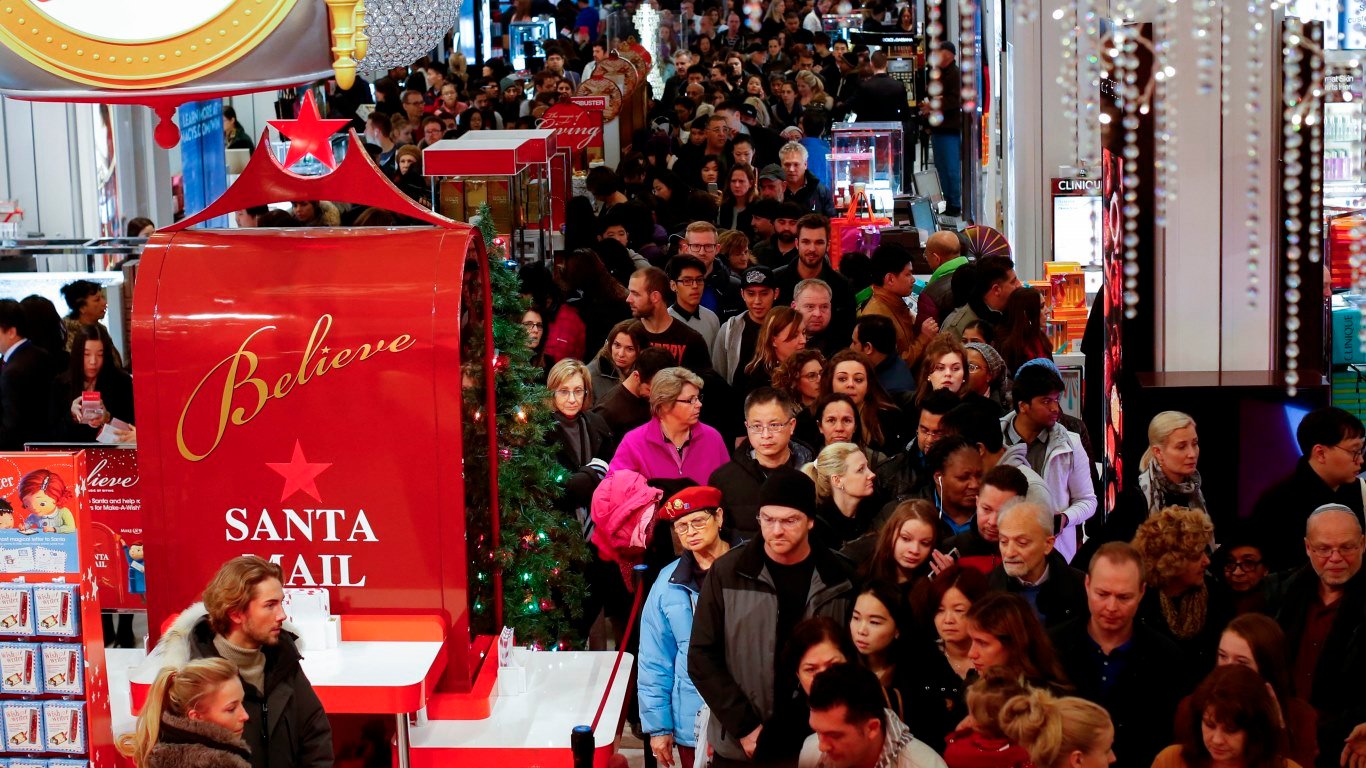
Michelle Meyer projects 5.5% growth in US retail sales across the holiday window she marks from November 1 through Christmas Eve, based on aggregated real-time transaction data from the Mastercard Economics Institute.
Meyer concedes roughly half the growth is inflation, not units. For most companies, that qualifier would sting. For Mastercard, a network that clips a percentage of gross dollar volume, the inflation half spends the same as the volume half.
The stock has gone nowhere for a year, trading at $560.18 after a 6.61% drop over the past month and a 1.10% decline over the past year.
The market may dispute the forecast or worry about something beyond volume.

Why the Split Matters More Than the Headline
A retailer facing equal price and volume growth fights for gross margin. A network that takes a toll on nominal transactions collects on both halves with no incremental effort.
Meyer’s own framing supports the mechanism: “About half of the increase in the holiday spending numbers is due to inflation. Real spending is holding up. We are seeing pretty incredibly powerful growth rates when it comes to actual spending units transactions.”
That showed up in the second quarter. Worldwide gross dollar volume grew 8% while domestic assessments rose 10%, with CFO Sachin Mehra attributing the wedge “primarily driven by pricing.”
Cross-border assessments rose 20% against 12% cross-border volume, again with pricing and mix filling the gap. Nominal dollars run straight into the fee schedule.
A House Economist Forecasting a House-Friendly Season
Meyer runs the Mastercard Economics Institute, so her forecast naturally favors her employer.
The underlying dataset captures what shoppers actually did at checkout, which is stronger than sentiment work, though an interested party still shapes the interpretation.
The Q2 report supports the signal. Revenue grew 14.1% year over year on adjusted EPS of $5.04, beating consensus by 5.66%.

Sentiment Says One Thing, Cards Say Another
The University of Michigan Consumer Sentiment Index sat at 55.2 in July 2026, below the 60 level flagged as recessionary.
Retail sales tell a different story. The August reading of $773.9 billion was the high point of the trailing year, up 1.2% from July.
Meyer credits the labor market: “The strong labor market which we continue to see… The broadening of job growth and that supportive of wages, I think is the most critical factor.”
Card data has beaten sentiment as a spending predictor for several cycles because surveys increasingly measure political mood as much as household finance.
AI Shoppers and the Category Mix
Meyer highlights a wider merchant set among AI power users in restaurants, beauty services and specialty food. That is good for a network paid on relationships and ambiguous for merchants absorbing more comparison shopping.
Category strength in travel, restaurants, and live entertainment points to consumers funding experiences, which tend to be discretionary and cyclical. CPI hit 334.1 in August, up 0.4% in a single month, giving the inflation half of Meyer’s forecast a live tailwind.
Labor breadth can narrow quickly, and payroll dispersion across sectors will show it before the headline unemployment rate moves.
Bull and Bear Case for MA Stock

The bull case is a toll booth on nominal consumption. Mastercard collects on inflation and volume identically, with cross-border volume up 12% and value-added services up 20% in the most recent quarter, stacking three engines onto a holiday tailwind.
Meyer’s summary is the cleanest version of the setup: “Consumers have purchasing power and they are absolutely putting it to work.”
The bear case is that payments multiples already assume a permanently healthy consumer. The stock trades near $560 with a market capitalization around $487 billion, and a 1.39% year-to-date decline suggests investors are pricing in something the transaction feed does not.
Interchange regulation, US merchant-class litigation, and stablecoin disintermediation remain live risks that could compress the take rate even as volumes grow.
The deciding variable is whether real transaction counts keep expanding once the inflation contribution fades. If units grow when prices normalize, the network keeps compounding. If units flatten, the 5.5% headline was a one-cycle gift, according to Mastercard Economics Institute.
Contact [email protected] for any questions or corrections.
Omor Ibne Ehsan is a writer at 24/7 Wall St. He is a self-taught investor with a focus on growth, cyclical, and dividend equities that have strong fundamentals, value, and long-term potential. He also has an interest in high-risk, high-reward investments such as penny stocks.