AMD Shares Are About to Become Even More Valuable And That Keeps Me Buying
Lisa Su's latest earnings call left me convinced the market still has not priced what AMD is actually building, and I added to my position again this week to get ahead of the milestone I think reprices everything.

This post may contain links from our sponsors and affiliates, and Flywheel Publishing may receive compensation for actions taken through them.
I keep adding to my position in AMD (NASDAQ:AMD | AMD Price Prediction), and I own that conviction openly. I added again this week above $600, because the more I sit with the Q2 filing and the earnings call, the more I think the market is still catching up to what Lisa Su has built.
Data Center Is Doing the Heavy Lifting
Q2 FY2026 revenue came in at $11.54B, up 50.1% YoY, and Data Center revenue more than doubled to $6.72B, up 107% YoY, or 58% of the mix. Data Center operating income swung to $2.10B from a $155M loss a year earlier. Non-GAAP gross margin expanded to 56% and operating margin to 27% from 12%. Management guided Q3 to roughly $13B, plus or minus $300M, up about 41% YoY.
On the call, Lisa Su said AMD expects Data Center revenue to more than double year-over-year in 2027 and that EPS will materially clear the $20 annual EPS target set at Financial Analyst Day. Analysts have followed her: the 2027 average EPS estimate has climbed from 13.1037 ninety days ago to 15.5707 today across 50 analysts.
Customer Book That Reads Like the AI Buildout
Anthropic committed to up to 2 gigawatts of MI450 in Helios racks. OpenAI named AMD a core preferred partner for 6 gigawatts. Meta signed up for up to 6 gigawatts of Instinct GPUs. Microsoft is expanding Helios on Azure, and Oracle is standing up its first public AI supercluster with 50,000 AMD GPUs. The balance sheet backs the ramp: $13.1 billion in cash and short-term investments against debt/equity of 0.071 and interest coverage of 28.2x.
Split Setup That Widens the Door
Shares closed at $629.26, up 193.83% year to date and 291.14% over one year. Market cap sits at around $1.027 trillion. AMD’s only prior split was a 2-for-1 in August 2000. With the price and market cap now both across the thresholds where mega-cap tech names typically act, my read is that the probability of a split announcement over the next 6 to 12 months sits at 80%+. A split widens retail access at this price and deepens options liquidity, and I want to own more shares before that door opens wider.
AMD’s Edge Over NVIDIA and Intel
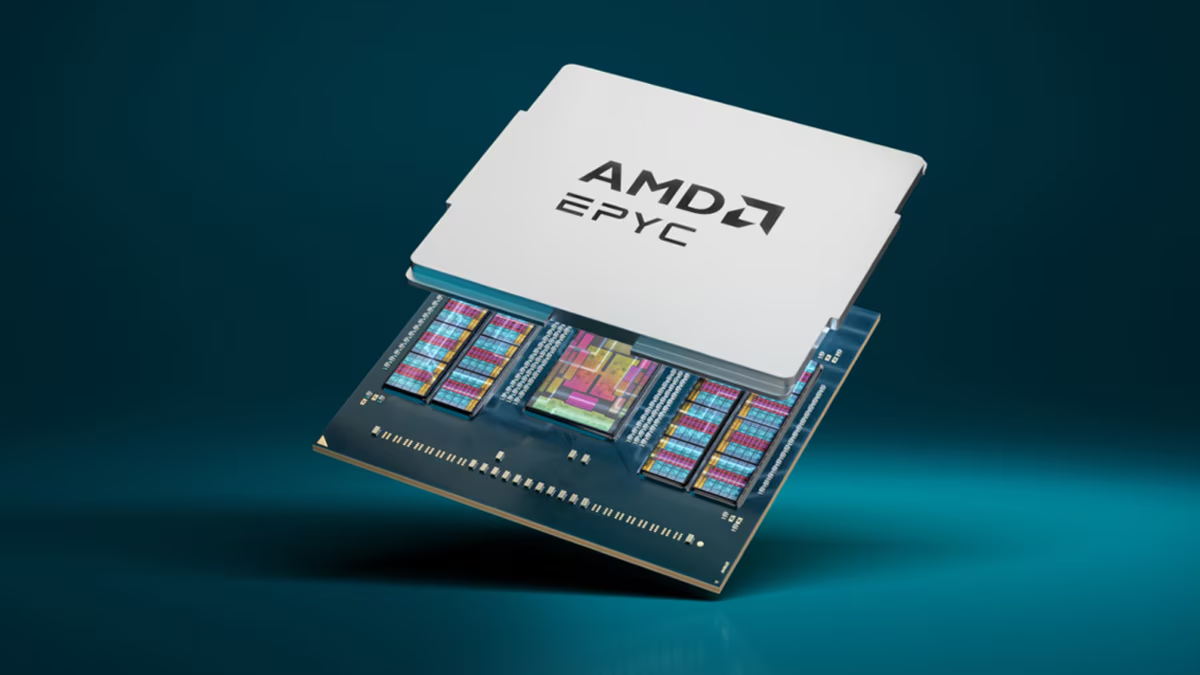
NVIDIA (NASDAQ:NVDA) is the incumbent, and I own some. What draws me to AMD here is that OpenAI, Meta, and Anthropic all placed multi-gigawatt orders alongside their NVIDIA relationships, which tells me a credible second source is now table stakes. Intel (NASDAQ:INTC) is the other name investors reach for on the x86 side, and AMD gained x86 server revenue share year-over-year again in Q2 while delivering its fifth consecutive quarter of record server CPU revenue. That share shift is the whole argument.
Risk I Refuse to Wave Away
Valuation is the real risk. Trailing P/E is 237 and price to free cash flow is 153. Forward P/E is 40, and that number only holds if the 2027 EPS ramp lands. Export controls on AI accelerators already cost about $440M in net inventory and related charges in FY2025, and Gaming revenue fell 31% YoY in Q2 on softer semi-custom. The thesis still holds for me because the Data Center curve and the customer book are doing the work quarter after quarter.
I keep buying because the compute demand behind Helios, EPYC, and Instinct is showing up in the P&L, and I want to own more of that runway before the next milestone reprices it.
Contact [email protected] for any questions or corrections.
Alex Sirois is a financial writer with experience spanning both retail and institutional investing. He has written for InvestorPlace and held roles at BNY Mellon and Bernstein, giving him a perspective that bridges Main Street portfolios and Wall Street analysis.
Alex holds an MBA from George Washington University and has built his career across multiple industries, including e-commerce, education, and translation — a breadth of experience that informs how he breaks down complex financial topics for everyday investors. His writing is conversational, actionable, and grounded in long-term, buy-and-hold investing principles.
At 247 Wall St., Alex focuses on delivering analysis that is both accessible and useful, with a clear emphasis on helping readers make more informed decisions with their money.