Linde Has Quietly Compounded for Years. These 3 Stocks Share Its Stickiest Advantage
Some companies grow quietly because their customers physically cannot leave them, and four stocks have turned that structural trap into decades of compounding returns most investors overlook entirely.


Boring is a portfolio construction choice. Consider that Linde (NASDAQ:LIN | LIN Price Prediction) has raised its quarterly dividend every year in the recorded history from $0.825 in December 2018 to $1.60 in 2026, while quietly compounding at 61.42% over five years. The four names below share a specific structural feature: their customers are physically or contractually tethered. A gas plant sits inside a semiconductor fab’s fence line. A safety mark is molded into a product. A technician is stationed at the refinery. Leaving means re-engineering the relationship, not filing a change order.
Linde: Air Separation Units Behind the Fence Line
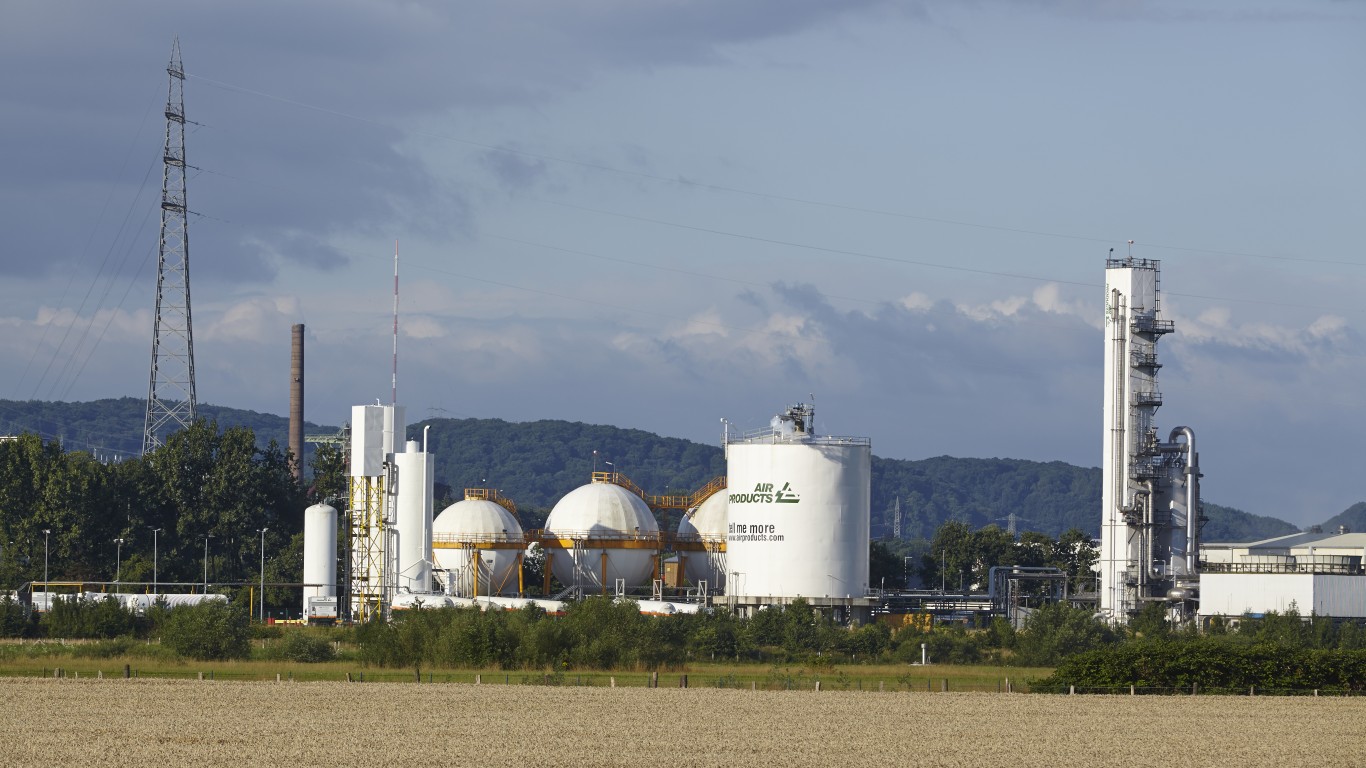
Linde is the world’s largest industrial gas supplier. Its on-site business builds air separation and hydrogen units on customer property under take-or-pay contracts that run for years, sometimes decades. The customer does not switch suppliers because the supplier’s plant is bolted to their site. In the second quarter, sale-of-gas backlog reached a record $8.1 billion after adding $1 billion of new electronics wins, with total project backlog of $11.00B.
Margin history is the pricing-power evidence. Q2 2026 operating margin was 29.5% with return on capital of 23.5%, and reported pricing rose 2%, broad-based across all geographies, generally tracking local inflation. On durability, the dividend has stepped up every year on record, reaching a trailing 12-month total of $6.30. Risk: the U.S. home-care business (LinkCare) is dragging margins, and management is evaluating strategic options while cost inflation continues to bite.
Air Products: Contracts Measured in Decades
Air Products (NYSE:APD) runs the same behind-the-fence model as Linde. It builds, owns, and operates air separation and hydrogen facilities for refineries, chemical plants, and semiconductor fabs. Recent commitments include four air separation units and underground pipeline systems for a Taiwan semiconductor customer, and a Samsung deal for multiple production facilities in South Korea. The traditional industrial gas backlog stands at approximately $3 billion, and management is targeting roughly $1.5 billion per year in project capex going forward.
On pricing, Q3 2026 adjusted operating margin was 25.6%, with 110 bps of margin expansion, and adjusted EPS was $3.47 versus $3.34 estimated. The dividend record is the clearer durability signal: quarterly payments extend from 1999 through 2026, with the per-share amount rising from $0.18 in 1999 to $1.81 in 2026 (that kind of multi-decade raise streak is exactly what we screened for in our free Dividend Kings guide). Shares carry a beta of 0.924 for the group’s smallest name, while APD itself has returned 17.41% year to date. Risk: management just recorded a $2.9 billion pre-tax charge exiting the Louisiana Clean Energy Complex and the Casa Grande Arizona project, a real capital-allocation stumble on the clean-energy megaproject strategy.
UL Solutions: A Certification Mark That Locks In Retesting
UL Solutions (NYSE:ULS) is the independent safety-science firm behind the UL Mark. Once a product carries the mark, changing certifiers means retesting entire product lines, and customers are enrolled in ongoing surveillance programs that recur every quarter. Ongoing Certification Services generated $270M in Q2 26, versus $237M in Certification Testing and $248M in Non-cert Testing & Other. Retesting also travels with product change: when input costs rise, CEO Jenny Scanlon noted, customers “value engineer that product and redesign it or change your formulations,” and that “frequently leads to retesting of that product.”
Margin trend supports the pricing thesis. Q2 2026 adjusted EBITDA margin expanded 140 bps to 26.8%, and full-year 2026 is guided to about 27.0%. Adjusted EPS was $0.59. Shares trade at a P/E of 27. On dividends, ULS is a young public company; the record shows quarterly payments rising from $0.125 in 2024 to $0.145 in 2026, an emerging pattern rather than an aristocrat pedigree. Risk: management flagged geopolitical uncertainty and China regulatory exposure, and the pending ~€575M acquisition of Eurofins’ Electrical & Electronics testing business still requires regulatory approval.
Mistras Group: Technicians Stationed at the Refinery
Mistras Group (NYSE:MG) is the small-cap in the roster and the most operational. It runs non-destructive testing, inspection, and monitoring programs on pipelines, refineries, aircraft components, power infrastructure, and bridges. Its Integrated Field Solutions business, essentially technicians stationed on customer sites running continuous asset-integrity programs, generated $164.2M of $193.1M in Q2 26 revenue. Management described the recurring nature of the work directly: “Our proprietary technology solutions, including the ARC crawler, monitoring technologies, and PCMS data offerings, continue to play an increasingly important role in our customer inspection programs.”
Margins are lower than the industrial-gas peers, but trend and cash conversion have both improved: Q2 26 adjusted EBITDA margin was 13.3%, up 30 bps, and operating cash flow swung to $14.91M from -$9.26M year-over-year. Bank-defined leverage was approximately 2.2 times as of June 30, 2026, the lowest since 2018. There is no dividend, so this is a stability case. Risk: heavy oil & gas customer concentration is producing inspection deferrals as elevated crude prices delay maintenance, and management said it “anticipate that a majority of the deferrals from the first half of 2026 will continue to be pushed further out.”
Closing Notes
These businesses will not make headlines the way an AI stock does, and that is precisely their appeal. The industrial-gas duopoly earns its returns because the customer cannot swap suppliers without unbolting a plant; the certifier earns its returns because the mark is molded into the product; the inspection firm earns its returns because the technicians are already on site. Position them as ballast, size them modestly, and let the compounding do the unglamorous work.
Contact [email protected] for any questions or corrections.
Chris Lange is a financial and geopolitical writer with more than a decade of experience covering a myriad of topics. He has published thousands of articles for 24/7 Wall St., with past coverage focused heavily on stocks, IPOs, healthcare, defense, global affairs, and technology.
His work has been quoted, or referenced by a number of outlets including Business Insider, USA Today, Yahoo Finance, MSN, The Motley Fool, and many other publications. A graduate of Southwestern University, he studied business with a focus on investments and has previous experience in banking and startups.
When not reading or writing the news, he is following his passion for Lacrosse, playing chess, or building solar projects with his dad.