5 Industrial Distributors With a Competitive Advantage Hiding in Plain Sight
Some distributors are so deeply wired into their customers' factories and procurement systems that a cheaper rival barely registers as a threat. Five industrial companies have built that kind of grip, and their dividend histories reveal just how durable the…


The least interesting link in an industrial supply chain is often the most defensible one. When a distributor’s vending machines are bolted to the wall of a customer’s factory, its software sits inside the customer’s procurement system, and its reps know where every spare bearing lives, a slightly cheaper competitor is not really a competitor at all. Consider one plain data point: at Fastenal, contract customers now represent 75.8% of revenue, with 140,789 weighted vending devices installed at customer sites at the end of the second quarter. That is what embedded looks like.
Grainger: Broadline MRO for Anyone Who Runs a Building
Grainger (NYSE:GWW | GWW Price Prediction) sells the unglamorous stuff that keeps factories, hospitals, schools and government facilities running: safety gear, lighting, motors, hand tools, cleaning supplies, fasteners. Its High-Touch Solutions business handles North American businesses and institutions, while Zoro and MonotaRO serve smaller and Japanese customers. The lock-in is procurement plumbing. Once Grainger’s catalog is wired into a customer’s purchasing system and a rep is helping run on-site inventory, replacing the relationship means rebuilding the plumbing. CEO D.G. Macpherson described the arrangement plainly on the August call: “We’re helping them manage inventory in ways that fit their specific needs, and that is contributing to strong year-over-year growth at these locations.”
The dividend record is the durability evidence. Grainger has paid a quarterly dividend continuously in the returned history from 1999-02-04 through 2026-08-10, with no gaps and no zero-dollar payments across 111 records. The per-share amount stepped up from $0.15 per quarter in 1999 to $2.49 in the latest 2026 records, and there are no splits on record to complicate that comparison. The company kept raising the payout through the 2008-2009 industrial recession and the 2020 COVID shock. Risk: management continues to flag tariff and trade policy shifts and freight cost headwinds in High-Touch Solutions, and the stock is down 3.06% over the past month as the market digests those pressures.
Fastenal: Fasteners, Vending Machines and Sticky Contracts
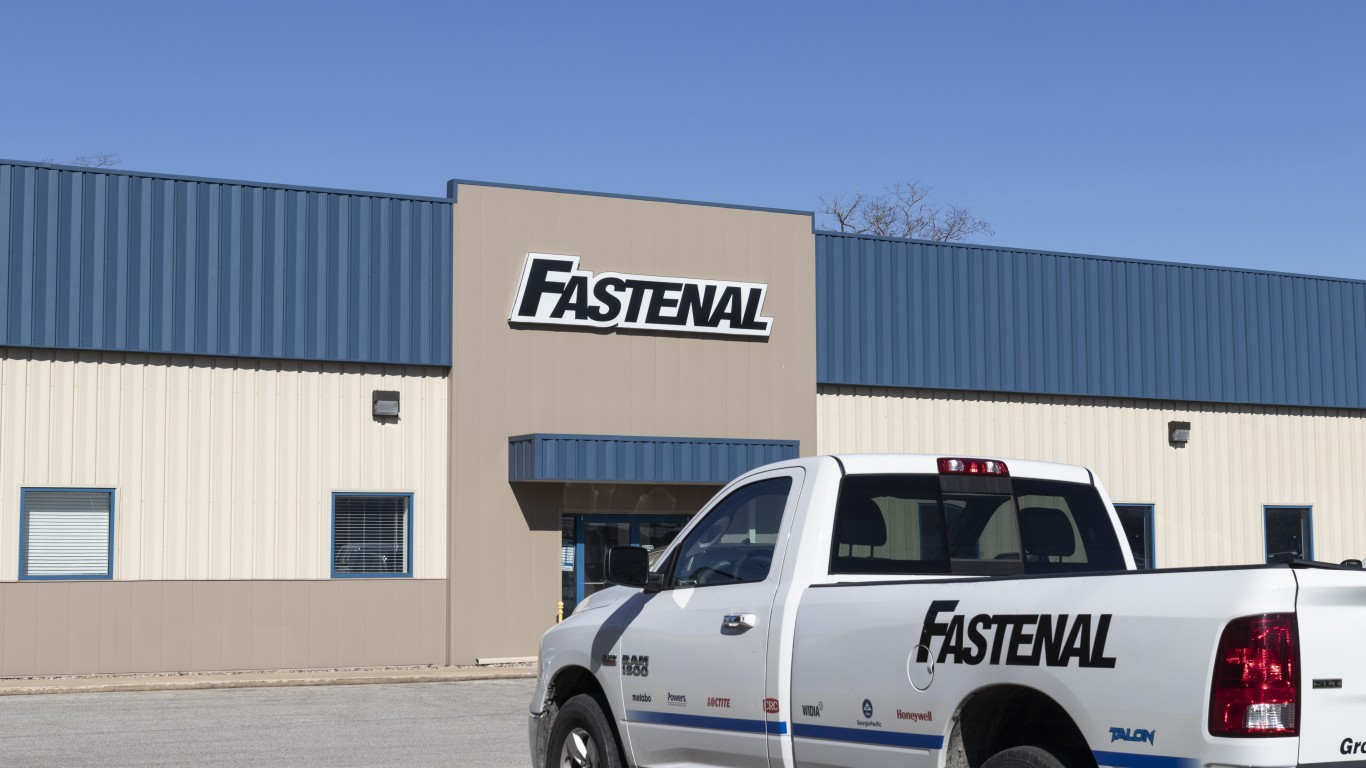
Fastenal (NASDAQ:FAST) distributes fasteners and MRO supplies, but the actual product is embedded logistics. Vendor-managed inventory means Fastenal owns the process of keeping the right bolt, glove or drill bit on a shelf next to the line worker who needs it. FASTBin and FASTVend devices are literally installed on the customer’s floor. As management put it, “Devices installed today are deposits into next quarter’s sales, into next year’s retention, and into the operational rigor and efficiency that show up in our margin structure.” The number of customer sites spending $50,000 or more per month grew 16.5% year over year, with revenues from those sites growing over 26%.
Pricing power is documented rather than asserted: roughly 290 basis points of Q2 sales growth came from product pricing actions, and Q2 gross margin was 44.6% in Q1 with operating margin at 20.3%. Fastenal has paid a quarterly dividend in the returned history from 1999-02-24 through 2026-07-28, and the shares have absorbed five 2-for-1 forward splits, most recently on 2025-05-22, which is why raw per-share amounts look small. The company kept paying through 2008-2009 and 2020. Risk: management flagged a customer mix shift toward larger accounts that structurally compresses gross margin, and shares have returned only 10.01% over the past year despite double-digit sales growth.
MSC Industrial Direct: Metalworking Tools and the Coiled Spring
MSC Industrial Direct (NYSE:MSM) is the metalworking specialist: carbide cutting tools, taps, drills, gauges, plus general MRO, sold through mscdirect.com and a National Accounts channel. The lock-in is physical. Approximately 30,800 vending machines were installed at quarter end (up 7% year over year) and 426 customers had an in-plant program (also up 7%). Sales through vending were up 15% year over year and represented roughly 20% of total net sales; sales to in-plant customers were up 16% and represented roughly 21%. When a distributor is running a stockroom inside your factory, switching means dismantling a working process.
The dividend record shows a business whose cash flows survive the cycle. MSC has paid a regular quarterly dividend continuously in the returned history back to the early 2000s, with the regular quarterly amount rising from $0.05 in 2003 to $0.87 in the four most recent quarters, and no splits on record. The company also made several outsized special distributions along the way, including $5.75 with a 2020-01-21 ex-date and $3.50 with a 2020-11-30 ex-date, which should be read separately from the regular payout. The regular dividend held through the 2008-2009 downturn and the 2020 shock. Risk: management warned of lapping stronger prior-year pricing benefits and competition from aggressive pricing, and the most recent four quarterly payments have held flat at $0.87 rather than stepping up again.
Applied Industrial Technologies: Bearings, Fluid Power and Facility Knowledge
Applied Industrial Technologies (NYSE:AIT) distributes bearings, power transmission, fluid power, industrial automation and engineered solutions to MRO and OEM customers across North America. The switching cost is expertise. Applied’s engineers know which pump is installed on which line at which plant, and they specify the replacement. CEO Neil Schrimsher framed it this way: “We’re seeing increased number of customers looking to us as we know their operating facilities so well that we can help them with advancements in fluid power systems, robotics, and vision.” Automation organic sales grew over 20% year over year, the strongest in more than four years, and 27 of the top 30 U.S. industry verticals were up year over year in the service-center network.
The dividend record: quarterly payments run continuously in the returned history from 1999-02-10 through 2026-08-14, with a clean progression through recent years from $0.30 per payment in 2018 to $0.51 in 2026. Split history is minor: two 1.5x adjustments in 2004 and 2006. The regular dividend held through 2008-2009 and 2020. Risk: management called out inflationary headwinds including $6.4 million of LIFO expense in Q4 and more difficult year-over-year comparisons ahead.
Watsco: HVAC Distribution to a Fragmented Contractor Base
Watsco (NYSE:WSO) is the largest North American HVAC and refrigeration distributor, selling equipment, parts and supplies to contractors in a highly fragmented market of more than 2,100 distributors. The customer relationship runs through software as much as trucks. More than 70,000 contractors and technicians engage digitally, e-commerce ran at $2.7 billion trailing-twelve-months (37% of sales) and OnCallAir generated $1 billion of GMV in the first half of 2026. When a small contractor uses Watsco’s app to price a job in a homeowner’s kitchen, that contractor is not shopping for a different distributor next week.
Management stated on the July call that “2026 marks our 52nd consecutive year of paying dividends” and that the annual dividend was increased 10% to $13.20 per share in April. The Fuse dividend feed did not return the underlying record on this pull, so we lean on management’s own dated statement rather than any calculated streak. Fifty-two consecutive years spans multiple recessions, including 2008-2009 and 2020. Risk: Q2 gross margin compressed 180 basis points to 27.5% as the business lapped 2025’s outsized A2L transition pricing benefits, and the shares are down 13.56% over the past year.
Boring Summary
None of these are undiscovered. What they share is a customer relationship that has to be pried out rather than switched away from: vending machines on the floor, procurement APIs in the ERP, engineers who know the plant, apps used to sell jobs. The dividend records above are useful mostly as evidence that the cash flow survives cycles. For a durable core, that is often enough (if multi-decade payout streaks are the filter you care about, we ranked ten of the longest-running raisers by valuation in a free Dividend Kings report).
Contact [email protected] for any questions or corrections.
Chris Lange is a financial and geopolitical writer with more than a decade of experience covering a myriad of topics. He has published thousands of articles for 24/7 Wall St., with past coverage focused heavily on stocks, IPOs, healthcare, defense, global affairs, and technology.
His work has been quoted, or referenced by a number of outlets including Business Insider, USA Today, Yahoo Finance, MSN, The Motley Fool, and many other publications. A graduate of Southwestern University, he studied business with a focus on investments and has previous experience in banking and startups.
When not reading or writing the news, he is following his passion for Lacrosse, playing chess, or building solar projects with his dad.