Three Major Analysts Bet on Meta’s AI Pivot With Price Targets Approaching $920
JPMorgan, Raymond James, and BofA all raised their Meta price targets in the same week, and their reasoning has little to do with advertising. The catalyst they keep pointing to could redefine what kind of company Meta actually is.


Three major Wall Street firms lined up behind Meta Platforms (NASDAQ:META | META Price Prediction) this week, all pointing to the company’s new Muse AI franchise as the catalyst that could unlock a second revenue engine beyond digital advertising.
JPMorgan’s Doug Anmuth lifted his price target to $920 from $820, Raymond James’s Josh Beck boosted his to $860 from $650, and BofA’s Justin Post reiterated a Buy rating with an $810 target.
For long-term investors, the coordinated price target raises signal that Meta stock is transitioning from an ad-cycle story to an AI platform story.
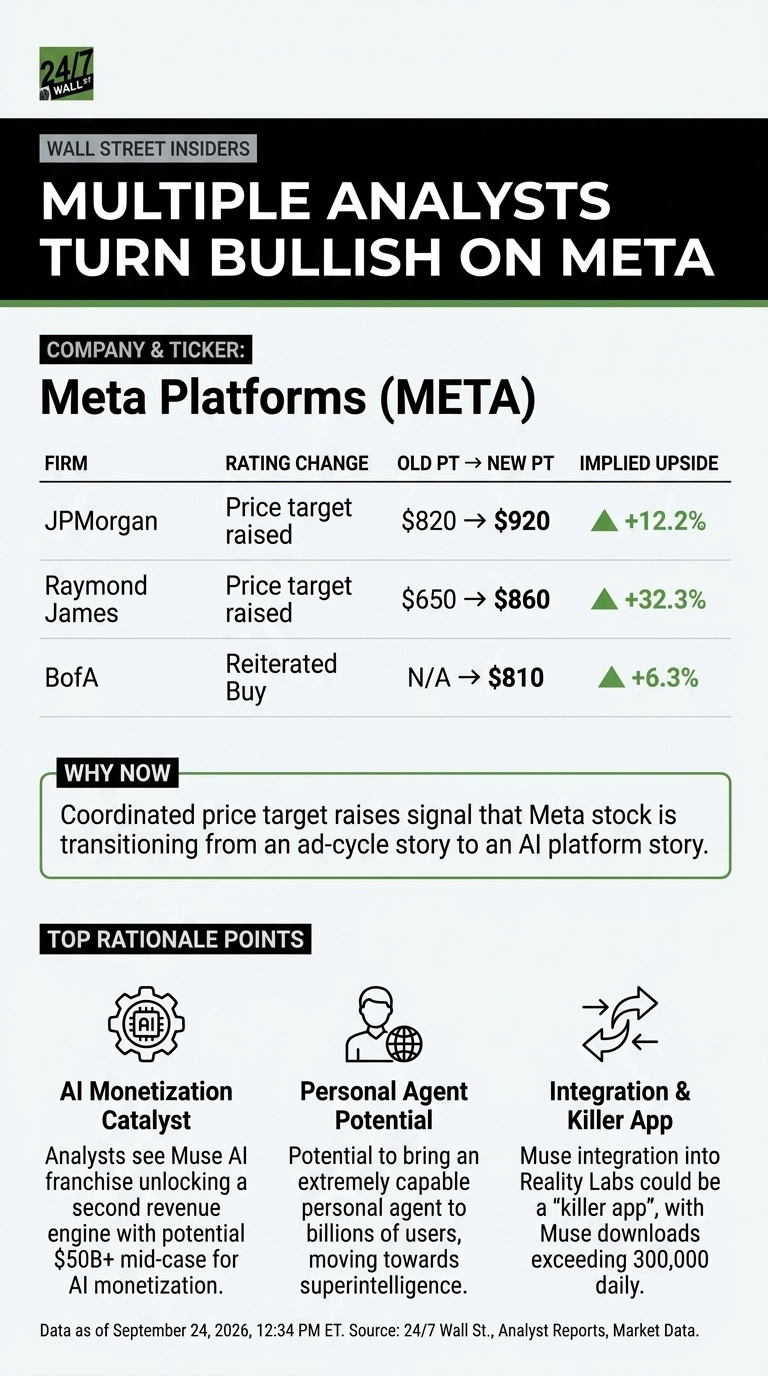
| Ticker | Company | Firm | Action | Old Rating | New Rating | Old Target | New Target |
|---|---|---|---|---|---|---|---|
| META | Meta Platforms | JPMorgan | Price target raised | Overweight | Overweight | $820 | $920 |
| META | Meta Platforms | Raymond James | Price target raised | Strong Buy | Strong Buy | $650 | $860 |
| META | Meta Platforms | BofA | Reiterated | Buy | Buy | n/a | $810 |

Inside the Analysts’ Bullish Case
Anmuth argues Meta “continues to move towards superintelligence with Muse off to a strong start,” and sees potential to bring an “extremely capable personal agent to billions of users.”
Beck flags daily Muse downloads exceeding 300,000 and points to a scenario analysis with a $50 billion-plus mid-case for AI monetization, with advertising the most capital-efficient path.
Post echoes that view, calling Muse integration into Reality Labs hardware a potential “killer app” the segment has lacked.
Company Snapshot Behind the Upgrades
Meta carries a market cap of roughly $1.88 trillion and trades at 28 times trailing earnings, with a forward multiple of 22. Second-quarter 2026 revenue reached $60.80 billion, up 27.96% year over year, though diluted EPS of $6.18 came in shy of the $7.22 consensus, weighed by $2.40 billion in legal charges and $1.18 billion in severance.
Family of Apps ad revenue rose 27% year over year, with ad impressions up 14% and average price per ad up 12%. CEO Mark Zuckerberg told investors AI is “accelerating every major part of our core business.”

Why the Bullish Shift Matters Now
Meta stock has run hard into these upgrades, gaining 36.41% over the past month and 15.72% year to date to $762, brushing against its 52-week high of $763.90.
The average Wall Street price target sits at $761.01, with 47 Buy and 8 Strong Buy ratings versus 7 Holds, so the fresh JPMorgan and Raymond James numbers push above the current consensus.

Management guided third-quarter revenue to $61 billion to $64 billion and reaffirmed 2026 operating income above 2025, even as full-year capex was set at $130 billion to $145 billion. Meanwhile, near-term estimate revisions remain mixed: for fiscal 2026, 4 EPS revisions moved up and 45 moved down over the trailing 30 days.

What It Means for Your Portfolio
For retirement-focused investors already holding Meta, the analyst upgrade wave validates the thesis that AI spend is starting to translate into monetizable products beyond infrastructure costs. That said, capex intensity, Reality Labs losses of $19.2 billion in 2025, youth-related legal trials, and EU regulatory pressure remain real overhangs.
With Meta stock near record highs and estimate revisions skewing negative in the very near term, the revised targets support a long-horizon research thesis that warrants a closer look at position exposure.
Contact [email protected] for any questions or corrections.
Vandita Jadeja is a financial publisher with over a decade of experience writing about financial topics, including investment, savings, retirement, insurance and banking. Vandita is a Chartered Accountant who loves to debunk financial concepts for readers.
Her work has appeared on sites that include The Motley Fool, InvestorPlace, and Benzinga. She covers investing and focuses on stock picks and price prediction for 24/7 Wall St.
When not looking for the next stock investment opportunity, she can be found traveling, reading, chasing sunsets and enjoying her iced latte.