Nvidia’s Glass Packaging Push Could Reshape AI Chips
The next leap in Nvidia's AI performance may have nothing to do with the GPU itself. A shift in the material holding these chips together could determine how much memory fits in a package and how fast costs spiral upward.


- Glass could help Nvidia build larger AI chip packages with denser connections and room for more high-bandwidth memory.
- Rising HBM prices increase the economic stakes of every packaging decision.
- SCHMID is supplying equipment to companies developing glass-core substrates, but technical and customer qualification hurdles remain.
Nvidia (NASDAQ: NVDA | NVDA Price Prediction) has made investors accustomed to dramatic improvements in GPU performance. Its next major advance, however, may come from something far less visible than the processor: the material that supports and connects the chips inside the package.
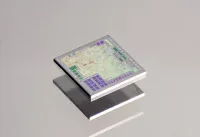
That material could be glass. As Nvidia’s AI systems grow, the package must accommodate larger processors, more memory, and an increasing number of electrical connections. Glass could give designers a more stable platform on which to build them. If manufacturers can make it reliably at scale, glass could become one of the technologies that allows Nvidia’s future GPUs to grow beyond today’s packaging limits.
This is a potentially significant change for the companies that make packaging equipment and substrates. It also has implications for memory suppliers. A larger package can create room for more HBM at a time when each additional gigabyte is becoming increasingly expensive.
Nvidia Is Running Into the Limits of the Package
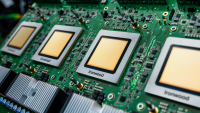
An AI accelerator is no longer simply a processor mounted on a board. The GPU must communicate at high speed with HBM positioned close beside it. The package provides the physical space and connections that make this arrangement possible.
As Nvidia adds computing capacity, it needs to move more data between processors and memory. A more powerful GPU cannot deliver its full benefit if the surrounding package cannot support sufficient memory capacity or the required interconnects. Package size has consequently become a design constraint in its own right.
TSMC (NYSE: TSM) has already been expanding its CoWoS advanced packaging platform. Its CoWoS-S technology supports a silicon interposer up to approximately 2,700 square millimeters, while CoWoS-L and CoWoS-R provide routes to larger designs. TSMC says CoWoS-L continues to scale to integrate more silicon and memory. Glass is attracting attention as manufacturers consider how to keep expanding the package beyond current material limits.
There is an important distinction here. A glass-core substrate could replace the organic core in the larger package substrate. That would not automatically eliminate the silicon interposer used for fine connections between a GPU and its HBM. Future packaging designs may combine these materials in different ways. The immediate attraction of glass is a larger, flatter, more dimensionally stable foundation for an increasingly complex assembly.
What Glass Could Change
Conventional organic substrate materials become harder to control as packages grow. Heat and processing can cause distortion or warpage, making it more difficult to align connections across a large area. Glass offers a different combination of flatness, rigidity, and electrical properties.
Intel (NASDAQ: INTC), which has invested in glass substrate development, has described the potential for 50% less pattern distortion and much higher interconnect density. These are technology claims associated with Intel’s development effort, not measured improvements for an Nvidia GPU. They explain why packaging companies see glass as a way to build larger systems with finer connections.
For Nvidia, the potential benefit is straightforward. More usable package area could support more processing chips, more HBM, or both. Improved dimensional control could help manufacturers form reliable connections across that larger area. Better signal integrity could become increasingly valuable as those connections carry more data.
Glass would address a packaging bottleneck. It would not create additional HBM supply. In fact, if it enables Nvidia to place more memory in a future package, demand for HBM per accelerator could increase. That is an opportunity for Micron (NASDAQ: MU) and other memory producers, even as it puts greater pressure on supply.
What the HBM Cost Model Shows
According to Table 1, two changes are driving the economics of HBM: growth in the overall market and a rising assumed price per gigabit. The table holds memory capacity at 288 GB from 2025 through 2028 so that the change in the modeled cost per GPU reflects price alone. At 288 GB, that cost rises from $3,917 in 2026 to $7,373 in 2027 because the assumed price increases from $1.70 to $3.20 per gigabit.
The final two rows make a separate, same-year comparison. The $7,373 figure is the modeled 2027 cost for a GPU with 288 GB. The $4,915 figure directly beneath it is the modeled 2027 cost for a GPU with 192 GB. Both use the same $3.20 price. The $2,458 difference comes entirely from the 96 GB reduction in capacity.
Table 1. HBM Market Growth and Modeled Memory Cost per GPU Package
| Metric | 2024 | 2025 | 2026 | 2027 | 2028 |
| Global HBM market revenue ($ billions) | 16 | 35 | 49 | 70 | 100 |
| Capacity used for annual cost comparison (GB per GPU) | 192 | 288 | 288 | 288 | 288 |
| Assumed blended HBM price ($/Gb) | 1.20 | 1.35 | 1.70 | 3.20 | 3.40 |
| Modeled HBM cost at annual comparison capacity ($ per GPU) | 1,843 | 3,110 | 3,917 | 7,373 | 7,834 |
| Alternative 2027 design: HBM cost at 192 GB ($ per GPU) | — | — | — | 4,915 | — |
| 2027 saving versus the 288 GB configuration ($ per GPU) | — | — | — | 2,458 | — |
The Information Network calculations convert gigabytes to gigabits by multiplying by eight, then multiply by the assumed price per gigabit. Thus, the 2027 comparisons are 288 × 8 × $3.20 = $7,373 and 192 × 8 × $3.20 = $4,915, rounded to whole dollars. The pricing assumptions are based on estimates in the supplied Samsung Securities inserts. The 2026 and 2027 global market figures are calculated estimates between Micron’s approximately $35 billion 2025 HBM market estimate and its approximately $100 billion projection for 2028; they are not reported annual market results. Micron has also cited approximately $16 billion for 2024.
The 192 GB alternative illustrates an eight-high memory configuration if the number of HBM stacks beside the GPU and the capacity of each DRAM die are otherwise held constant. “Eight-high” refers to the number of DRAM dies stacked vertically inside each HBM device. It is a design scenario, not an announced Nvidia specification. It also describes a different choice from adopting glass: glass concerns the platform on which the GPU and HBM devices are assembled, while eight-high describes the construction of each HBM device.
The modeled $2,458 saving therefore should not be credited to glass. It shows how much a lower-memory GPU could save under the table’s pricing assumptions. Glass presents the opposite possibility as well: by supporting a larger package, it could allow Nvidia to use more HBM when the performance benefit justifies the added cost.
The table excludes GPU dies, the substrate, interposer, assembly, and manufacturing losses. Those omissions matter when evaluating glass. A new substrate must justify its cost across the whole package, while its reliability becomes more consequential as the value of the components assembled onto it rises.
SCHMID’s Opportunity Is Real, but Still Early
SCHMID Group (NASDAQ: SHMD) has said it is engaged with major companies in the supply chains of Nvidia, Intel, and AMD as they examine glass-core substrates. The company supplies technology and equipment intended to help turn those designs into manufacturable products. That gives investors a specific equipment company to watch as the industry tests glass. It does not establish that Nvidia has awarded SCHMID a production contract or committed a future GPU to glass.
SCHMID has identified through-glass-via metallization as a central technical obstacle. Glass does not conduct electricity, so manufacturers must create small holes through it and turn them into dependable electrical pathways. Making the holes is only part of the process. The metal connections must be consistent across large substrates and reliable through subsequent assembly and operation. SCHMID has also identified end-customer qualification as a milestone still to be completed.
Its existing financial results should be kept separate from the future glass opportunity. SCHMID reported €46.0 million in revenue for the first half of 2026, compared with €16.9 million a year earlier, and maintained full-year revenue guidance above €100 million. It also lowered its adjusted EBITDA margin guidance to 6%–9%. Growing equipment demand across its business does not tell investors how much revenue production glass substrates will eventually generate.
One comment from SCHMID management is especially revealing. The company said customers are currently pursuing larger panel-level packages for performance and package size, rather than primarily to save money. That puts glass where Nvidia’s roadmap is headed: toward more capable systems whose physical dimensions and connections are becoming strategic design decisions.
SCHMID is not alone in pursuing the opportunity. Intel has developed glass packaging technology, while Absolics is building a glass-core packaging ecosystem with support from a $100 million U.S. advanced packaging research award. The breadth of activity suggests that glass is becoming an industry development effort, although commercial adoption remains uncertain.
Corning (NYSE: GLW) is another name investors may associate with glass. Its announced Nvidia partnership, however, focuses on optical connectivity for AI data centers. That agreement should not be counted as a confirmed glass-substrate win inside Nvidia’s GPU packages.
Investor Takeaway
Glass could be a major step in AI packaging because it targets a problem Nvidia cannot solve by improving GPU silicon alone. Future accelerators need enough package area, stable geometry, and dense connections to bring processors and memory together. If glass provides that foundation at acceptable yield, Nvidia gains another path to larger and more capable AI systems.
Table 1 puts a price on the memory decisions surrounding that opportunity. Under the stated assumptions, the modeled HBM bill for a 288 GB GPU more than doubles between 2026 and 2027 despite unchanged capacity. A 192 GB design would lower that bill, while a larger glass-enabled package could make room for more HBM and raise it. Nvidia would have to weigh either configuration against the performance and economics of the finished accelerator.
For investors, the glass milestones are customer qualification, reliable through-glass connections, and evidence of production yields suitable for high-value AI packages. Those developments would turn glass from a promising material into a measurable equipment and substrate opportunity.
Contact [email protected] for any questions or corrections.
Dr. Robert Castellano has over 40 years of experience analyzing the high-tech industries. He is president of The Information Network (www.theinformationnet.com). He earned a PhD degree in Chemistry from Oxford University (UK). His PhD thesis advisor, John Goodenough, won the Nobel Prize in Chemistry in 2019 for the invention of the Lithium Ion Battery. He writes with George Gilder, novelist, futurist, and economist, and his team for Eagle Financial Publishing.