SK Hynix Just Expanded Coherent’s AI Upside
SK Hynix just published a technology roadmap that redraws where optics belong inside an AI system, and one company supplies nearly every component required to build it.


The investment case for Coherent Corp. (NYSE: COHR) | COHR Price Prediction has largely centered on one increasingly important problem: artificial intelligence processors are producing data faster than conventional electrical connections can move it. That imbalance has driven rapid demand for Coherent’s 800-gigabit and 1.6-terabit optical transceivers, indium phosphide lasers, optical circuit switches, and silicon-photonics components.
A new technology roadmap from SK hynix Inc. (NASDAQ: SKHY) suggests that Coherent’s opportunity could become substantially broader.
On August 20, SK hynix announced that it had collaborated with researchers from several leading universities on a co-packaged-optics roadmap published in Nature Electronics. The paper describes an AI architecture in which optical links move beyond communications between conventional network switches and directly connect separate pools of processors and memory.
That distinction is the investment hook. Coherent is already benefiting as data centers replace copper connections with optical transceivers. Nvidia has also moved CPO into production for networking switches. SK hynix is now describing an additional stage in which photonics becomes part of the architecture connecting processors with memory resources.
If the industry follows this direction, optics will not remain confined to the edges of AI servers and switches. It will move progressively closer to the most valuable components in the system: accelerators and high-bandwidth memory.
Coherent is positioned across nearly every critical portion of that transition. The company supplies high-power indium phosphide lasers, external laser-source modules, silicon-photonics components, microlens arrays, fiber-attach units, polarization-maintaining fiber, optical circuit switches, and complete optical transceivers. It has demonstrated a 6.4-terabit silicon-photonics CPO system and has secured very-high-volume, multiyear orders from a leading AI data center customer.
The market has already recognized Coherent as an AI optical-transceiver company. SK hynix’s roadmap creates a more expansive possibility: Coherent could become an enabling supplier for the optical fabric connecting processors, switches, and memory throughout the AI system.
SK Hynix Is Looking Beyond HBM
SK hynix became one of the largest financial beneficiaries of the AI boom by solving the first major memory bottleneck. Its high-bandwidth memory places vertically stacked DRAM close to the processor and connects it through an extremely wide interface, allowing substantially more data to reach the accelerator than conventional server memory can provide.
That position has generated extraordinary cash flow. On August 19, SK hynix announced a KRW40 trillion, or approximately $28.7 billion, share-repurchase program. The company will buy and cancel 24.07 million common shares, representing approximately 3.3% of its issued shares.
The cancellation is important because those shares will be permanently removed rather than held in treasury for possible reissuance. SK hynix also committed to returning more than 50% of cumulative free cash flow generated during its 2025–2027 shareholder-return period through repurchases, cancellations, and dividends.
One day after announcing the buyback, however, SK hynix focused attention on what comes after HBM.
The company’s CPO technology roadmap argues that the AI industry is moving from chip-level competition toward system-level competition. HBM increased bandwidth between memory and an accelerator, but increasingly large AI systems must also move data between thousands of accelerators, multiple memory resources, storage systems, and network switches.
Electrical signals encounter greater power consumption, heat generation, and signal-integrity problems as speeds and distances increase. The industry can continue improving copper connections, but the physical limitations become progressively more difficult and expensive to overcome.
Optical connections carry more data over longer distances while consuming less energy per bit. CPO moves the optical conversion closer to the processor or switching silicon, minimizing the distance traveled electrically.
SK hynix’s proposed architecture goes further than the CPO switches attracting most current investment attention. It describes a photonic interposer that directly connects computing resources in an XPU pool with memory resources in a separate memory pool.
This would allow processors to access larger and more flexible quantities of memory rather than depending entirely upon the HBM physically attached to each accelerator. The architecture remains a roadmap rather than a commercial product, but its direction is important. The world’s leading HBM supplier believes future memory systems will increasingly require optical as well as electrical connectivity.
Why This Matters More Than Another CPO Announcement
Investors have been hearing about CPO for several years, creating understandable skepticism about whether every new roadmap represents a meaningful commercial development. In this case, two factors make the announcement more important.
First, CPO has entered production.
In May, Nvidia Corp. (NASDAQ: NVDA) announced that its Spectrum-X Ethernet Photonics switches were in production as part of the Vera Rubin infrastructure ramp. The platform uses CPO and 200-gigabit-per-second serializer/deserializer technology to support networks connecting extremely large numbers of AI accelerators.
Nvidia says Spectrum-X Ethernet Photonics provides five times better power efficiency, five times longer AI-system uptime, and 1.3 times faster deployment than networks based on traditional transceivers. CoreWeave, Lambda, and Oracle Cloud Infrastructure are among the first identified adopters.
The production announcement moved CPO beyond a laboratory demonstration or conference prototype. Data center customers can now begin deploying the technology within commercial AI infrastructure.
Second, SK hynix is not an optical-component manufacturer attempting to create demand for its own products. It is the leading supplier of the HBM used with Nvidia accelerators. Its decision to publish a roadmap for processor-to-memory optical architecture provides independent confirmation that data movement is becoming a system-level constraint.
Nvidia validates the near-term CPO market in network switches. SK hynix expands the long-term opportunity toward memory and compute.
Coherent participates in both.
Coherent Has More Than a Laser Position
The immediate temptation is to frame CPO primarily as an external-laser opportunity. That interpretation is incomplete for Coherent because the company supplies a considerably broader collection of components.
A CPO system must generate light, deliver it to the optical engine, modulate it with data, align it precisely, and transfer it into optical fiber. Each function requires specialized active and passive components.
High-power continuous-wave indium phosphide lasers provide the light. External laser-source modules move those lasers away from the hot switch package, improving thermal stability, reliability, and serviceability. Silicon-photonics integrated circuits modulate the light with data. Microlens arrays and fiber-attach units align the optical signal with the fiber, where extremely small deviations can increase loss and impair performance.
Coherent participates at each of these levels.
The company produces high-power indium phosphide continuous-wave lasers at its Sherman, Texas, facility. It integrates lasers with isolators and thermoelectric cooling into external laser-source modules. It designs silicon-photonics products and manufactures microlenses, polarization-maintaining fiber, prisms, and fiber-attach assemblies.
Coherent’s vertical participation does not guarantee that it will supply every component in a production platform. Nvidia and other customers will maintain multiple suppliers to reduce risk and preserve negotiating leverage. However, Coherent’s breadth gives it several opportunities to win content within the same system.
It also allows Coherent to optimize components as a coordinated optical platform instead of developing each product independently. That can become increasingly important as CPO architectures require tighter alignment, lower optical loss, higher laser power, and greater reliability.
According to Table 1, the optical transition is developing across several increasingly demanding stages. Coherent already generates substantial revenue from pluggable transceivers, is positioned in commercial CPO switching platforms, and could eventually address processor-to-memory optical architectures of the type proposed by SK hynix.
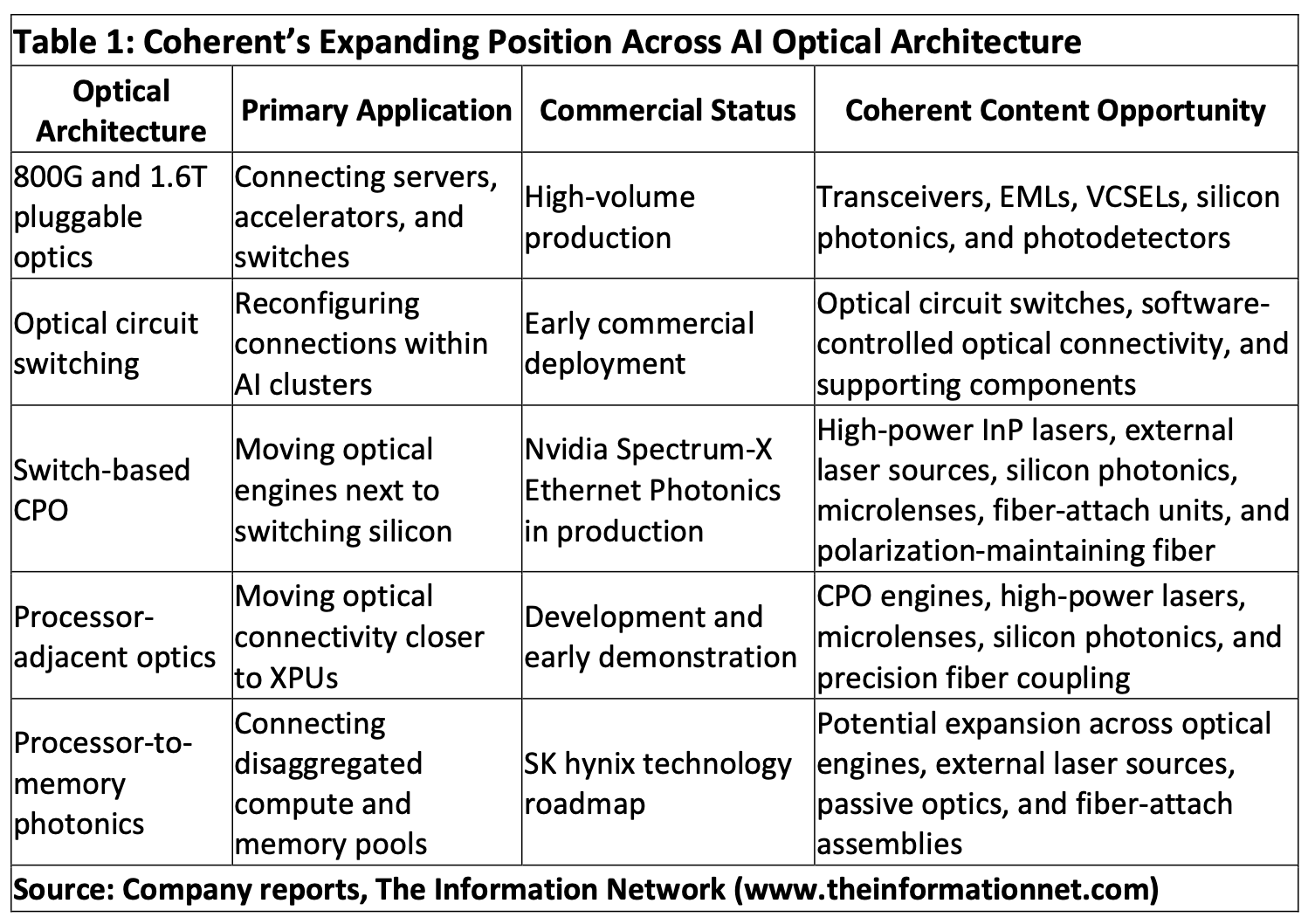
The progression matters because each stage increases the amount of optical content required to support an AI system. Pluggable optics connect discrete pieces of equipment. Switch CPO moves photonics onto the switching package. Processor-to-memory photonics could embed optical communication more deeply within the compute architecture.
That is why Coherent describes CPO as an expansion of its serviceable available market rather than merely a replacement for existing transceivers.
A Potential $15 Billion Market
At its March 2026 Optical Fiber Communication investor presentation, Coherent estimated that the CPO serviceable available market could exceed $15 billion by 2030.
That forecast is a company estimate rather than an independent guarantee, but it illustrates the scale of the opportunity management believes is developing. More importantly, the estimate was based principally on CPO and near-packaged-optics adoption in switches and processors. SK hynix’s proposed memory-pooling architecture could increase the ultimate market by adding more optical interfaces around memory.
The addressable market should not be interpreted as revenue Coherent will automatically capture. The supply chain includes Lumentum Holdings Inc. (NASDAQ: LITE) in high-power lasers and external laser sources, Corning Inc. (NYSE: GLW) in optical fiber and connectivity, TSMC in silicon-photonics manufacturing and advanced packaging, and numerous companies supplying connectors, fiber assemblies, and optical engines.
Coherent’s advantage is not that it operates without competitors. It is that it competes across more individual CPO components than most publicly traded alternatives.
Lumentum may possess particularly strong exposure to the high-power external-laser bottleneck. Corning supplies essential fiber, alignment grooves, and connectivity products. Coherent combines laser and passive-optical technologies with transceivers, silicon photonics, fiber attachment, and advanced manufacturing.
That breadth gives Coherent several potential revenue paths as customers determine which CPO architectures reach volume production.
The Commercial Evidence Is Already Building
Coherent is not relying solely upon SK hynix’s future roadmap.
The company disclosed at OFC 2026 that it had secured very-high-volume, multiyear orders from a market-leading AI data center customer for CPO solutions. The products include high-power continuous-wave lasers and external laser sources manufactured using Coherent’s expanding 6-inch indium phosphide platform.
Coherent has also demonstrated a socketed 6.4-terabit silicon-photonics CPO platform. The demonstration combined an external laser source, an internally produced indium phosphide continuous-wave laser, an isolator, thermoelectric cooling, polarization-maintaining fiber, microlenses, and fiber-attach technology.
The importance is not simply the 6.4-terabit data rate. The demonstration showed that Coherent can integrate active and passive technologies drawn from multiple portions of its portfolio into a working CPO architecture.
The company’s Sherman facility is ramping high-power continuous-wave lasers on 6-inch indium phosphide wafers. Moving from 3-inch to 6-inch wafers increases the available manufacturing area by approximately four times, allowing more devices to be fabricated during each process cycle. Coherent has reported that yields on its 6-inch platform have exceeded those of its older 3-inch lines.
This manufacturing transition is essential because the CPO opportunity cannot be monetized through technical demonstrations alone. Coherent must produce large quantities of high-power lasers with consistent performance, reliability, and acceptable cost.
Nvidia’s March agreement provided additional validation. The company invested $2 billion in Coherent as part of a multiyear, nonexclusive strategic partnership covering advanced optical technology, manufacturing expansion, research and development, and future capacity access. The agreement also includes a multibillion-dollar purchase commitment.
Nvidia made a parallel investment in Lumentum, confirming that it intends to maintain multiple laser suppliers. But its willingness to invest directly in Coherent demonstrates that the company’s manufacturing capacity and technology have become strategically important to Nvidia’s AI roadmap.
Coherent’s Current Revenue Acceleration
CPO offers substantial future upside, but investors do not need to wait for processor-to-memory photonics to justify Coherent’s current AI position. Its established optical business is already converting higher AI infrastructure spending into revenue growth and margin expansion.
During Coherent’s fiscal fourth quarter, Data Center and Communications revenue increased 59% year over year and 19% sequentially to $1.62 billion. The segment reached 79% of total company revenue, compared with a much smaller contribution from the Industrial business.
Total quarterly revenue increased 34% year over year to $2.05 billion, or 42% on a pro forma basis excluding divested operations. Non-GAAP gross margin expanded by 215 basis points to 40.2%, while adjusted earnings increased to $1.74 per share from $1.00 one year earlier.
For fiscal 2026, Data Center and Communications revenue increased approximately 40% to $5.27 billion. Coherent’s full-year revenue reached $7.12 billion, increasing 23% on a reported basis and approximately 28% on a pro forma basis.
Management guided fiscal first-quarter 2027 revenue to between $2.2 billion and $2.4 billion, with non-GAAP earnings of $1.85 to $2.05 per share. The midpoint of the revenue range would represent another sequential increase of approximately 12%.
The current growth is being driven primarily by conventional optical products rather than the longer-term CPO opportunity. Coherent is shipping 800G transceivers while rapidly ramping 1.6T products across multiple customers. The higher-speed products carry higher initial average selling prices and can improve product mix as manufacturing yields rise.
This provides an important balance to the investment case. Coherent does not require immediate mass adoption of SK hynix’s photonic-memory architecture. Its current optical business is already growing quickly, while CPO and processor-to-memory connectivity add longer-term optionality.
From SiC Tailwinds to AI Optical Growth
The longer-term revenue record shows how completely Coherent’s growth engine has changed. The fiscal 2022 baseline is important because the Materials operation initially expanded strongly in fiscal 2023 before weaker consumer electronics and the EV-driven SiC retrenchment reduced revenue.
According to Table 2, Networking revenue increased 55.6% from fiscal 2022 through fiscal 2025, while Materials declined 14.7% and legacy Coherent Lasers declined 5.6%. The smaller decline in Lasers should not be interpreted as evidence that the acquired business produced a superior return. II-VI paid approximately $7.1 billion for legacy Coherent and assumed substantial debt and integration costs for a business that subsequently generated little revenue growth.
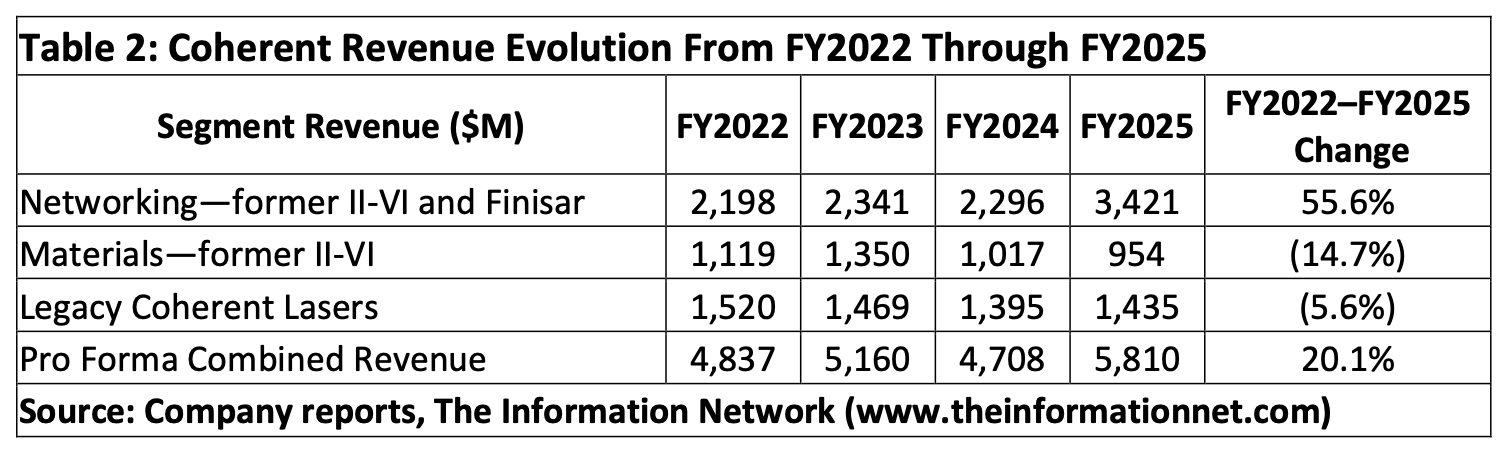
Note: The fiscal 2022 Lasers figure represents legacy Coherent’s trailing-12-month pro forma revenue. Networking and Materials reflect II-VI’s recast segment results.
The Materials decline does not invalidate the SiC investment thesis that existed in 2023. Materials initially increased 20.6%, from $1.119 billion in fiscal 2022 to $1.350 billion in fiscal 2023, consistent with Coherent’s disclosure that SiC revenue had grown more than 40%.
Most of the fiscal 2024 Materials contraction resulted from a significant consumer-electronics customer’s design change. The later weakness reflected slowing automotive and SiC demand as the U.S. EV market retrenched. That reversal was becoming identifiable in early 2024 before it became fully visible in Coherent’s annual results.
Materials also retained considerable economic value. Fiscal 2025 Materials revenue declined 6%, but segment profit increased 19% to $355 million because of better product mix, improved pricing, and lower manufacturing costs.
Networking produced a fundamentally different result. Revenue increased from $2.198 billion in fiscal 2022 to $3.421 billion in fiscal 2025, before Data Center and Communications accelerated further in fiscal 2026.
Optical networking became the growth platform that SiC appeared capable of becoming before the EV downturn. The difference is that optical demand is now being supported simultaneously by Nvidia’s product roadmap, hyperscaler capital spending, the transition from 800G to 1.6T transceivers, CPO commercialization, and the potential movement of photonics toward processors and memory.
The historical numbers therefore add an important dimension to the SK hynix announcement. Coherent is not attempting to build an optical business around an unproven technology roadmap. It is extending the strongest-performing part of its existing portfolio into another layer of AI infrastructure.
Why the Market Could Still Be Underestimating Coherent
Coherent’s share price already reflects substantial enthusiasm for AI optical networking. The stock cannot be characterized as an undiscovered or conventionally inexpensive company based on trailing GAAP earnings.
The possible mispricing lies elsewhere. Investors may be valuing Coherent primarily as a supplier of faster generations of pluggable optical transceivers. That captures the existing 800G-to-1.6T transition but does not necessarily capture the full expansion of optical content inside future AI systems.
If CPO merely replaces pluggable transceivers one-for-one, the investment opportunity would be less compelling because revenue would migrate between product categories rather than create a substantially larger market.
Coherent’s argument is that CPO expands the market because optics begins replacing copper in additional connections. The optical content moves from the front panel of a switch closer to the switching ASIC, then toward processors, and potentially toward pools of memory.
SK hynix’s roadmap supports that argument. It does not present CPO as a different packaging format for the same network connection. It presents optical communication as part of a restructured computing and memory architecture.
That is a significantly larger vision—and one in which Coherent’s broad component portfolio becomes more valuable.
Risks Remain Substantial
The principal risk is adoption timing. SK hynix’s photonic-interposer architecture remains a technology roadmap, not a product with a disclosed manufacturing date or customer commitment. Processor-to-memory optical links will require new standards, packaging techniques, memory controllers, software, and system architectures.
CPO also creates reliability and serviceability challenges. Integrating optical engines close to a hot switch ASIC can complicate manufacturing and repair. External laser sources solve part of the problem by keeping replaceable lasers away from the hottest silicon, but fiber coupling and optical alignment must remain stable under demanding operating conditions.
Customer concentration presents another concern. AI optical demand is driven by a relatively small number of hyperscalers and accelerator-platform companies. Large customers can change architectures, qualify competing suppliers, or alter deployment schedules. Nvidia’s agreement is nonexclusive, and Coherent must continue competing with Lumentum and other suppliers for content.
Coherent is also investing heavily to expand capacity. Capital expenditures reached approximately $1.10 billion during fiscal 2026, while rapid growth increased working-capital requirements. Converting orders into profitable revenue will depend upon manufacturing yields, utilization, and execution across multiple facilities.
Finally, strong demand does not eliminate valuation risk. Investors have already rewarded optical companies for anticipated AI growth. Any delay in 1.6T deployments, CPO production, or hyperscaler capital spending could produce substantial share-price volatility.
These risks argue against treating the SK hynix announcement as an immediate earnings event. Its importance is strategic: it increases the number of AI connections that could eventually become optical.
Investor Takeaway
SK hynix’s announcement is not simply another endorsement of CPO. It expands the technological objective.
Nvidia has already moved co-packaged optics into production for Ethernet switches. SK hynix is now proposing an architecture in which optical links connect processors directly with pooled memory resources. The combination suggests that photonics is progressing from data center networking toward the internal architecture of AI computing systems.
Coherent is unusually well positioned for that progression because it does not depend upon a single optical component. The company supplies indium phosphide lasers, external laser sources, silicon photonics, microlenses, optical circuit switches, polarization-maintaining fiber, and fiber-attach assemblies. It has demonstrated an integrated 6.4T CPO platform and has secured very-high-volume, multiyear orders from a leading AI data center customer.
The revenue record supports the thesis. Networking increased 55.6% between fiscal 2022 and fiscal 2025, while the company’s Data Center and Communications segment grew another 59% year over year during the latest quarter. Total quarterly revenue reached $2.05 billion, and management expects as much as $2.4 billion in the current quarter. Nvidia’s $2 billion investment provides additional validation and supports the capacity expansion required to meet future demand.
The SK hynix roadmap adds something not fully reflected in those current results. If optical connectivity moves from switches toward processors and memory, Coherent’s addressable market increases without requiring the company to abandon its existing transceiver business. Pluggable optics, optical circuit switching, CPO, and processor-to-memory photonics can coexist as separate layers of the same AI infrastructure.
Coherent estimates that CPO alone could become a market exceeding $15 billion by 2030. SK hynix’s entry into the discussion suggests that even this estimate may not capture the full long-term opportunity if memory architectures become increasingly optical.
Coherent is already helping AI systems move data between servers and switches. SK hynix has now provided a roadmap for moving optics directly toward compute and memory. That development makes Coherent more than a beneficiary of the current transceiver cycle. It positions the company for a broader architectural change in how future AI systems are connected.
Contact [email protected] for any questions or corrections.
Dr. Robert Castellano has over 40 years of experience analyzing the high-tech industries. He is president of The Information Network (www.theinformationnet.com). He earned a PhD degree in Chemistry from Oxford University (UK). His PhD thesis advisor, John Goodenough, won the Nobel Prize in Chemistry in 2019 for the invention of the Lithium Ion Battery. He writes with George Gilder, novelist, futurist, and economist, and his team for Eagle Financial Publishing.