Retiring on $800K? These 4 ETFs Let You Take 5% Safely
Pulling an extra $8,000 a year from your retirement portfolio sounds reasonable until you see where the bill actually lands. A four-ETF strategy built around income and growth could change that calculation, but only if you add one rule most…

This post may contain links from our sponsors and affiliates, and Flywheel Publishing may receive compensation for actions taken through them.
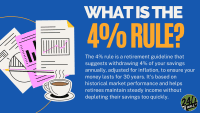
Pull 4% a year from an $800K portfolio, or pull 5%. The difference is $8,000 a year, every year. That money covers a trip, a car repair, or help with a grandchild’s tuition. It lands in your account now, and taking it feels reasonable.
The cost comes decades later, in the last five years of your plan, when you are oldest and have the fewest options to correct a shortfall. A four-fund mix of the JPMorgan Nasdaq Equity Premium Income ETF (NASDAQ:JEPQ), Schwab U.S. Dividend Equity ETF (NYSEARCA:SCHD), Global X U.S. Preferred ETF (NYSEARCA:PFFD), and Vanguard S&P 500 ETF (NYSEARCA:VOO) can make the higher rate more manageable, especially matched with a spending rule you set in advance.
Your Extra $8,000 Comes Out of the Final Stretch
Every extra dollar you spend early stops compounding. That shortfall builds quietly and lands at the far end of your horizon, so a plan built to last your lifetime can run dry in its final stretch, exactly when you are least likely to be able to return to work.
Timing makes the problem worse. If stocks fall hard in your first few years of retirement while you keep making withdrawals, you sell more shares at low prices to raise the same cash. Those shares miss the recovery. Planners call this sequence-of-returns risk: bad years early do the most lasting damage.
What Decades of Withdrawal Research Found
Financial planner William Bengen’s research and the Trinity study tested withdrawal rates against historical U.S. market periods. Both found the same pattern. Higher starting withdrawal rates ran out of money more often than lower ones.
A Spending Rule Makes 5% Survivable
The fix is a safeguard. Decide today that after a down year you will trim withdrawals, such as skipping that year’s inflation adjustment to your withdrawal, until the portfolio recovers. Write the rule down before the decline comes. Nobody volunteers to cut spending while their balance is falling, so you make the call while markets are calm.
JEPQ Reduces How Much You Sell in a Down Market
JEPQ owns large Nasdaq-100 stocks and collects option income through bank-issued structured notes, turning part of the market’s upside into monthly cash. Its largest positions as of June 30, 2026 included NVIDIA at 6.6% and Apple at 5.7%, with about $40.7 billion in net assets.
It paid $0.68255 per share in September, with monthly payments over the past year ranging from $0.44612 to $0.70497. That cash covers part of your withdrawal, so you sell fewer shares after a drop. The fund’s adjusted price rose 20.33% over the past year.
SCHD Gives Your Income a Raise
Your costs keep rising late in retirement. SCHD targets financially strong companies with sustainable dividends, holding QUALCOMM, Texas Instruments, and Coca-Cola, across about $94.9 billion in net assets. Its latest quarterly payout of $0.2665, payable September 28, exceeded the prior quarter’s payout of $0.2525. The fund returned 27.34% over the past year on an adjusted basis.
PFFD Adds a Separate Payment Stream
PFFD holds U.S. preferred shares, which pay set dividends and rank ahead of common stock. Issuers range from Boeing, its largest position at 4.7%, to Wells Fargo, NextEra Energy, and Southern Company. The $2.2 billion fund has paid $0.10 per share monthly, a steady pace that moves differently from your stock funds.
The risks are real. Preferreds trade like long-term bonds, so rising interest rates hurt their price. The 10-year Treasury yield rose to 5.18% on September 24 from 4.20% a year earlier, and PFFD’s adjusted price fell 2.78% over the past year. Heavy bank and insurance company exposure adds credit risk.
VOO Funds the Years You Cannot See Yet
A portfolio supporting 5% needs growth alongside income. The money you spend in your final years comes from growth your portfolio earns in the early ones. VOO tracks the S&P 500 for a 0.03% expense ratio, among the lowest costs available. Its adjusted price rose 18.57% over the past year and 321.54% over ten years, and its most recent quarterly distribution was $1.8226.
Trade-Offs to Weigh Before You Commit to 5%
Even with this mix, 5% carries risk. JEPQ trades away some upside in strong rallies. SCHD’s dividends can be cut. PFFD can fall when rates rise. With the 10-year Treasury near 5.18%, government-backed income at that yield is available, which none of these funds can guarantee.
Still, the extra $8,000 is real, and so is the risk to your last five years. Growth from VOO, rising dividends from SCHD, monthly cash from JEPQ and PFFD, and a spending rule set in advance give the higher rate the structure it needs to last.
Contact [email protected] for any questions or corrections.
Ryne Mauck is an investment writer covering exchange-traded funds, retirement planning, and portfolio strategy. Through his work at 24/7 Wall St. and other investment platforms, including Seeking Alpha, he aims to provide clear, research-driven insights that help investors make more informed decisions while maintaining a long-term approach to investing.
Ryne holds a B.Sc. in Finance and an M.A. in Political Science. He is a formerly registered Municipal Advisor Representative and has passed the Series 50, Series 63, and Series 65 exams. His articles are not intended to be, nor should they be interpreted as, financial advice.