AMD Pays $8.2 Billion in Stock for Non-Chipmaking Startup as CEO Bets on Physical AI
Lisa Su just committed billions in AMD stock to a startup that makes virtual worlds instead of chips, betting that understanding physical AI from the inside is the only way to outmaneuver NVIDIA where it matters most.

This post may contain links from our sponsors and affiliates, and Flywheel Publishing may receive compensation for actions taken through them.
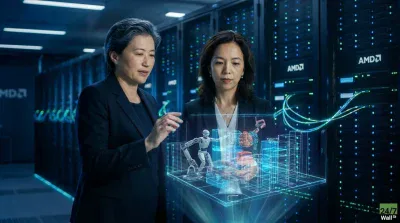
AMD (NASDAQ:AMD | AMD Price Prediction) will hand over $8.2 billion of its own stock for World Labs, a startup whose product is software that generates three-dimensional worlds, according to reporting from CNBC’s Kate Rooney.
The buyer is AMD, and the seller’s founder is Fei-Fei Li, the computer scientist best known for creating the ImageNet dataset that helped launch modern computer vision.
Chief Executive Lisa Su’s logic is that you cannot design competitive silicon without understanding the models that will run on it. AMD’s hardware roadmap already runs through the biggest AI labs.
Shares closed at $607.87 in the latest session, down 3.61% on the day but up 183.84% year to date. A move that size sets a high bar for this deal.
AMD trades at about 162 times trailing earnings and roughly 40 times forward earnings. Investors are already pricing in years of AI growth, so this acquisition must produce returns that justify the expectations built into the stock price.
What AMD Actually Bought With World Labs
Spatial intelligence is software’s ability to understand a physical scene: where objects sit, how far apart they are, and what happens when one moves.
World Labs builds models that generate full three-dimensional environments, which robotics and simulation teams use to train machines before real-world deployment. The field is now called physical AI.
A language model predicts the next word in a sequence. A world model has to keep geometry, lighting, and physics consistent from every angle a robot might see.
Those workloads are memory hungry, fitting Su’s remark that “larger model sizes really benefit from the larger memory footprint.”
Why AMD Chose to Pay Entirely in Stock
Paying in shares preserves cash. AMD held $13.1 billion in cash and short-term investments at the end of the second quarter, and an all-stock deal keeps that money available for the Helios ramp.
Existing holders absorb the cost through dilution, although the price is small next to a market value above $1 trillion.
The effective price depends on whether AMD shares are fairly valued. If they are rich, the structure favors current shareholders, because they exchange expensive paper for a real asset while World Labs’ owners carry the risk of a drop.
NVIDIA’s Software Moat Is What AMD Is Really Chasing
NVIDIA (NASDAQ:NVDA) has kept developers loyal through CUDA, the software layer that makes moving code to another chip costly.
AMD has narrowed that gap with ROCm. Su said “more than 3 million models now run out of the box on AMD,” and open source contributions to ROCm have increased more than tenfold over the past year.
World Labs adds an in-house workload for tuning Instinct GPUs and a star researcher who can recruit talent.
The deal likely buys credibility in physical AI faster than it closes the ecosystem gap, because NVIDIA already sells robotics simulation tools to the customers World Labs will court.
(For readers thinking about who else gets paid as this expansion continues, 24/7 Wall St. walked through seven suppliers behind the AI boom that aren’t chipmakers in a free report you can grab here.)
Risks That Could Erode the Value of This Deal
Key person risk comes first. Much of World Labs’ value rests on Fei-Fei Li, who is joining AMD as an executive, and founder retention after acquisitions is uneven.
The transaction still needs regulatory clearance, so management’s closing timeline remains an expectation until reviewers sign off.
The largest risk is the distance between research and product adoption. World Labs’ models must become tools that run clearly better on AMD hardware, and that translation can take years.
AMD Stock After the World Labs Deal
The bull case for AMD treats World Labs as a small option on top of a data center business that is compounding quickly.
Data Center revenue grew 107% year over year to $6.72 billion in the second quarter, and management now expects the segment to more than double year over year in 2027.

Third-quarter guidance of about $13 billion supports that path, and 40 times forward earnings is defensible for that growth rate.

If you want purer exposure to physical AI and robotics demand, NVIDIA is the cleaner choice because its simulation and robotics software already has developer adoption. The compromise is owning a larger incumbent with less catch-up upside than AMD still offers.

AMD stock is indeed a buy, but I’m more bullish on NVDA stock long-term, as it is far less expensive.
Contact [email protected] for any questions or corrections.
Omor Ibne Ehsan is a writer at 24/7 Wall St. He is a self-taught investor with a focus on growth, cyclical, and dividend equities that have strong fundamentals, value, and long-term potential. He also has an interest in high-risk, high-reward investments such as penny stocks.