This 1 Number Will Be NVIDIA’s Catalyst Before It Reports Earnings in August
A quiet software release tied to SIGGRAPH 2026 may matter far more to NVIDIA's next decade than its blockbuster hardware lineup, and a single number buried in the announcement explains why investors should pay attention before August 26.


NVIDIA (NASDAQ:NVDA | NVDA Price Prediction) just quietly reset how investors should think about its next decade. The chip story is well told. The software story now has a number.
The Number
Three. That is how many open-source Omniverse libraries NVIDIA is releasing on GitHub as part of its Agent Toolkit expansion tied to SIGGRAPH 2026: ovrtx, ovphysx and CAD-to-SimReady. Three libraries sound modest. What they actually do is embed NVIDIA’s simulation stack directly inside the 3D and CAD tools engineers already use, letting AI agents handle sensor simulation, physics, and asset validation without leaving Houdini, Onshape, or Blender. That is the anchor: three open-source libraries designed to make NVIDIA the default runtime for physical AI development.

What It Means
NVIDIA’s physical AI thesis has always needed a software layer to match the hardware. This is that layer. NVIDIA is meeting developers inside the tools they already run. SideFX is integrating the libraries into Houdini. PTC (NASDAQ:PTC) is integrating them into Onshape. Four Inception startups (ForgeCAD, Lightwheel, Moonlake AI, and Palatial) are building agent-driven workflows on top. Every one of those integrations is a lock-in point.
The financial scale behind this software push is already visible in the reported numbers. Q1 FY27 Data Center revenue reached $75.25 billion, up 92% year over year, with Data Center Networking revenue of $14.8 billion, up 199% year over year. Total revenue landed at $81.61 billion, up 85.2%, with non-GAAP EPS of $1.87 versus a $1.7738 estimate. The company is guiding Q2 FY27 revenue to $91.0 billion plus or minus 2% at a 75% non-GAAP gross margin. Those margins are the tell. Hardware alone rarely runs at that level for long. Software attach does.

Market Reaction
The stock has cooled since the Q1 FY27 filing. Shares traded around $206.86 on Aug. 3, down nearly 12% from their year-to-date high. But over the past month, NVIDIA is up 5.78% with a one-year gain of nearly 15%. Longer horizons still tell the compounding story: 916% over five years. Market cap sits near $5.01 trillion against a P/E of 31 and a forward P/E of 23. NVIDIA reports Q2 FY27 financials on Aug. 26, and shares could rally into the company’s earnings call, especially with a renewed focus on the three-library release.
The Bull Case
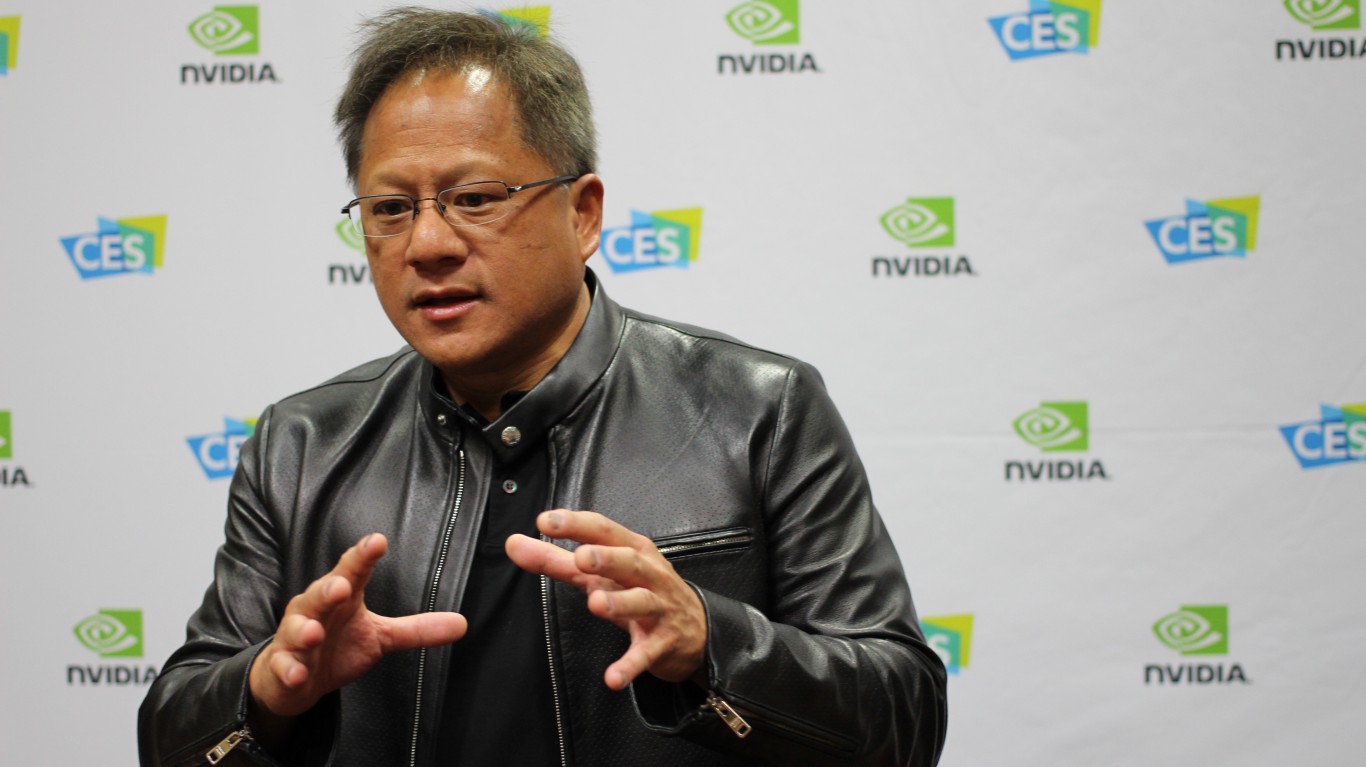
The three-library release matters because it converts NVIDIA’s hardware lead into a developer standard. Jensen Huang framed it directly: “The physical AI era will be built in simulation first.” If that is correct, the company that owns the simulation runtime owns the training ground for every robot, autonomous vehicle, and industrial system that follows.
The rest of the R&D disclosure reads like an argument for the same thesis. NVIDIA announced NemoClaw for the OpenClaw agent platform, OpenShell with privacy and security controls, and an Agent Toolkit for building autonomous enterprise AI agents. It rolled out Alpamayo 1.5 and Omniverse NuRec for autonomous driving, new Cosmos and Isaac GR00T N models, and the Halos OS unified safety architecture. It expanded partnerships for autonomous driving with Hyundai, Kia, Uber, BYD, Geely, Isuzu, and Nissan. On the compute side, the Vera Rubin platform and BlueField-4 STX anchor the next generation, and NVIDIA Dynamo 1.0 boosts generative and agentic inference on Blackwell GPUs by up to 7x.
Huang’s own framing from the call: “Agentic AI has arrived, doing productive work, generating real value and scaling rapidly across companies and industries. NVIDIA is uniquely positioned at the center of this transformation as the only platform that runs in every cloud, powers every frontier and open source model, and scales everywhere AI is produced, from hyperscale data centers to the edge.”
Capital return backs the operating story. The board approved an additional $80 billion share repurchase authorization, raised the quarterly dividend from $0.01 to $0.25 per share, and returned approximately $20.0 billion to shareholders in Q1. Analyst positioning is lopsidedly constructive, with 48 Buy ratings, 10 Strong Buy ratings, two Hold ratings and one Sell ratings, and an analyst target price of $302.31.

Bottom Line
Three libraries do not sound like a moat until you notice where they land: inside Houdini, inside Onshape, inside the tools engineers already trust. That is how software ecosystems compound. Long-term holders should track two catalysts from the input data. First, the RTX Spark systems arriving in fall 2026 from ASUS, Dell, HP, Lenovo, Microsoft Surface and MSI, which put local physical AI compute in developer hands. Second, the Q2 FY27 guidance of $91 billion plus or minus 2%, which is the next reported test of whether agentic and physical AI demand keeps compounding. Three libraries. One thesis. A company that keeps making its ecosystem harder to leave.
Contact [email protected] for any questions or corrections.
Joel South covers large-cap stocks, dividend investing, and major market trends, with a focus on earnings analysis, valuation, and turning complex data into actionable insights for investors.
He brings more than 15 years of experience as an investor and financial journalist, including 12 years at The Motley Fool, where he served as an investment analyst, Bureau Chief, and later led the Fool.com investing news desk. He has also co-hosted an investing podcast and appeared across TV and radio discussing market trends.