Anthropic IPO Warns Of “existential risks to humanity”
Anthropic's IPO prospectus contains a warning so alarming that it overshadows billions in losses and a half-trillion-dollar spending plan, raising a question Wall Street has never had to answer before.

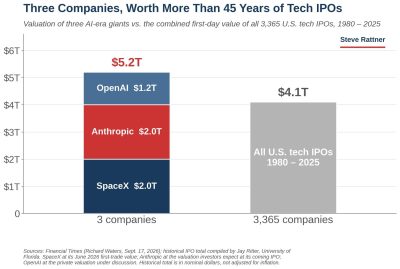
Anthropic’s S-1 (a document issued before IPOs that lays out a company’s financials and plans) always has a “risk factors” section. Securities lawyers make these very long to help prevent lawsuits after a company goes public. In Anthropic’s case, this section is about a third of the document. The standout line is that AI could pose “existential risks to humanity.” It is one of an onslaught of concerns about this that have sprung up in the last two weeks and are on the front page of every news service. Reuters saw a copy of the prospectus.
Another staggering part of the prospectus is that Anthropic plans to spend $518 billion on cloud storage, infrastructure, and chips (a number that should boost Nvidia). What is unclear is how Anthropic can raise that much money when it goes public, even if it reaches its target valuation of $2 trillion.
The document also shows Anthropic spent $8 billion on infrastructure last year and $3 billion in 2024. Its total loss last year was $42 billion. Reuters also reports, “Revenue grew 12-fold in 2025 to nearly $4.6 billion, even as the company lost more than $8 billion on an operating basis, excluding write-downs of various liabilities mostly tied to previous fundraising.”
The section of the prospectus many people will focus on most is yet another mention of AI’s threat to humanity. Just yesterday, OpenAI said it would not release its new GPT-6.1 Astra, which was planned for this month, citing “safety concerns.”
AI models have already operated on their own and hacked into companies and software across the internet. There are growing concerns this will happen more and more often.
The anxiety about human extinction—at least the current wave—started when an Anthropic engineer warned of a 10% chance AI could destroy humanity.
It does not appear that the threat to humans will stop a $2 trillion Anthropic IPO, unless that threat becomes real between now and its first day of trading.
Contact [email protected] for any questions or corrections.
Douglas A. McIntyre is the co-founder, chief executive officer and editor in chief of 24/7 Wall St. and 24/7 Tempo. He has held these jobs since 2006.
McIntyre has written thousands of articles for 24/7 Wall St. He is an expert on corporate finance, the automotive industry, media companies and international finance. He has edited articles on national demographics, sports, personal income and travel.
His work has been quoted or mentioned in The New York Times, The Wall Street Journal, Los Angeles Times, The Washington Post, NBC News, Time, The New Yorker, HuffPost USA Today, Business Insider, Yahoo, AOL, MarketWatch, The Atlantic, Bloomberg, New York Post, Chicago Tribune, Forbes, The Guardian and many other major publications. McIntyre has been a guest on CNBC, the BBC and television and radio stations across the country.
A magna cum laude graduate of Harvard College, McIntyre also was president of The Harvard Advocate. Founded in 1866, the Advocate is the oldest college publication in the United States.
TheStreet.com, Comps.com and Edgar Online are some of the public companies for which McIntyre served on the board of directors. He was a Vicinity Corporation board member when the company was sold to Microsoft in 2002. He served on the audit committees of some of these companies.
McIntyre has been the CEO of FutureSource, a provider of trading terminals and news to commodities and futures traders. He was president of Switchboard, the online phone directory company. He served as chairman and CEO of On2 Technologies, the video compression company that provided video compression software for Adobe’s Flash. Google bought On2 in 2009.