3 Semiconductor Stocks With Fortress Balance Sheets and Proven Dividend Raises
Most chipmakers struggle to sustain dividends through brutal industry downturns, but three semiconductor companies have quietly built the cash flow machines and balance sheet discipline to keep raising payouts no matter where the cycle goes.

Chipmakers have a reputation for wild earnings swings and huge factory bills, both of which can strain a steady dividend. That makes the few semiconductor companies that keep raising their payouts worth a closer look, because every check they mail says the business throws off cash through the whole cycle. The clearest example came when Texas Instruments (NASDAQ:TXN | TXN Price Prediction) increased its dividend 7% to $1.52 per share, marking 23 consecutive years of increases. The three names below are Broadcom (NASDAQ:AVGO), Texas Instruments and Qualcomm (NASDAQ:QCOM). Their yields are modest. Their cash flows are what make them notable for income investors, and each one has a different kind of cycle risk.
Broadcom: Record Free Cash Flow Dwarfs the Dividend Bill
Broadcom has the lowest yield in this group at 0.76%, based on an annualized dividend of $2.60 per share and a recent price of $355.14. The dividend is lowest next to the share price, but it is very well covered.
Dividend safety: Broadcom produced $13.7 billion of free cash flow in its fiscal third quarter, equal to 46% of revenue. It paid $3.1 billion in dividends over the same period. Measured against trailing earnings per share of $7.83, the annual dividend takes about 33% of profits. The balance sheet is moving the right way. Cash ended the quarter at $24 billion, management repaid $5.6 billion of long-term debt during the quarter, and it retired another $1.5 billion of notes after the quarter closed. The remaining $59.6 billion of fixed-rate debt has an average coupon of 4%.
Track record: Broadcom has paid a dividend every quarter since December 2010, and the amount has stepped up many times. The two most recent increases took the quarterly payout from $0.53 to $0.59 to $0.65. The last raise was declared on December 9, 2025, so income investors should keep an eye on the fiscal fourth-quarter earnings report scheduled for December 9, 2026.
Bull case: Broadcom designs custom AI accelerators for hyperscalers including Google, Meta and OpenAI, sells the Ethernet switches that connect them, and runs an infrastructure software business with a 94% gross margin. AI semiconductor revenue reached $16.7 billion in the quarter, up 221% year over year. Management guided fourth-quarter revenue to about $34.8 billion and expects fiscal 2027 AI revenue of around $115 billion (that kind of early-mover setup is exactly what we studied in our free Next Nvidia playbook). Hock Tan, the chief executive on the call, put it this way: “Q3 demand was simply hot and we’re just getting started.” The stock trades at about 19 times forward earnings, so investors get that growth plus a growing payout.
Risk: This is a cycle tied to a handful of customers. Broadcom’s AI outlook depends on six XPU customers, and management said installations still depend on land, power and data center shells being ready. Should leading AI labs pull back on spending, Broadcom’s cash growth could stall quickly, even though the dividend would still be covered by a wide margin.
Texas Instruments: 23 Straight Years of Raises and a Cash Flow Rebound
Texas Instruments yields about 2.07%, based on its new annualized dividend of $6.08 and its stock trading at $293.80. The newly raised $1.52 quarterly payment goes out on November 10 to shareholders of record on October 30.
Dividend safety: TI has the best dividend-growth record of the three. The quarterly payout went from $1.24 in 2023 to $1.30, $1.36, $1.42 and now $1.52, with one raise each autumn. Coverage is lower than at Broadcom. Trailing dividends of $5.62 per share against trailing EPS of $6.58 work out to a payout ratio near 85%. Free cash flow is what has changed. Trailing 12-month free cash flow reached $6.5 billion, up from $1.8 billion a year earlier, and TI returned $5.8 billion to owners over that stretch. The balance sheet holds $7 billion of cash and short-term investments against $14 billion of debt.
Bull case: TI makes analog and embedded processing chips. These are low-cost, long-lived parts that go into factory equipment, cars and power systems. Second-quarter revenue rose 22.82% to $5.463 billion, and data center revenue doubled year over year. For income investors, capital spending matters most. Quarterly capex fell to $514 million from $1,305 million a year earlier now that the heavy 300mm factory work is done, and that freed-up cash can go to shareholders. Management guided third-quarter revenue to $5.65 billion to $6.15 billion. The stock is up 72.21% year to date, which tells you investors already expect the recovery to last.
Risk: If the cycle turns, there is little buffer. The around 85% payout ratio leaves little room if industrial demand fades, and trailing free cash flow includes $1.6 billion of CHIPS Act incentives that will not repeat forever. Management also plans to fund the Silicon Labs acquisition with cash and new debt. A downturn would test how far that 23-year run can stretch. At about 28 times forward earnings, investors are paying up for the recovery.
Qualcomm: Licensing Cash and a Massive Buyback Back Up the Payout
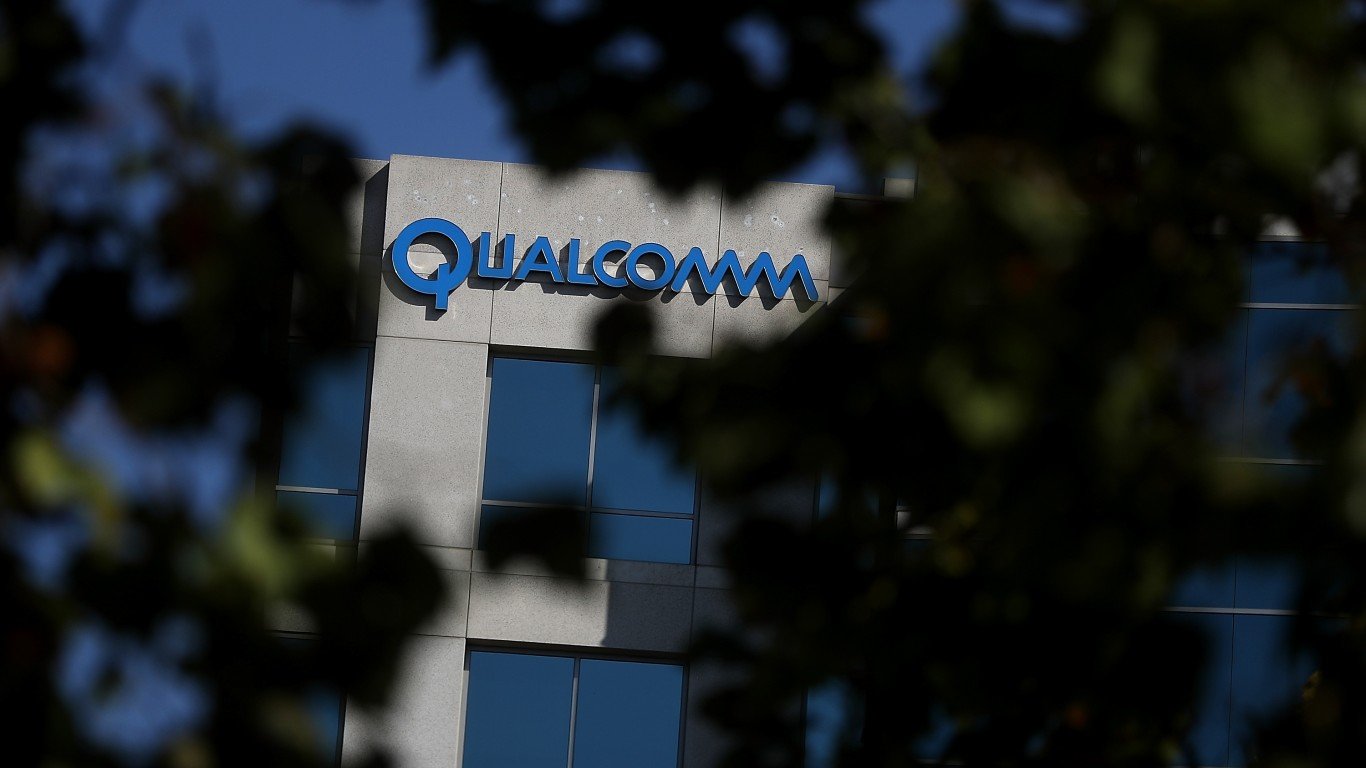
Qualcomm yields 1.93% on an annualized dividend of $3.68, with the latest quarterly check at $0.92. Its free cash flow yield is 6.49%, which means the dividend uses only about 30% of the free cash flow the business produces.
Dividend safety: The balance sheet is conservative. Debt to equity is 0.77, net debt is just 0.61 times EBITDA, with interest coverage at 18.61x. Qualcomm returned $2.3 billion to shareholders in its fiscal third quarter, including $1.4 billion of buybacks, and it has a $20 billion repurchase authorization in place. Because so much of the payout goes to buybacks, management could slow repurchases in a downturn and leave the dividend alone. The record shows a raise every year from 2020 through 2026, most recently from $0.89 to $0.92. Over the full history, the quarterly payout has grown from $0.05 in 2003.
Bull case: Qualcomm sells Snapdragon processors for phones, cars and connected devices, and it takes in patent royalties through its QTL licensing arm. That licensing business posted a 69% EBT margin, a high-margin source of cash that does not depend on building chips. The company also renewed its global patent license agreement with Apple in September. Automotive revenue rose 61% to $1.588 billion, its 23rd straight quarter of double-digit growth. Management is targeting $40B in non-handset revenue by fiscal 2029, helped by data center work that includes a new multi-generational collaboration with Amazon.
Risk: Qualcomm faces a handset cycle hitting at the same time as rising costs. Handset revenue fell 20% to $5.086 billion, and net income dropped 24.91% as memory, wafer and packaging costs rose. Management expects Apple product revenue to fall about 50% from the September quarter to the December quarter, and it guided chip-segment margins down to 23% to 25%. Non-GAAP EPS of $2.21 missed the $2.22 consensus estimate. Earnings coverage is weaker than cash coverage right now, with the stock at about 36 times trailing earnings.
Three Chipmakers, Three Ways to Get Paid Through the Cycle
Broadcom has the widest coverage and the lowest yield, and AI cash flow is funding both the dividend and debt paydown. Texas Instruments has the strongest raise record and the highest yield of the three, but also the thinnest payout buffer, so its upcoming third-quarter report matters most for the dividend. Qualcomm sits in the middle: free cash flow covers the dividend comfortably, licensing royalties add a steady stream of cash, and a big buyback can be cut back before the dividend is touched. For income investors who want chip exposure, all three dividends look well supported by cash flow at this point in the cycle.
Contact [email protected] for any questions or corrections.
Chris Lange is a financial and geopolitical writer with more than a decade of experience covering a myriad of topics. He has published thousands of articles for 24/7 Wall St., with past coverage focused heavily on stocks, IPOs, healthcare, defense, global affairs, and technology.
His work has been quoted, or referenced by a number of outlets including Business Insider, USA Today, Yahoo Finance, MSN, The Motley Fool, and many other publications. A graduate of Southwestern University, he studied business with a focus on investments and has previous experience in banking and startups.
When not reading or writing the news, he is following his passion for Lacrosse, playing chess, or building solar projects with his dad.