Constellation Brands or Lamb Weston: One Is Selling More and Earning Less. The Other Is Selling Less and Earning More.
Two consumer defensive stocks are headed in opposite directions at once, with one racking up sales while profits shrink and the other watching revenue fall while earnings surge. Before both report on the same October morning, one pattern has to…


Does Constellation Brands (NYSE:STZ | STZ Price Prediction) or Lamb Weston (NYSE:LW) hold up better? These consumer defensive names mirror each other: Lamb Weston is selling more and making less; Constellation is selling less and making more. Only one of these patterns can be sustained for another quarter.
Lamb Weston says it will report fiscal 2027 first-quarter results on October 6, 2026, at approximately 8:00 a.m. ET, and Constellation says it will report its second-quarter fiscal 2027 results after the U.S. close on October 6, 2026, with an analyst call at 8:00 a.m. ET on October 7, 2026.
Similar Yields Shift the Tiebreak to Durability
Lamb Weston yields 3.5%, and Constellation yields 3.7%. Constellation’s $4.12 annual dividend per share reflects its $113.52 share price, while Lamb Weston’s $1.52 reflects $43.90. Both have low beta: 0.40 for Constellation and 0.46 for Lamb Weston, making both true defensive holdings.
Constellation turns 20.1% of revenue into net profit and achieves a 23.7% return on equity. Lamb Weston posts 4.39% net profit margin and 16.3% return on equity, respectively. Constellation has a significantly larger earnings buffer to support its dividend.
Winner: Constellation Brands
Mirror-Image Growth Reveals Who Is Paying for Volume
| Metric | Lamb Weston | Constellation |
|---|---|---|
| Quarterly revenue growth | 5.6% | −3.3% |
| Quarterly earnings growth | −6.2% | 30.7% |
| Operating margin | 9.8% | 35.9% |
At Lamb Weston, volume rose 7% while price/mix fell 6%. Edible oil and freight costs jumped, and underutilized European plants led to an announced closure in the Netherlands.
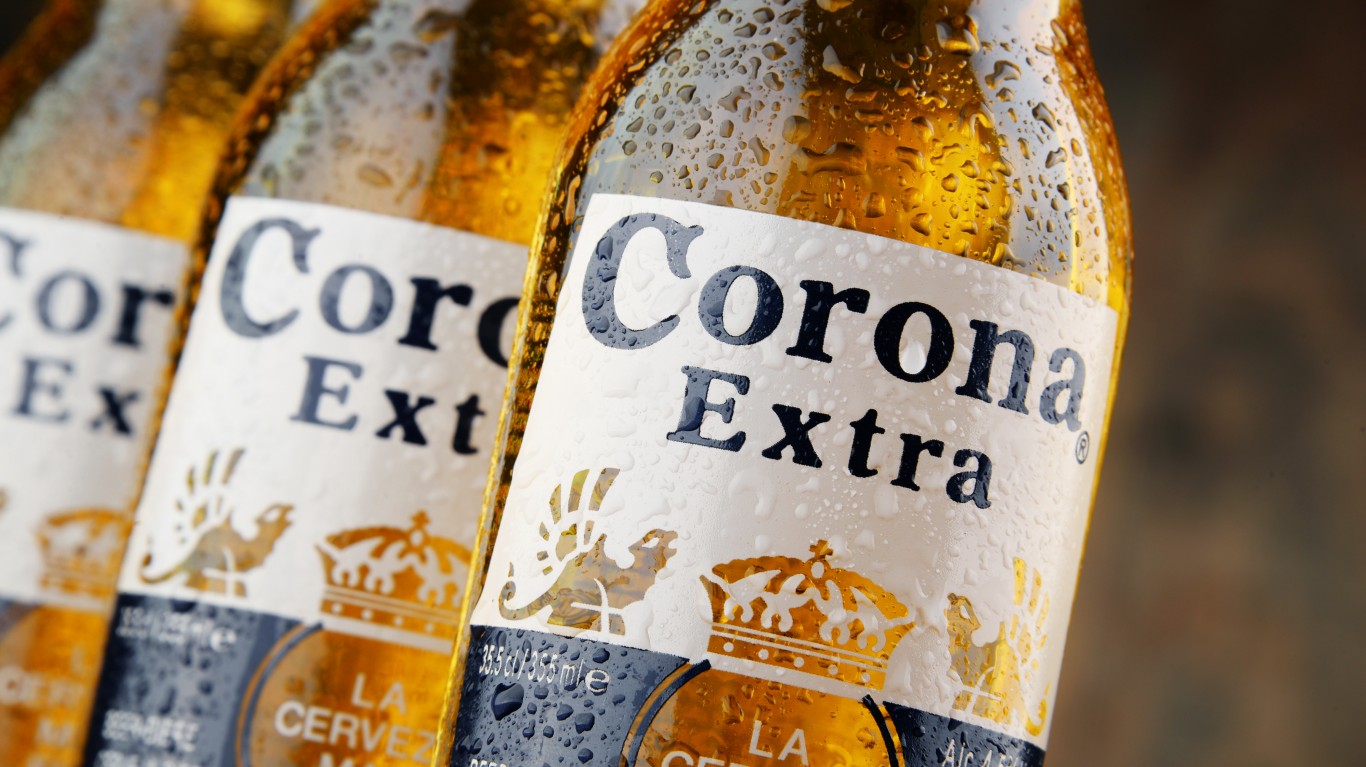
At Constellation, most of the revenue drop comes from wine brand divestitures. Organic net sales rose 3%. Beer gross margin reached 39% from better factory cost coverage, cost savings, and pricing. Modelo Especial depletions fell 2% and Corona Extra fell 5%.


Potato processing relies on commodity inputs and capital-intensive plants, while imported beer commands brand pricing power. Lamb Weston’s real problem is that earnings are moving in the wrong direction.
Winner: Constellation Brands
Pessimism Already Priced Into Constellation
Lamb Weston is up 2.8% this year but fell 13.6% over the past month and 31.5% over the past year. It trades below its $54.33 analyst target within a 52-week range of $37.62 to $67.07.
Constellation is down 19.2% this year, 21.6% over one year, and 47.7% over five years. It trades just above its $110.60 52-week low and well below its $163.35 target, so it doesn’t need much good news to surprise.
Constellation has a trailing earnings multiple of 11 and a forward earnings multiple of 10. Lamb Weston trades at 21 and 14. On EV/EBITDA, Constellation’s 9.29 is lower than Lamb Weston’s 10.19.
Winner: Constellation Brands
Constellation Brands Earns the Retirement Slot
Constellation wins. It offers a similar yield, much better margins, a lower valuation, and a beaten-down stock price. Constellation’s revenue drop comes mostly from wine divestitures; management confirmed fiscal 2027 comparable EPS guidance of $11.20 to $11.90. Lamb Weston’s growing sales may appeal to turnaround investors, but with thin margins and a trailing multiple nearly twice Constellation’s, buyers are paying more for less profit. The biggest risk for Constellation is a continued decline in its core beer brands. If Modelo Especial and Corona Extra volumes keep shrinking, the margin story falls apart.


What to Watch in the Releases
- Lamb Weston: international EBITDA, expected to rise 40% to 50% in fiscal 2027.
- Constellation: beer depletions compared with last quarter’s 1.8% shipment growth.
Contact [email protected] for any questions or corrections.
Trey has been an editor and author at 24/7 Wall St. for more than a decade, where he has published thousands of articles analyzing corporate earnings, dividend stocks, short interest, insider buying, private equity, and market trends. His comprehensive coverage spans the full spectrum of financial markets, from blue-chip stalwarts to emerging growth companies.
Beyond 24/7 Wall St., Trey has created and edited financial content for Benzinga and AOL's BloggingStocks, contributing additional hundreds of articles to the investment community.
Trey's editorial expertise extends across multiple publishing environments. He served as production editor at Dearborn Financial Publishing and development editor at Kaplan, where he helped shape financial education materials. Earlier in his career, he worked as a writer-producer at SVE. His freelance editing portfolio includes work for prestigious clients such as Sage Publications, Rand McNally, the Institute for Supply Management, the American Library Association, Eggplant Literary Productions, and Spiegel.
Outside of financial journalism, Trey writes fiction and has been an active member of the writing community for years, moderating workshop sessions at regional conventions.