STZ vs. HSY: Which Consumer Staple Will Deliver Consistent Dividend Growth?
Two consumer staples stocks sit near 52-week lows with nearly identical dividend yields, but one has been quietly raising payouts at six times the rate of the other while protecting margins through commodity chaos.

Constellation Brands (NYSE:STZ | STZ Price Prediction) and Hershey (NYSE:HSY) have nearly the same dividend yield, and both trade close to their 52-week lows. So which one better fits a retirement-income profile? Constellation yields 3.62% at $113.40. Hershey yields 3.58% at $159.91. The businesses behind those yields are very different.


Dividend and Income: Hershey’s Raises Keep Up With Inflation
Hershey’s forward dividend is $5.808 per share. It raised the quarterly payout to $1.452 from $1.37, an increase of about 6%. Its record goes back to a $0.24 quarterly payment in 1999. Constellation’s forward dividend is $4.12, and its latest raise was just 1%.
Constellation covers its dividend more easily. Its payout equals about 37% of the low end of its fiscal 2027 comparable EPS guidance of $11.20 to $11.90. Hershey’s equals roughly 69% of its $8.36 to $8.52 adjusted EPS guide. But Constellation directs its spare cash to buybacks: $924.1 million in fiscal 2026. A retiree needs income that grows faster than prices, and 1% increases don’t do that. Winner: Hershey.
Durability and Pricing Power: Hershey’s Margins Show It Can Raise Prices
In the second quarter, price increases added about 12 points to Hershey’s sales growth. Volume fell about 8 points, yet revenue still rose 6.6% to $2.79 billion. Adjusted gross margin expanded 350 bps to 41.6%, and adjusted operating margin expanded 450 bps to 20.2%. That came after a 2025 in which commodity costs pressured gross margin. Adjusted EPS of $1.90 beat the $1.43 consensus, Hershey’s fourth straight beat. Management also cited “good visibility into cocoa deflation next year.”

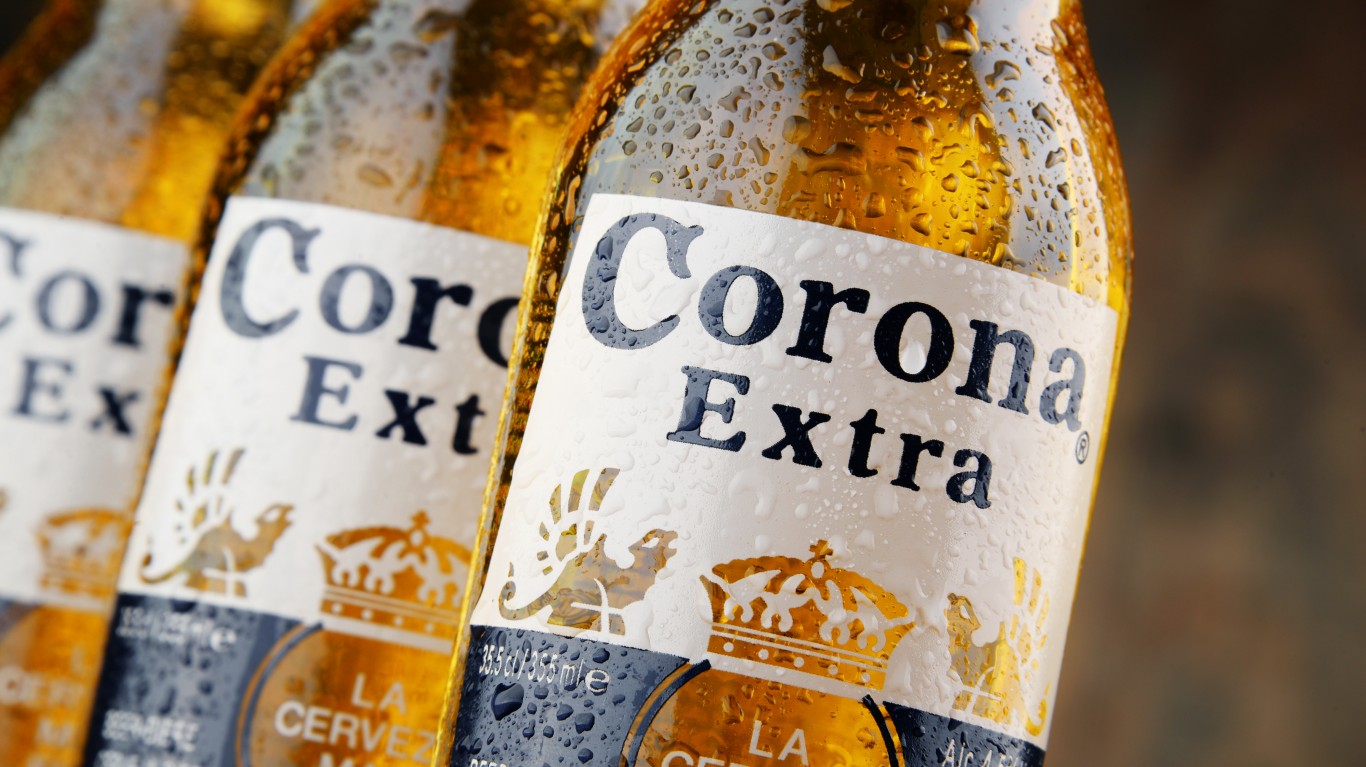
Constellation’s beer business is still very profitable, with a 39% beer gross margin. But pricing added only 20 basis points of margin in the quarter. Modelo Especial depletions (sales from distributors to retailers) fell 2%, and Corona Extra’s fell 5%. Fiscal 2027 organic net sales guidance is (1)% to +1%. The company also faces aluminum tariffs, heavy reliance on Mexican production and pressure on Hispanic consumers, and it pulled its fiscal 2028 outlook. CEO Nick Fink called it “a volatile quarter.” Winner: Hershey.
Valuation Versus History: Constellation Is Priced for Trouble
Constellation trades at 11 times trailing earnings and 10 times forward earnings. Hershey trades at 22 and 18. Constellation sits about 21% below its 200-day average of $143.57, just above its 52-week low of $111.54 and far below its high of $166.17. The stock is down 41.68% over five years. The average analyst target of $163.35, supported by 11 Buy and 3 Strong Buy ratings, suggests Wall Street thinks the discount has gone too far.

Hershey is down too, about 16% below its 200-day average of $191.2 and close to its 52-week low of $156.16. Even so, it costs about twice as much per dollar of earnings. Winner: Constellation, by a wide margin.
Verdict: Hershey Is the Retirement Holding
Hershey wins two of the three dimensions, and they are the two that matter most to retirees: income that keeps growing and a proven ability to protect margins. The long-term results agree. Hershey gained 113.57% over ten years, while Constellation lost 19.45%. Hershey’s beta (a measure of how much a stock moves with the market) is 0.097, compared with 0.4 for Constellation.
Constellation fits a different investor: a value buyer with a long view who wants a well-covered yield at a low multiple and can wait for beer sales to turn around. For income-focused retirement profiles, Hershey’s numbers line up better (the whole point of a dividend ladder is never having to sell a share, and we laid out how to build one in a free guide).
Here’s what would flip the conclusion. On Constellation’s side, it would take Modelo and Corona depletions growing again, a restored fiscal 2028 outlook and real dividend raises once the Veracruz brewery comes online. On Hershey’s side, the case weakens if cocoa costs don’t fall in 2027 or volume keeps dropping as prices rise. The next things to watch are Hershey’s Halloween season and Constellation’s next depletion report.
Contact [email protected] for any questions or corrections.
Chris Lange is a financial and geopolitical writer with more than a decade of experience covering a myriad of topics. He has published thousands of articles for 24/7 Wall St., with past coverage focused heavily on stocks, IPOs, healthcare, defense, global affairs, and technology.
His work has been quoted, or referenced by a number of outlets including Business Insider, USA Today, Yahoo Finance, MSN, The Motley Fool, and many other publications. A graduate of Southwestern University, he studied business with a focus on investments and has previous experience in banking and startups.
When not reading or writing the news, he is following his passion for Lacrosse, playing chess, or building solar projects with his dad.