Meta Stock Could Have Another Big Run Ahead. Here’s My 2027 Price Prediction
Meta's ad business just delivered its best monthly stock performance in three years, and the numbers suggest that run may not be finished. One valuation scenario points to a price Wall Street has not yet penciled in for 2027.


Meta Platforms (NASDAQ:META | META Price Prediction) just reminded investors what AI-powered advertising can do. Shares rose 26.79% in September, which was the stock’s best month since 2022. That run lifted year-to-date gains to 10.13%. The engine behind the rebound is Meta’s ad business.
Second-quarter ad revenue rose 27% to $59.36 billion, with impressions up 14% and price per ad up 12%. Management said that was faster growth than any other company’s reported ad business. With momentum back, let’s look at what it will take for Meta to reach $1,000 per share in 2027.
Wall Street Targets $794, Leaving Room for a Bigger Run
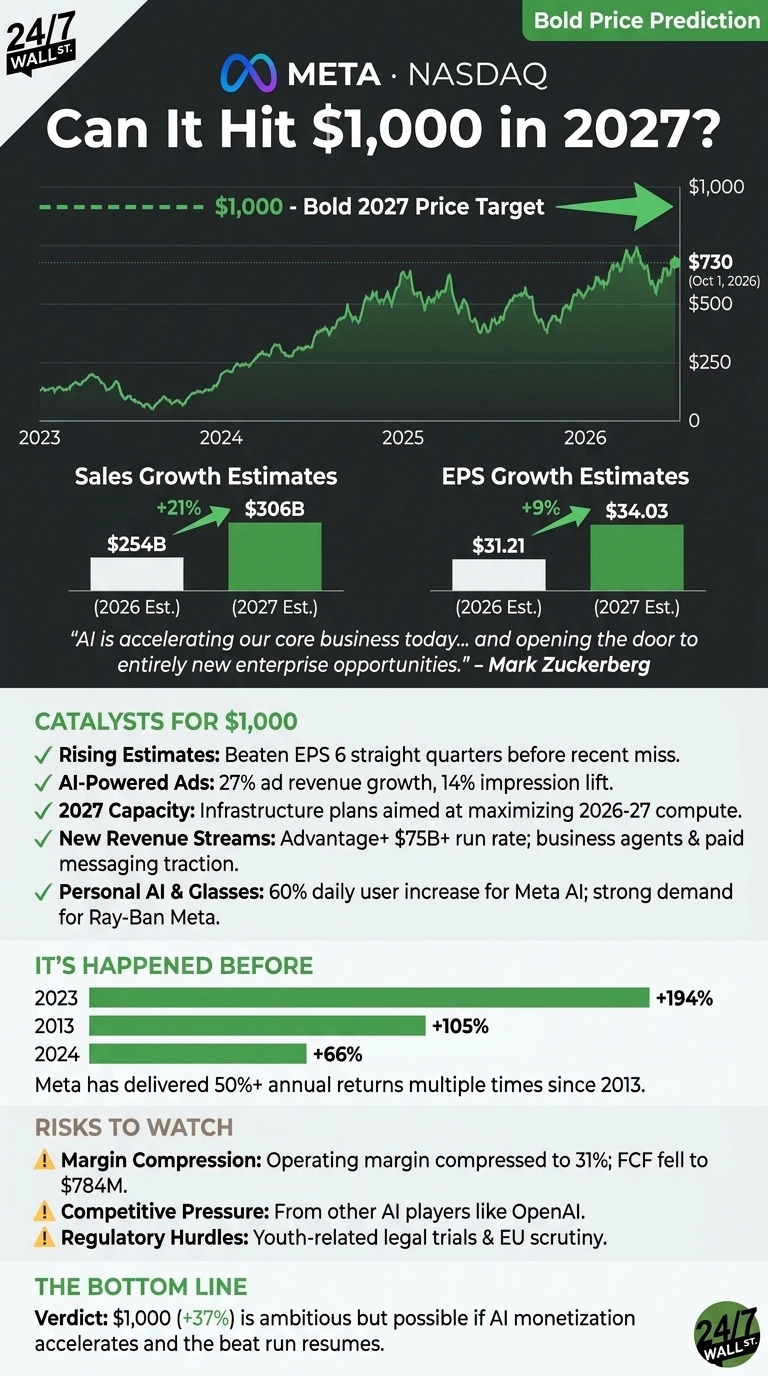
Analysts have an average price target of $793.91. That implies 8.8% upside from today’s $729.98. Ratings lean bullish: 8 Strong Buys, 47 Buys, 7 Holds and zero Sells.

For 2027, analysts expect revenue of $306.4 billion, up 21% from the 2026 estimate. They project EPS of $34.0317, up from $31.2129. Estimates have been falling. Ninety days ago, the 2027 EPS forecast stood at $34.9236, and analysts made 39 downward revisions against 7 upward during the trailing 30 days.
Second-quarter EPS of $6.18 missed the $7.22 consensus. That shortfall came from $2.40 billion in legal charges and $1.18 billion in severance.

Here’s What It Takes for Meta to Reach $1,000
At today’s price, Meta trades at 21x 2027 earnings estimates. That puts it level with the S&P 500’s forward multiple of roughly 21x to 23x. At $1,000, shares would trade at about 29x forward earnings. That premium has support: an 82% gross margin, 3.60 billion daily active people, and revenue growth above 20%.
What Could Push Meta to $1,000?
- A return to beating estimates: Meta exceeded EPS estimates for 6 straight quarters before the second-quarter miss. Without the one-time charges, Q2 operating income would have grown 9%.
- Capacity built for 2027: CFO Susan Li said Meta’s infrastructure plans aim at “maximizing 2026 and 2027 capacity,” and that Meta has “numerous ROI positive places” to put more compute to work.
- New revenue streams: More than 1 million businesses use Business Agents every week. Advantage Plus has passed a $75 billion annual run rate. Other Family of Apps revenue reached $1 billion, up 73%.
- Personal AI and glasses: Daily Meta AI users rose 60% after Muse Spark was integrated. Reality Labs revenue grew 16% on demand for AI glasses. Mark Zuckerberg called personal agents a potentially “extremely important and massive market.”

Hurdles remain: free cash flow fell to $784 million last quarter. Muse also faces competitive pressure from OpenAI, and youth-related legal trials are still pending.
Meta’s History Says a 37% Gain Is Within Reach
Reaching $1,000 requires a 37% gain. Meta has beaten that mark in six years since 2013.
Shares rose 194% in 2023, 105% in 2013, 66% in 2024, 57% in 2019, 53% in 2017 and 43% in 2014. The stock also fell 64% in 2022, so the swings run both ways.
$1,000 Is a Stretch, but Here’s Why It’s Possible
Meta needs a 37% gain to reach $1,000, which is well above Wall Street’s target. Still, the stock trades near the market’s multiple while revenue grows above 20%.
The 2026 capex plan of $130 billion to $145 billion is aimed directly at 2027 capacity, and that spending flows straight to the power, cooling, and networking suppliers behind the data centers (we covered seven of them in a free report on the AI infrastructure buildout).
If the beat run resumes and AI products start producing revenue, a rerating to 29x is possible. Such gains are rare in any single year, but this is the pattern for how Meta could deliver outsized returns in 2027.
Contact [email protected] for any questions or corrections.
Vandita Jadeja is a financial publisher with over a decade of experience writing about financial topics, including investment, savings, retirement, insurance and banking. Vandita is a Chartered Accountant who loves to debunk financial concepts for readers.
Her work has appeared on sites that include The Motley Fool, InvestorPlace, and Benzinga. She covers investing and focuses on stock picks and price prediction for 24/7 Wall St.
When not looking for the next stock investment opportunity, she can be found traveling, reading, chasing sunsets and enjoying her iced latte.