The Grocery Aisle Dividend Bundle: 4 Packaged Food Stocks, 4 Very Different Dividend Stories
Four packaged food stocks sit on the same grocery shelves, but their dividends tell completely different stories about which companies are quietly rebuilding and which ones are still in danger of the next cut.

The center of the grocery store has been a hard place to own stocks. Conagra Brands (NYSE:CAG | CAG Price Prediction) has lost 48.84% of its value over five years, and General Mills (NYSE:GIS) and Campbell’s (NASDAQ:CPB) have also fallen hard. J.M. Smucker (NYSE:SJM) has gone the other way. All four sell off the same shelves, but each one leaves income investors with a very different dividend check and a very different level of safety.
General Mills: 127 Years of Payments and an Ultra-High Yield With a Catch
General Mills yields about 7.6% on its $2.44 annualized dividend at a share price of $32.02. It qualifies as an ultra-high-yield stock, but consider where that yield came from. The quarterly payout has been $0.61 since 2025, while the shares are down 27.83% year to date and 35.86% over five years. When the price falls and the dividend stays the same, the yield rises on its own. In this case the high yield reflects doubt in the market, with the payout itself unchanged.
Its dividend history is strong. General Mills is in its 127th consecutive year of continuous dividends, and the quarterly rate went from $0.59 to $0.60 to $0.61 before leveling off. Coverage is lower. Against fiscal 2027 adjusted EPS guidance of $3.00 to $3.20, the dividend uses roughly 76% to 81% of earnings. Fiscal 2026 free cash flow was $1.63B. In the seasonally light first quarter, free cash flow came to $207.3 million, while dividends paid were $330.5M. Leverage is running “just a touch” above four times net debt to EBITDA, against a three-times target that management says will take “at least a couple years” to reach.
Bull case: The company’s pressures have names. Stretched shoppers are waiting for promotions, smaller insurgent brands are taking fruit snack share, and Wilderness dry dog food is shrinking. Management is responding with $750 million of fiscal 2027 cost savings, $3 billion in total by fiscal 2030, and new products that grew from 3% to 5% of net sales. Organic sales held flat last quarter, and adjusted EPS of $0.75 beat the $0.72 consensus.
Risk: Adjusted operating profit is guided down 8% to 13% in constant currency this fiscal year, which leaves very little room for the payout to grow.
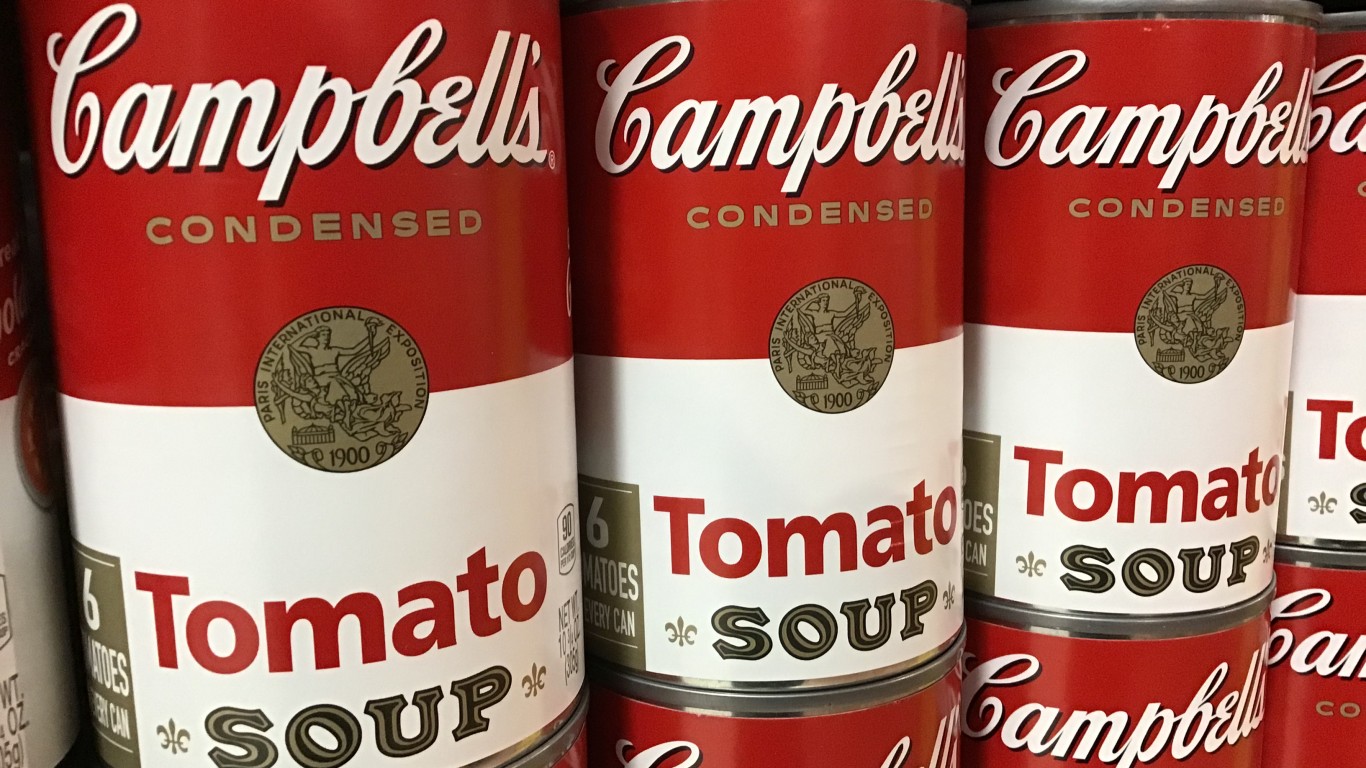
Campbell’s: A 36% Dividend Cut That Rebuilds Coverage
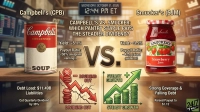
Campbell’s yields about 5.1% on its new $1 annualized dividend at $19.62. Trailing yield screens show a bigger number because they still include the old $0.39 checks. If you buy at today’s price, the reset rate is what you will collect. The shares are down 25.13% year to date and 41.77% over five years.
The board cut the quarterly payout to $0.25, a 36% reduction, to speed up debt reduction. Before that, the dividend rose in small steps: $0.35 from 2017, $0.37 from late 2021 and $0.39 from 2025. Coverage is now much better. The new rate uses about 56% to 61% of fiscal 2027 adjusted EPS guidance of $1.65 to $1.80. Fiscal 2026 free cash flow was $678 million, against $470 million of dividends at the old rate. The balance sheet is the pressure point: total liabilities are $11.49B against equity of $3.85B, and a $500 million bond comes due in March.
Chief executive Mick Beekhuizen called the cut “a difficult decision, but it’s an unfortunately necessary decision that we needed to take.”
Bull case: Rao’s, Goldfish, Pepperidge Farm and Swanson give Campbell’s real pricing power, and Meals & Beverages organic sales grew 3%. A new $500M cost-savings program runs through fiscal 2030, and the company plans price increases on roughly 60% of its portfolio.
Risk: Snacks are getting worse. Segment operating earnings fell 34% in the fourth quarter, and the company took $117M in impairments on its Cape Cod and Kettle Brand trademarks.
Conagra Brands: Half the Dividend, Full Focus on Debt
Conagra yields about 5.2% on its $0.70 annualized payout at $13.36. Income investors should know that “held flat” describes a level that was already cut. The quarterly dividend dropped from $0.35 to $0.175, a 50% reduction, and the latest declaration kept it at that level. Trailing screens still show the old payments. The shares are down 18.46% year to date.
The lower rate is easy to cover. It uses about 47% to 50% of fiscal 2027 adjusted EPS guidance of $1.40 to $1.50. Fiscal 2026 free cash flow was $978.7 million, against $669.7 million of dividends at the old rate. First-quarter free cash flow was negative $127.9M because of legal payments and a seasonal inventory build. Leverage was 3.99 times, and management plans to pay down about $250 million of debt this year. The dividend history shows steady increases, from $0.2125 between 2018 and 2020 up to $0.35 from 2023, before the cut.
“Our target is three times,” CFO Dave Marberger said. “We are maniacally focused on getting there as soon as possible.”
Bull case: First-quarter adjusted EPS of $0.41 beat the $0.28 consensus, and Ardent Mills equity earnings rose 71.8%. Frozen volumes are falling, and higher gas prices are cutting into convenience-store snack traffic. Management is responding by trimming SKUs across a single-serve meal portfolio of more than 400 SKUs, dropping Celeste Pizza and raising marketing spend to 3% of net sales.
Risk: Costs are rising faster than planned. Cost of goods inflation is running near 7%, and transportation inflation is double the company’s original plan.
J.M. Smucker: Outlier in the Aisle With a Growing Payout
Smucker yields about 3.8% on its $4.48 forward dividend at $117.21. Here the yield math runs in reverse. The stock is up 23.46% year to date, 13.15% over the past year and 16.46% over five years. A rising price has kept the yield modest even as the payout keeps growing.
This is the strongest dividend of the four. The quarterly rate rose from $1.10 to $1.12, and it has increased every year since 2017, when it was $0.75. The forward payout uses only about 41% to 43% of raised fiscal 2027 adjusted EPS guidance of $10.50 to $11.00. Full-year free cash flow guidance went up to about $1.1B, and first-quarter free cash flow alone was $337.3M. Smucker already reached its three-times leverage target in the quarter and plans to pay down roughly $500 million of debt. Management said, “We remain committed to the quarterly dividend, which we recently announced an increase.”
Bull case: Coffee has pricing power. U.S. Retail Coffee grew 13% to $807.8M, and Café Bustelo grew 23%. Uncrustables growth guidance was raised to high single digits, with new capacity coming online in McCalla, Alabama. Even after the rally, the stock trades at about 12 times forward earnings.
Risk: The headline beat had help. First-quarter adjusted EPS of $3.24 included a $0.84 per share benefit from one-time tariff refunds, and Hostess sales fell 7%.
Coverage and Debt Separate the Payouts That Hold
The dividends in this group that can hold share three things: a payout well below earnings, free cash flow that grows, and leverage already near target. Smucker has all three. Campbell’s and Conagra cut their payouts to rebuild coverage. General Mills offers the highest yield of the group, but it also has the weakest earnings coverage, and its stock price has done the most to push that yield up. The same warning signs that preceded the Campbell’s and Conagra cuts tend to show up well before a board acts, and we catalogued them in a free guide to spotting dividend traps. In packaged food, the yields that held up came from companies that kept growing their cash flow.
Contact [email protected] for any questions or corrections.
Chris Lange is a financial and geopolitical writer with more than a decade of experience covering a myriad of topics. He has published thousands of articles for 24/7 Wall St., with past coverage focused heavily on stocks, IPOs, healthcare, defense, global affairs, and technology.
His work has been quoted, or referenced by a number of outlets including Business Insider, USA Today, Yahoo Finance, MSN, The Motley Fool, and many other publications. A graduate of Southwestern University, he studied business with a focus on investments and has previous experience in banking and startups.
When not reading or writing the news, he is following his passion for Lacrosse, playing chess, or building solar projects with his dad.