Jensen Huang Vs. Satya Nadella: Whose Promises About AI Better Approximate The ‘Truth’?
Jensen Huang speaks in gigawatts and doubling demand while Satya Nadella speaks in seat counts and cost curves, but one of them is quietly funding his own customers to keep the story alive.

This post may contain links from our sponsors and affiliates, and Flywheel Publishing may receive compensation for actions taken through them.
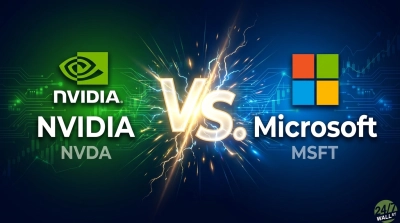
NVIDIA (NASDAQ:NVDA | NVDA Price Prediction) and Microsoft (NASDAQ:MSFT) just reported quarters built on AI. Their chief executives made different promises. Jensen Huang talks in gigawatts and doubling demand. Satya Nadella talks in seats, tokens and cost curves. NVIDIA sells the hardware and Microsoft is one of its biggest buyers, so each set of claims helps test the other.
Gigawatts Carry Huang. Copilot Seats Carry Nadella.
NVIDIA posted revenue of $96.22B, up 105.8% year over year. Networking grew 138%, suggesting buyers want whole AI factories. Huang summed up his view: “Now, compute is revenue.”
At Microsoft, Azure grew 43% and Microsoft 365 Copilot passed 30 million paid seats. The earnings beat got help from a $3.2B gain on Anthropic.
| Bold Claim | Huang | Nadella |
|---|---|---|
| Headline Promise | ~70% revenue growth in fiscal 2028 | Azure growth of ~45% in constant currency next quarter |
| Capacity Story | Supply covers about 70% of demand | Roughly double capacity in two years |
| Weak Spot | AI labs backed by NVIDIA’s balance sheet: roughly a quarter of next year’s business | Backlog up only 25% excluding OpenAI |
Huang Funds His Demand. Nadella Hedges His Models.
NVIDIA has committed nearly 50 billion in leading labs and offers take-or-pay guarantees to neoclouds. Management called this “circular financing.” Days sales outstanding extended to 60 days from 45, showing to longer payment terms for big buyers.
Nadella is building in options. Microsoft’s catalog holds more than 11,000 models, and its Maya 200 chip delivers 30% better performance per dollar. Customers outside leading labs generated nearly 90% of Microsoft Cloud revenue, which gives his demand claims a broad base.
Memory Costs and Cash Flow Will Decide This
NVIDIA expects gross margins to bottom at 71% to 72% in Q4 as memory prices rise, so even the leader of this market faces cost pressure. Microsoft’s free cash flow fell 23% to $19.64B, and capex is heading toward approximately $175 billion. The key question is whether Vera Rubin makes about 20% of data center revenue in Q3 as expected.
Investors have sided with Huang so far. NVIDIA is up 28.4% year to date, while Microsoft is up 9.28%. The expansion underneath both names reaches well past chipmakers, something we mapped out covering the power, cooling and networking suppliers behind the AI factories, here.
Why I Trust Nadella’s Math a Bit More Right Now
Huang has the better track record. NVIDIA beat EPS estimates most recently, with $2.22 against $2.09 expected. A growing share of his demand depends on money NVIDIA itself provides, which is weaker proof.
Nadella’s promises are smaller and easier to check: seat counts, Azure growth and margins expected to slip less than one point. With a P/E near 29 against NVIDIA’s 48, Microsoft’s valuation reflects steadier compounding expectations, while NVIDIA’s reflects higher growth expectations. My view would shift if NVIDIA delivers its Q3 guidance of $108B while relying less on financing it backs itself.
Contact [email protected] for any questions or corrections.
Alex Sirois is a financial writer with experience spanning both retail and institutional investing. He has written for InvestorPlace and held roles at BNY Mellon and Bernstein, giving him a perspective that bridges Main Street portfolios and Wall Street analysis.
Alex holds an MBA from George Washington University and has built his career across multiple industries, including e-commerce, education, and translation — a breadth of experience that informs how he breaks down complex financial topics for everyday investors. His writing is conversational, actionable, and grounded in long-term, buy-and-hold investing principles.
At 247 Wall St., Alex focuses on delivering analysis that is both accessible and useful, with a clear emphasis on helping readers make more informed decisions with their money.