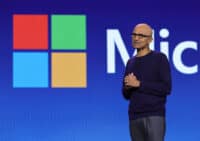
Why Microsoft Could Surprise and Hit $4 Trillion Before NVIDIA Does

This post may contain links from our sponsors and affiliates, and Flywheel Publishing may receive compensation for actions taken through them.

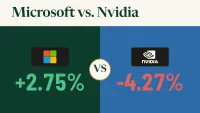
Microsoft (NASDAQ:MSFT | MSFT Price Prediction) and NVIDIA (NASDAQ:NVDA) have both just reported earnings, and their market values are nearly identical at about $3.76 trillion and $3.75 trillion. Microsoft makes money from AI through subscriptions and contracts. NVIDIA sells the hardware that runs it. The company the market rewards next will probably reach $4 trillion first.
Azure Backlog Lifts Microsoft. Vera Rubin Lifts NVIDIA.
Microsoft’s revenue rose 18.8%[1] to $92.28 billion, which is steady growth for a company this large. Azure grew 48%[1]. Commercial remaining performance obligation (contracted revenue not yet recognized) rose 73%[1] to $677 billion. That backlog is already signed, so it doesn’t depend on next quarter’s chip orders. Management said customer demand still exceeds supply. Windows OEM and Devices fell 22%[1] as PC demand weakened.
NVIDIA grew much faster. Revenue reached $115.84 billion[2], up 103.2%. Vera Rubin brought in nearly $20 billion[3] in its first quarter of production shipments. Interim CEO Colette Kress said Rubin is “off to an explosive start.”[2]
| Business Driver | Microsoft | NVIDIA |
|---|---|---|
| Growth Engine | Azure and Copilot | Vera Rubin systems |
| Next-Quarter Revenue Outlook | $96B to $97.1B[4] | $130B ±3%[2] |
| Soft Spot | PC market weakness | No China data center compute in the outlook |
Subscription Moat Meets Hyper-Growth Momentum
Microsoft is spreading AI across many products. CEO Satya Nadella told analysts that its advantage comes from adding value at every layer of the stack. Foundry now has over 120,000 customers[4], which shows broad enterprise adoption. Microsoft also designs its own Maia chips, and Maia 300 targets 40% more tokens per watt[4] than leading GPU systems. That could weaken NVIDIA’s pricing power.
NVIDIA carries more risk. Jensen Huang resigned, and the board is searching for a permanent CEO[3]. Three direct customers made up 14%, 11% and 11%[2] of revenue, so a lot depends on very few buyers. Even so, management raised its fiscal 2028 growth outlook to about 75%[3].
Capex Payback and China Rules Come Next
The question is whether Microsoft’s planned calendar-year capex of about $170 billion[4] produces the Azure growth of 49% to 50% it guided for next quarter. For NVIDIA, check whether gross margin really bottoms at 71% to 72%[3] as management expects. The new Commerce Department export rules also matter.
Why I Give NVIDIA the Edge, With Microsoft as a Sleeper
To reach $4 trillion, Microsoft needs a gain of about 6.4% and NVIDIA needs about 6.7%. With gaps that close, volatility probably decides the race. NVIDIA’s beta is 2.247, compared with 1.045 for Microsoft, so its shares move much more sharply in either direction. The stock fell 27.4% in a month, and a rebound could happen just as quickly.
I think NVIDIA’s momentum and its $130 billion[2] revenue outlook give it the advantage. Microsoft offers lower volatility, and its backlog could let it pass NVIDIA quietly if chip stocks stay shaky. A strong permanent CEO hire at NVIDIA would strengthen my view. Another drop there would give Microsoft the opening.
Contact [email protected] for any questions or corrections.
Alex Sirois is a financial writer with experience spanning both retail and institutional investing. He has written for InvestorPlace and held roles at BNY Mellon and Bernstein, giving him a perspective that bridges Main Street portfolios and Wall Street analysis.
Alex holds an MBA from George Washington University and has built his career across multiple industries, including e-commerce, education, and translation — a breadth of experience that informs how he breaks down complex financial topics for everyday investors. His writing is conversational, actionable, and grounded in long-term, buy-and-hold investing principles.
At 247 Wall St., Alex focuses on delivering analysis that is both accessible and useful, with a clear emphasis on helping readers make more informed decisions with their money.