Applied Optoelectronics Has Fallen Hard for 6 Months: This Wall Street Analyst Expects It’s Going to Double Soon
Applied Optoelectronics has shed more than half its peak value in six months, weighed down by repeated share sales and a memory shortage that blindsided the market, yet one analyst still sees the stock doubling from here and has the…

This post may contain links from our sponsors and affiliates, and Flywheel Publishing may receive compensation for actions taken through them.
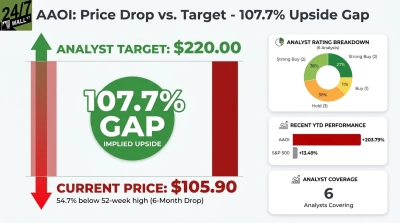
Applied Optoelectronics (NASDAQ:AAOI) currently trades at $105.90, and the average analyst price target is $163.40. That leaves an implied upside of 54.3%.
The Texas company makes optical transceivers. Its 400G, 800G and 1.6T transceivers move data between AI servers, and it also sells 1.8 GHz CATV amplifiers to cable operators. Last quarter, revenue rose 86.4% to $191.92 million, its fifth straight record.
One analyst sees far more upside than the consensus. Mike Genovese at Rosenblatt Securities has a Buy rating and a Street-high $220.00 target, which implies 107.7% upside, about a double.
Repeated Share Sales Erased Half of the Rally
Dilution weighed on the stock. The company filed a $600 million at-the-market offering, its third major equity raise of 2026, and the stock fell 13.77% in one session. Shares are now 54.7% below their 52-week high of $233.67 and about 29.7% lower over six months.
A memory shortage cut third-quarter revenue by $20 million to $25 million. Analysts made six downward revisions to EPS, with the average falling from $0.2783 to $0.1433. In the 30 days after the second-quarter report, the stock fell 20.42% while the SPDR S&P 500 ETF Trust (NYSEARCA:SPY) fell 1.4%.
Why Rosenblatt Still Expects a Double
Genovese’s case rests on several factors. These include an 800G and 1.6T super-cycle, design wins at hyperscale customers, and a mix shift toward higher-margin data center products. Management guided third-quarter revenue to $255M–$290M, which it called 130% growth at the midpoint, and expects 800G revenue to grow nearly five times sequentially.
Next comes 1.6T. It has more than $200 million of orders in hand. It expects more than $17 million of 1.6T revenue in the fourth quarter and monthly capacity above 930,000 pieces by year-end. Responding to Genovese on the call, the CEO said that without the 100G drag, fourth-quarter capacity could support “more than $500 million of revenue.”
Margins are the other factor. Non-GAAP gross margin was 29.8%, and management is targeting about 40%. Consensus EPS is expected to rise from $0.68 in 2026 to $4.602 in 2027.
Coverage is thin. Of six analysts, two rate the stock Strong Buy, one Buy and three Hold. The 2026 EPS average has fallen from $0.8883, and the top 10 customers account for 99% of revenue.
Coherent and Fabrinet Are Also Down Sharply From Their Highs
Lumentum Holdings (NASDAQ:LITE | LITE Price Prediction) trades at $1,048.60, up 184.49% this year, with an $1,161.96 average target implying 10.8% upside.
Coherent (NYSE:COHR) trades at $302.38, 31.3% below its high, with a $412.52 target implying 36.4% upside.
Fabrinet (NYSE:FN) trades at $487.75, 34.9% below its high but up 17.06% last month, with a $734.11 target implying 50.5% upside.
Applied Optoelectronics has the largest consensus upside in the group, with Fabrinet close behind, and it also has the least coverage and is the only one still posting GAAP losses.
Triple-Digit Gains This Year, but Momentum Has Faded
At $105.90, the stock trades below the six-analyst average target of $163.40, which implies 54.3% upside. It is still up 203.79% year to date, compared with 13.49% for the S&P 500.
Over the past month, the stock fell 5.06% while the index gained 1.04%. With a beta of 3.843 and a forward P/E of 84x, it has typically moved harder than the market in both directions.
Third-Quarter Report Must Prove 1.6T Is Shipping
The outlook looks better if the third-quarter report shows 800G volume rising and confirms 1.6T shipments have started, setting up a fourth quarter well above the $427 million consensus. That is the path to $163 and eventually to $220.
The thesis weakens if the company sells more stock, gross margin stays stuck near 30%, or one of its three customers above 10% of revenue reduces orders.
Demand is real, but share sales keep diluting existing holders, and the gap closes only once 1.6T revenue shows up in reported numbers.
Contact [email protected] for any questions or corrections.
Alex Sirois is a financial writer with experience spanning both retail and institutional investing. He has written for InvestorPlace and held roles at BNY Mellon and Bernstein, giving him a perspective that bridges Main Street portfolios and Wall Street analysis.
Alex holds an MBA from George Washington University and has built his career across multiple industries, including e-commerce, education, and translation — a breadth of experience that informs how he breaks down complex financial topics for everyday investors. His writing is conversational, actionable, and grounded in long-term, buy-and-hold investing principles.
At 247 Wall St., Alex focuses on delivering analysis that is both accessible and useful, with a clear emphasis on helping readers make more informed decisions with their money.