Exxon’s 43-Year Dividend Streak Faces Its Biggest Test Yet as Oil Prices Slide
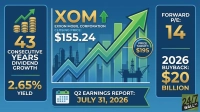
Exxon has handed investors a larger dividend check every year for 43 consecutive years, but sliding crude prices and a 61% quarterly free cash flow drop are now stress-testing the limits of that promise.

Oil has been volatile. West Texas Intermediate reached $114.58 on April 7, 2026, after bottoming at $55.44 in December 2025. It stood at $96.24 on October 6. Exxon Mobil (NYSE:XOM | XOM Price Prediction) shares closed at $169.01, up 43.18% this year, and yield 2.48%. If you own Exxon for the quarterly check, the question that matters is what happens when oil falls and then stays down.

What Funds the $4.12 Payout
Exxon pays $1.03 a quarter, or $4.12 a year. With about 4.11 billion shares outstanding, that works out to roughly $16.9 billion a year. In 2025, Exxon generated $51.97 billion of operating cash flow, spent $29.00 billion on capex and kept $26.13 billion in free cash flow. That covered the dividend easily. Add the $20B buyback, though, and total payouts ran ahead of free cash flow. Capex guidance for 2026 is $27B to $29B.

A corporate breakeven is the oil price at which operating cash flow just pays for capital spending plus the dividend. When crude falls below that level, the shortfall has to come from cash or borrowing. Exxon has not published a specific dividend breakeven in its recent reports, so its debt capacity becomes the real buffer. Debt-to-equity is 0.168, net debt/EBITDA is 0.548 and interest coverage is 56.28x. CEO Darren Woods put it this way:
“That growth is underpinned by disciplined capital allocation and an industry-leading balance sheet that gives us unmatched flexibility to invest through the cycle and consistently deliver industry-leading returns.”
A 43-Year Streak Tested by 2020
Exxon has raised its annual dividend for 43 consecutive years. When crude collapsed in 2020, management held the quarterly payout at $0.87 from 2019 through 2021 and did not cut it. Shell (NYSE:SHEL) cut its dividend in 2020. Its quarterly dividend is now $0.3906, and net debt was $52.6 billion in Q1 2026. For now, Chevron (NYSE:CVX) pays $1.78 after its 39th consecutive annual increase. Still, Chevron posted negative $1.549 billion of free cash flow in Q1 2026 and has leverage of 1.08x net debt/EBITDA.

Where a Price Slide Hits First
Q1 2026 showed how fast the numbers can tighten. Free cash flow fell 61.74% to $2.70B. The buyback gives first. Exxon pledges its $20B buyback only “assuming reasonable market conditions.” Capex cuts would follow. Costs offer support as well: structural savings have reached $16.3 billion since 2019. CFO Neil Hansen said on the July call:
“If you took our cash expenses this year and you just annualized it, our cash OPEX would look even with 2019.”
Guyana adds more support. Exxon has “fully recovered the $55 billion of investment,” which Hansen called “very much an inflection into free cash flow.” That matters, because EIA projects Brent below $70 per barrel through 2030.
Verdict: The Dividend Holds
Yes. In a long downturn, Exxon would slow buybacks, trim capex and lean on its low debt before cutting the dividend. Last quarter it produced more than $17 billion of free cash flow and reduced net debt by more than $7 billion. What a downturn would put at risk is dividend growth. For holders screening the rest of the high-yield energy complex, the seven warning signs that typically come before a cut are laid out in a free guide here.
Signals Holders Should Track Now
- Whether buybacks stay on pace for $20B
- Quarterly free cash flow compared with the dividend
- Net debt/EBITDA moving above 0.548
- Whether the fifth Guyana FPSO starts up by year-end
- Progress toward the $20B savings target
Contact [email protected] for any questions or corrections.
Chris Lange is a financial and geopolitical writer with more than a decade of experience covering a myriad of topics. He has published thousands of articles for 24/7 Wall St., with past coverage focused heavily on stocks, IPOs, healthcare, defense, global affairs, and technology.
His work has been quoted, or referenced by a number of outlets including Business Insider, USA Today, Yahoo Finance, MSN, The Motley Fool, and many other publications. A graduate of Southwestern University, he studied business with a focus on investments and has previous experience in banking and startups.
When not reading or writing the news, he is following his passion for Lacrosse, playing chess, or building solar projects with his dad.