Exxon’s Dividend Stays Safe Even if Oil Crashes to $79 a Barrel
The EIA sees oil sliding toward $79 a barrel by 2027, and income investors need to know whether Exxon's quarterly check survives the drop before crude gets there.

Exxon Mobil (NYSE:XOM | XOM Price Prediction) shares have risen 50.94% this year to $178.10. Crude helped: WTI trades at $96.24 a barrel, up 54.0% from a year ago. Income investors care more about the quarterly check of $1.03, which comes to $4.12 a year. The U.S. Energy Information Administration expects Brent to slide to $79/b in 2027 as Middle East supply comes back. That makes it worth asking whether the dividend holds up when crude falls.

Dividend Already Survived $64 Oil
Recent results show where Exxon’s dividend breakeven is. In Q4 2025, Brent averaged $64 per barrel. That quarter, Exxon brought in $12.68 billion of operating cash flow, spent $7.45 billion on capex and paid $4.37 billion in dividends. Free cash flow covered the payout 1.2 times. In Q2 2025, when U.S. crude prices were $62.58, coverage was 1.23 times. Free cash flow fully paid the dividend with oil in the low $60s.
Coverage Across the Full Cycle
For full years, free cash flow covered the dividend 1.84 times in 2024 and 1.37 times in 2025. Single quarters swing a lot more. Q1 2026 covered only 0.52 times, dragged down by $3.88B in mark-to-market timing effects and $706M of Middle East disruption losses. Q2 2026 covered it 3.96 times. On the July call, CEO Darren Woods said:
“That strength allows us to keep investing in advantaged opportunities, return surplus cash to shareholders, and maintain one of the strongest balance sheets in industry.”
Two structural changes raise the buffer. Structural cost savings have reached $16.3 billion since 2019. In Guyana, CFO Neil Hansen said Exxon has “fully recovered the $55 billion of investment along with all the operating costs,” and he called it “very much an inflection into free cash flow.”
Borrowing Room When Cash Falls Short
The 2020 crash gives a real stress test. Operating cash flow fell to $14.67 billion against $17.28 billion of capex, so free cash flow came in at negative $2.61 billion. Exxon still paid $14.87 billion in dividends and covered the gap with debt, which rose $20.72 billion to $67.64 billion.

Exxon has more room to do that again. Total debt is $42.37 billion against $259.38 billion of equity. Net debt/EBITDA is 0.548 and interest coverage is 56x. Comparable figures for Chevron (NYSE:CVX) are 0.94 and 13.7x. Exxon also has the planned $20B of 2026 buybacks, which it can cut long before the dividend.
Track Record Versus Chevron and Shell
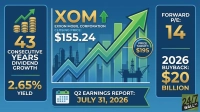
Exxon kept the quarterly payment at $0.87 through 2020 and raised it again in 2021. The company reports 43 consecutive years of dividend growth, the kind of run we screened for in our free Dividend Kings guide. Chevron is close behind with its 39th consecutive annual increase. Shell (NYSE:SHEL) cut its dividend in 2020, and its net debt rose to $52.6 billion in Q1 2026.
Verdict: Exxon Can Keep Paying
Yes, Exxon can keep paying its dividend through the next downturn. The payout is covered with oil in the low $60s, and the company has cut costs and turned Guyana into a cash generator since 2020. It also carries less debt than it did going into that crash. If crude drops below $60 for a long stretch, expect buybacks to shrink first and Exxon to borrow before it cuts the dividend, as it did in 2020. Income investors should watch two signals: free cash flow coverage over a full year and the size of the buyback.
Contact [email protected] for any questions or corrections.
Chris Lange is a financial and geopolitical writer with more than a decade of experience covering a myriad of topics. He has published thousands of articles for 24/7 Wall St., with past coverage focused heavily on stocks, IPOs, healthcare, defense, global affairs, and technology.
His work has been quoted, or referenced by a number of outlets including Business Insider, USA Today, Yahoo Finance, MSN, The Motley Fool, and many other publications. A graduate of Southwestern University, he studied business with a focus on investments and has previous experience in banking and startups.
When not reading or writing the news, he is following his passion for Lacrosse, playing chess, or building solar projects with his dad.