Oracle Fell Nearly 9% as CoreWeave’s Bond Scare Spread
CoreWeave's bond market flashed a warning that spread far beyond one AI startup, and Oracle shareholders absorbed a nearly 9% loss before the trading day even ended. What happens to Oracle's $664 billion backlog if the cost of AI debt…


Oracle (NYSE:ORCL | ORCL Price Prediction) closed at $130.55, and the average analyst price target stands at $237.97. That puts the implied upside at 82.3%. A gap that wide likely means the consensus has fallen behind the stock, because many targets likely precede the decline.
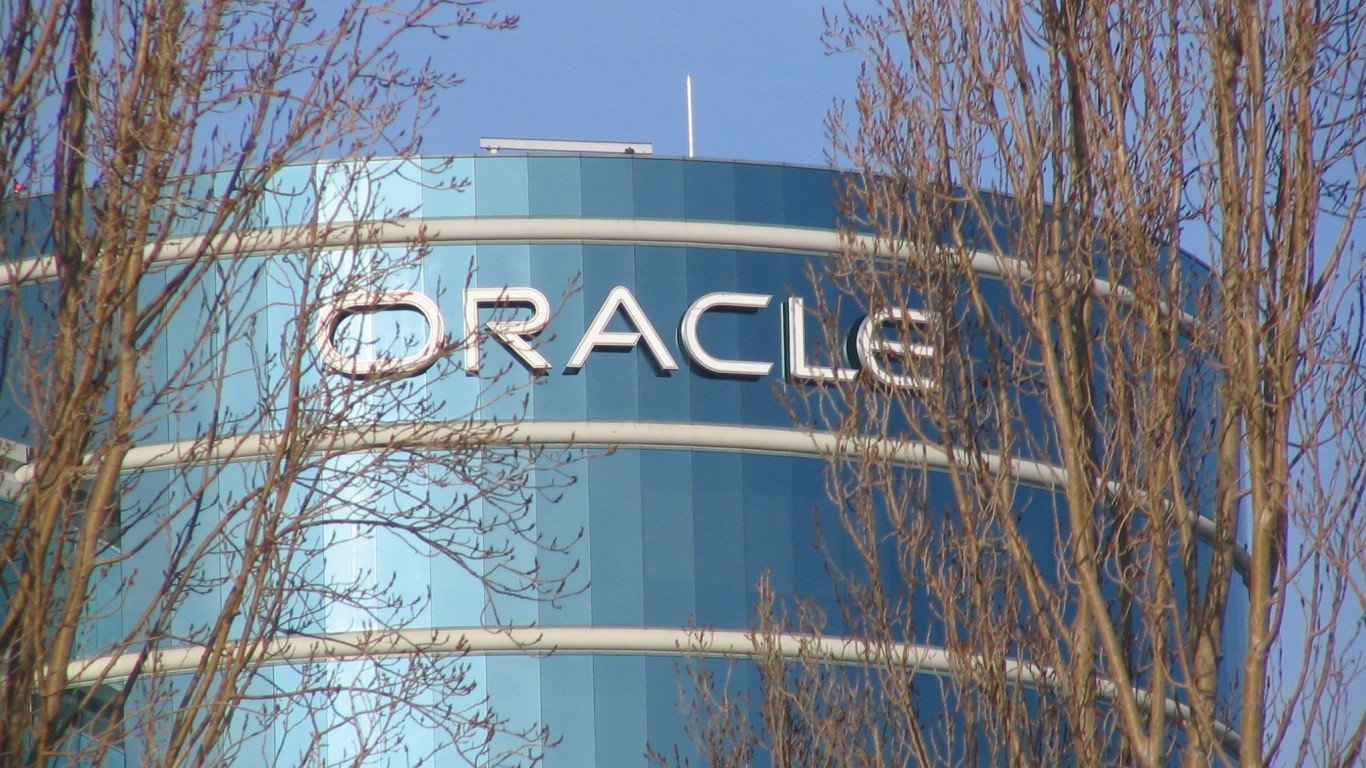
Oracle sells database software and enterprise applications. It also sells a growing amount of cloud capacity that AI labs rent to train and run their models. Wall Street watches that last business closely because Oracle has built up $664 billion in remaining performance obligations, a backlog many times larger than its current annual revenue.
Paying for that capacity strains Oracle’s balance sheet. Oracle spent $28.5 billion on capital expenditures last quarter, which left free cash flow at negative $5.4 billion. It also plans to raise roughly $40 billion this fiscal year through debt and equity. So when credit markets turn nervous about AI borrowing, Oracle’s stock usually falls with them.
CoreWeave’s Bond Scare Spread to Oracle Fast
Oracle fell 8.83%, or $12.65 per share. That erased about $38 billion in market value, leaving the company worth $395.76 billion. The stock slid another 2.45% to $127.35 after hours.
The trigger was CoreWeave (NASDAQ:CRWV), which closed down 15.46% at $65.78. That left it near its 52-week low of $60.55. The yield on its $1.25 billion of bonds due in 2032 touched 15% before closing at 14.5%.
Hot inflation data also pushed the NASDAQ down 1.9% and the S&P 500 down 1.07%, but Oracle fell much further than either index. Sentiment made the move worse. Chamath Palihapitiya asked whether the AI expansion was creating a private credit bubble, and Elon Musk replied: “Yikes.”
Why a 15% Yield Puts a Price on Oracle’s Buildout
AI capacity built with debt only makes sense as long as the debt stays affordable. When a leveraged operator’s bonds yield near 15%, lenders no longer treat GPU-backed financing as safe. Every company building data centers with borrowed money gets measured against that number.
Oracle’s finances look quite different from CoreWeave’s. Its operating cash flow was $23.1 billion last quarter, up 184%, and cloud infrastructure revenue rose 121% to $7.39 billion.
Still, Oracle’s interest expense rose 55% to $1.4 billion, and total liabilities reached $236 billion. Much of the backlog likely depends on a handful of very big AI customers. Oracle’s credit profile is stronger than CoreWeave’s, but investors are right to ask whether its own borrowing costs will rise.
Analysts Still See 82% Upside in a Thesis the Market Has Repriced
Of 43 analysts, 7 rate Oracle Strong Buy, 28 rate it Buy, 7 rate it Hold and 1 rates it Sell. Their mostly bullish case depends on the backlog turning into revenue.

Management expects “around half of our RPO to convert into sales over the next 36 months”. Fiscal 2027 revenue guidance was raised to at least $90 billion, with non-GAAP EPS of $8.10.
Demand looks solid. GPU utilization reached 97.9%, and capacity that came up for renewal was “renewed or resold at a 20% premium to prior contracts.”
The stock is still about 60% below its 52-week high of $322.54. It’s down 32.12% for the year, and the S&P 500 is up 12.87%. Analyst targets are only one data point. Many were set before this decline, so they assume financing stays easy to get.

If spreads on AI-linked credit keep widening, Oracle’s financing costs would rise right as it tries to raise money this year. If a major customer slows down its orders, the backlog would take a direct hit. With so much revenue tied to a few customers, that would quickly become a credit question.
Full-year capex guidance of $90 to $95 billion also has to stay within reach of the cash Oracle generates. Management hasn’t said when free cash flow will turn positive.
Should You Buy or Sell ORCL Stock
Oracle’s valuation at this price looks low relative to its growth outlook. At a forward P/E of 18x and a PEG ratio of 0.807, the market is already pricing in a real chance that the backlog fails to turn into revenue.
This selloff started in another company’s bond market, but the risk is real. If AI credit keeps weakening, the stock could return to its 52-week low of $114.50, and the after-hours decline suggests the selling may not be over.
Among AI cloud providers, Microsoft (NASDAQ:MSFT) has less balance-sheet strain. It produced $66.987 billion in free cash flow last fiscal year, and its interest coverage ratio is above 50, so it can fund its expansion with cash it already generates. Oracle has more upside if financing holds up, while Microsoft is likely to hold up better if credit stays tight.
Contact [email protected] for any questions or corrections.
Omor Ibne Ehsan is a writer at 24/7 Wall St. He is a self-taught investor with a focus on growth, cyclical, and dividend equities that have strong fundamentals, value, and long-term potential. He also has an interest in high-risk, high-reward investments such as penny stocks.