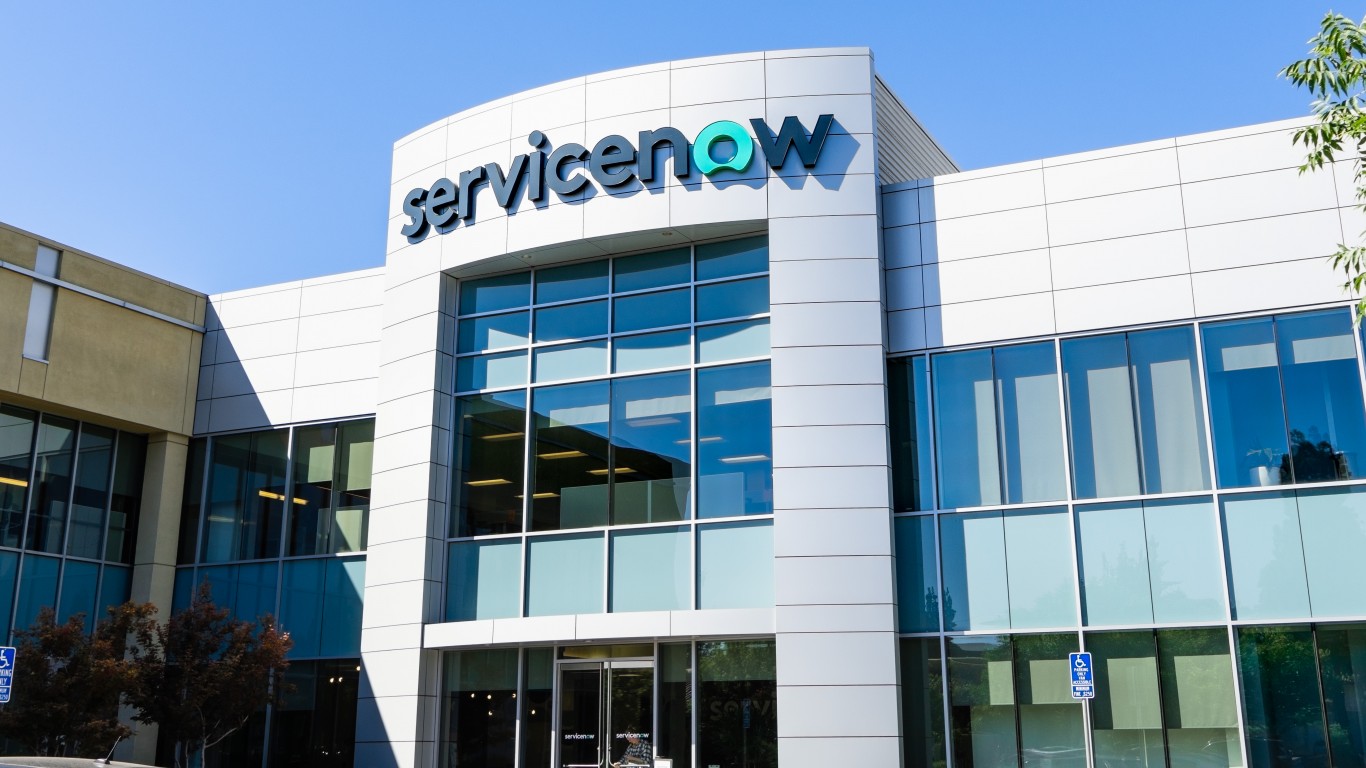
ServiceNow Climbs 5% After Denying Decagon Acquisition Interest; Salesforce Rises 4%, Palantir Dips
A flat denial from ServiceNow's president sent the stock surging, but the real question is whether shutting down acquisition rumors actually strengthens the company's position in a market crowded with AI rivals building the exact tools it claims not to…


A flat denial of takeover talk is lifting one of the biggest names in enterprise software. ServiceNow (NYSE:NOW | NOW Price Prediction) stock is up 5% to $146.93 in midday trading after the company rejected reports that it planned to buy Decagon, a privately held maker of artificial intelligence (AI) customer-service agents.
Meanwhile, Salesforce (NYSE:CRM) stock is up 4% to $245.39, a gain just shy of the advance in ServiceNow stock. Palantir Technologies (NASDAQ:PLTR) stock is down 0.9% to $199.07, moving opposite both of those software gainers. That split points to selective buying inside the enterprise software group.
Decagon Denial Sparks a Software Rally
ServiceNow moved to shut down the speculation on October 14. Amit Zavery, the company’s president, chief product officer and chief operating officer, stated, “We are aware of misinformation in the market today about our acquisition strategy. To be clear, ServiceNow has no interest or intention of purchasing Decagon.” Zavery added that the approach to acquisitions is unchanged and that ServiceNow prioritizes organic growth.
Management also sees no major strategic gaps requiring large-scale deals at this time, according to Zavery. Because ServiceNow sells workflow software on recurring subscriptions, the denial of a big acquisition signals where ServiceNow’s margins and product roadmap could be heading, and organic growth tends to keep spending tied to products ServiceNow controls end to end.
Home-grown agent tools already sit inside the ServiceNow lineup, including AI Control Tower for governing enterprise agents, Now Assist and Build Agent. That catalog gives ServiceNow an internal path into customer-service automation, the niche where Decagon competes.
Software Outpaces Large-Cap Tech
Sector funds are splitting along the same line as ServiceNow stock and Palantir stock. For a sector read, the iShares Expanded Tech-Software Sector ETF (CBOE:IGV) is up 0.9% to $108.65, a far smaller gain than the move in ServiceNow stock. Across large-cap technology, the Invesco QQQ Trust (NASDAQ:QQQ) is down 0.7% to $723.84, sliding in the same direction as Palantir stock.
Holders of both the iShares Expanded Tech-Software Sector ETF and the Invesco QQQ Trust are seeing their portfolios pulled in opposite directions. Because Palantir is a component of the Invesco QQQ Trust, the dip in Palantir stock and the fund’s decline land on the same side of the ledger.
Bull and Bear Cases for ServiceNow

On the bullish side, ServiceNow’s subscription model and its stated focus on organic growth could protect the margins that steady revenue supports, and skipping a large deal keeps management’s attention on shipping its own agent products. Recurring contracts give ServiceNow a predictable base that a big acquisition might have complicated.
However, a denial removes a rumor without adding new revenue for ServiceNow, and headline-driven gains can fade once the news moves on. Startups building AI customer-service agents, Decagon among them, show how crowded the ServiceNow corner of the market is becoming.
Salesforce offers a parallel story. Bulls see its Agentforce platform as proof that organic agent products can win customers, though bears may note today’s gain rests on sympathy rather than company-specific news. Palantir differs from both. Bulls point to its data-analytics strength with government and commercial clients, while bears argue its far higher valuation leaves room for more profit-taking on crowded agentic AI headlines (we profiled seven companies driving the AI expansion beyond the chipmakers in a free report here).
Organic Roadmap Faces Its Next Test
ServiceNow currently faces the question of whether organic product releases carry the roadmap the company says it doesn’t need deals to fill. Zavery’s comments set that bar publicly, which gives each product launch more weight in the debate over ServiceNow stock. Customer adoption of the existing agent lineup may offer the clearest early evidence.
Salesforce and Palantir face tests of their own. Salesforce must show its agent products keep drawing customers once the sympathy rally cools off, while Palantir must defend its premium as rivals crowd the agentic AI field. The takeaway: investors should keep their positions in ServiceNow stock moderate until adoption evidence arrives, and watch for whether gains broaden across the software group.
Contact [email protected] for any questions or corrections.
David Moadel is financial writer specializing in stocks, ETFs, options, precious metals, and Bitcoin. David has written well over 1,000 articles for leading online publications, helping investors understand markets, income strategies, and risk.His work has appeared in The Motley Fool, InvestorPlace, U.S. News & World Report, TipRanks, ValueWalk, Benzinga, Market Realist, TalkMarkets, Finmasters, 24/7 Wall St., and others.With a master’s degree in education, David has taught at the elementary, high school, and college levels. That teaching background shapes his writing style: clear, educational, and practical. David has also built a loyal social-media audience by providing trustworthy financial content on YouTube, X/Twitter, and StockTwits.